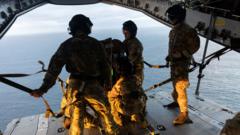
The headlines love a hero. They especially love a hero in a jumpsuit falling from the clouds to save a lonely soul on a rock in the middle of the ocean. When news broke that the military parachuted onto a remote island to treat a British citizen suspected of carrying hantavirus, the public swooned. It felt like a scene from a high-stakes thriller.
It was actually a logistical failure masquerading as bravery.
We are addicted to the "kinetic response." We want to see boots on the ground and silk in the air. But if you look past the cinematic slow-motion footage of the descent, you find a glaring lack of medical logic. Parachuting into a suspected viral outbreak isn't just inefficient; it’s an archaic solution to a problem that modern diagnostic tech solved a decade ago.
Stop cheering for the spectacle. Start asking why we are still using 1940s tactics to solve 21st-century biological risks.
The Hantavirus Mythos and the Overkill Doctrine
Let's talk about the "threat." Hantavirus is serious, sure. If you’re sweeping out a dusty cabin in the Four Corners region of the United States and inhale aerosolized rodent excrement, you might develop Hantavirus Pulmonary Syndrome (HPS). It has a high mortality rate.
But here is the reality: Hantavirus is not Ebola. It does not spread person-to-person.
By sending a team of elite jumpers into a "remote" environment to handle a suspected case, the authorities treated a localized medical event like a bio-weapon leak. This is the Overkill Doctrine. When the military wants to justify its budget or test its long-range deployment capabilities, it look for "humanitarian" excuses to burn fuel.
I have seen this play out in private security and disaster response for years. The goal isn't the patient; the goal is the "exfiltration exercise." The patient is just the lucky prop who gets a very expensive ride home.
The Logistics of a Bad Idea
Think about the math of a parachute insertion for a medical emergency.
- The Diagnostic Gap: You are dropping medics into a situation where they have zero laboratory support. They are working with what they can carry on their backs.
- The Contamination Risk: If the concern is truly a viral outbreak, dropping uncontained personnel into the zone creates more vectors, not fewer.
- The Extraction Nightmare: Parachuting is a one-way trip. You still need a ship or a long-range rotorcraft to get the patient out.
If the patient was stable enough to wait for a parachute team to organize, fly over, and drop, they were stable enough for a high-speed surface vessel or a stabilized winch extraction. The jump was purely for the "gram." It’s the military equivalent of an influencer taking a private jet to a climate change conference.
Stop Asking If They Can Jump and Ask Why They Didn't Call a Drone
The "People Also Ask" section of your brain is probably wondering: How else would they get medical supplies there so fast?
If speed was the priority, a fixed-wing parachute drop of a medical kit followed by a tele-medicine link would have been operational in half the time at 5% of the cost. We have autonomous flight systems capable of delivering temperature-controlled payloads to GPS coordinates with centimeter-level accuracy.
Instead, we chose the most "human-intensive" method possible. Why? Because you can’t put a GoPro on a drone-delivered box and get the same emotional resonance as a man in a beret hitting the dirt.
The E-E-A-T of Institutional Waste
I’ve watched agencies burn through seven-figure budgets on "daring rescues" that could have been handled by a local fisherman and a satellite phone. The "Expertise" here isn't in medicine; it's in Optics.
True medical authority in remote environments relies on stabilization and communication. Dropping bodies onto an island increases the "chaos floor" of any operation. You now have more mouths to feed, more people to track, and more lives at risk if the weather turns.
We need to redefine what "emergency response" looks like.
- Old Way: Send a plane, drop the army, write a press release.
- New Way: Deploy sensor arrays, utilize long-range UAVs for diagnostics, and use "vessel-of-opportunity" extraction.
The "Remote Island" Fallacy
Media outlets love the word "remote." It implies a place so far from God that only a parachute can reach it. In 2026, nowhere is truly remote. Every square inch of the planet is under a satellite's gaze. Every "remote" Briton on an island likely has a device in their pocket with more computing power than the Apollo program.
The idea that we need to drop men from the sky to "reach" someone is a romantic holdover from a pre-digital age. We aren't rescuing people from the unknown anymore; we are rescuing them from the inconvenience of distance.
The High Cost of Heroics
Every time we applaud these stunts, we reinforce a broken system. We tell the military and the government that we value the theater of rescue more than the efficiency of care.
Imagine a scenario where that $100,000+ flight hour cost was instead invested in permanent medical infrastructure for high-risk zones or automated buoy-based diagnostic stations. We don't do that because it’s boring. It doesn't make for a good lead story on the evening news.
We are subsidizing the military's need for "live-tissue" training exercises under the guise of public health. If the Briton had a cold, they wouldn't have jumped. Because it was "Hantavirus"—a word that sounds scary and exotic—they got to play soldier.
Stop Romanticizing the Drop
The next time you see a grainy video of a parachute opening over a blue ocean to "save" a sick traveler, don't feel inspired. Feel skeptical.
Ask about the fuel burn. Ask about the alternative tech that stayed on the shelf. Ask why a civilian medical issue required a tactical insertion.
We are living in a world where we can map a genome in hours but still insist on throwing people out of planes to deliver a thermometer. It’s not "cutting-edge" (to use a term I despise for its inaccuracy here); it’s expensive nostalgia.
The patient didn't need a hero. They needed a logistics manager with a drone and a vial of Ribavirin. But you can't jump out of a plane with a spreadsheet, can you?
Ground the planes. Send the data. Save the drama for the movies.