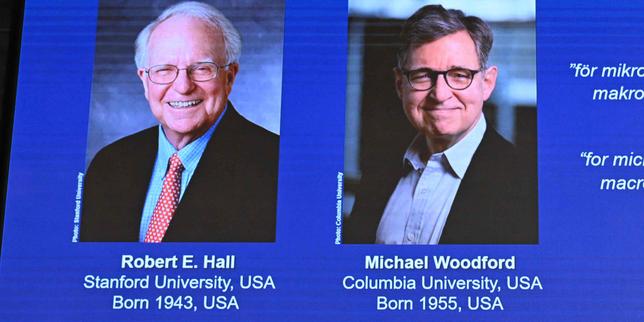
The committee in Stockholm handed the 2026 Sveriges Riksbank Prize in Economic Sciences in Memory of Alfred Nobel to Michael Woodford and Robert E. Hall. The official press release praised their monumental contributions to understanding how monetary policy steers aggregate economic activity and how sticky prices shape macroeconomic shocks. Economic journalists around the globe nodded along in solemn agreement, parroting the consensus that this recognition was long overdue for two titans of modern macroeconomics.
They are entirely wrong.
What the committee actually honored is a masterclass in elegant irrelevance. For decades, Woodford and Hall constructed mathematical frameworks that assume rational actors operating inside stable institutional bounds, treating central bank transparency as a cure-all and sticky wages as a solvable pricing friction. I have watched boards of directors and central bank governors base multi-billion-dollar allocation decisions on these exact models, only to watch reality shatter every single theoretical assumption within forty-eight hours. Rewarding these theories today is like giving a Nobel Prize in navigation to the cartographer who drew a gorgeous map of a continent that sank beneath the waves twenty years ago.
Let us dismantle the foundational myth of the Woodfordian monetary transmission mechanism. The core premise states that central banks manage inflation and output by steering short-term interest rates, which then calmly ripple through yield curves, corporate borrowing desks, and household balance sheets through the magical ointment of rational expectations. It sounds pristine on a blackboard at the University of Chicago or Columbia.
In practice, it is a fairy tale.
Markets do not react to forward guidance because they read the central banker's mind with pristine mathematical clarity. They react based on liquidity cascades, algorithmic feedback loops, and structural imbalances in collateral supply that traditional New Keynesian models completely exclude. When Hall spent decades analyzing price stickiness, he treated friction as an anomaly in an otherwise frictionless machine. Friction is not an anomaly. Friction is the engine. Companies do not keep prices sticky because of sluggish menu costs or slow information processing; they keep prices sticky because of deep contractual webs, regulatory capture, and asymmetric pricing power that renders standard monetary levers about as effective as tapping the dashboard of a supersonic jet to fix an engine fire.
To understand why this Nobel choice represents a retreat into academic comfort, we have to look at what they chose to ignore. While Woodford was busy writing the definitive treatise on interest rate rules, the actual monetary architecture of the global economy was migrating away from traditional commercial bank lending toward private credit markets, stablecoin liquidity pools, and algorithmic market makers. None of these entities care about Taylor rules. None of them optimize their behavior based on the expected path of the overnight federal funds rate over the next eight quarters.
Yet the economic establishment continues to worship the model because it keeps the math tractable. If you admit that expectations are not rational, that agents are fundamentally bounded by emotional contagion and structural panic, and that monetary policy is a blunt instrument blunter than a sledgehammer, your calculus stops working. You cannot write a neat differential equation for chaos. So, the profession honors theorists who gave them equations they could solve, rather than truths they could use.
Consider the obsession with price stickiness that defined Hall’s career. The traditional narrative tells us that wages are sticky downward because workers hate nominal wage cuts, leading to involuntary unemployment during downturns. Sounds neat. It ignores the structural reality of modern labor markets, where gig platforms, contract-to-hire arrangements, and automated vendor management systems have transformed nominal wage stickiness into a quaint historical artifact. In today's economy, companies do not slowly adjust wages downward during a crunch; they slash headcount by twenty percent via automated portal updates on a Tuesday afternoon while executive compensation packages are locked in via multi-year equity index formulas.
When your theoretical models rely on variables that no longer describe how transactions actually clear, you are not doing science. You are practicing astrology with extra steps.
The defense from the academic establishment will be swift. They will argue that models are abstractions, that abstractions are necessary to isolate causal mechanisms, and that Woodford and Hall provided the indispensable scaffolding that allowed central bankers to navigate the 2008 financial crisis and the post-pandemic inflation surge.
Let us look at how well that navigation worked.
Central banks spent a decade misdiagnosing inflation as transitory because their models relied on Phillips curve relationships that broke down the moment global supply chains fractured and labor participation rates shifted. They relied on forward guidance to anchor expectations, only to find that when inflation hit double digits, the public stopped believing the models entirely and started pricing grocery items based on what they saw at the register. The scaffolding didn't hold up the building. It collapsed on everyone's head.
Honoring the architects of these failed frameworks in 2026 is an admission of exhaustion. It signals an economics profession that has run out of new ideas and is retreating into the warm, familiar embrace of late-twentieth-century mathematics. It tells young researchers that if you want the highest honor in the field, you should not study the messy, decentralized, cryptographically secured, geopolitically fragmented reality of modern global commerce. Instead, you should build a cleaner, more mathematically tractable sandbox where the assumptions are pristine and the conclusions are completely useless.
We do not need another model that assumes away structural power dynamics, institutional rot, and the sheer irrationality of systemic leverage. We need an economics that treats friction as the default state of human exchange. Until the Nobel committee starts recognizing economists who study how power, networks, and raw liquidity actually collide in the dark, the prize remains an internal validation society for people who mistake elegance for accuracy.
Stop reading the citation. Look at the ledger. The models are empty.