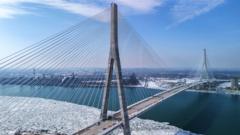
Pundits love a tragic narrative. Give them a $4.5 billion price tag, a few political spats across the 49th parallel, and a massive steel arch spanning the Detroit River, and they immediately start pounding out obituaries for North American integration.
They tell you the Gordie Howe International Bridge is a monumento to diplomatic friction. They call it an overbudget symbol of two allies drifting apart under trade tensions, tariffs, and populist posturing. Also making news in this space: Why the US Saudi Nuclear Deal Just Hit a Massive Wall.
They are dead wrong.
What these commentators view as a breakdown in diplomacy is actually something far more calculated: a cold-blooded, long-overdue destruction of a private trade monopoly, and the construction of hardened industrial security. The media sees a political rift because they focus on press conferences. Logistics engineers and trade strategists see an offensive masterclass in supply chain defense. Additional information on this are covered by NBC News.
If you think this bridge represents a fractured relationship, you do not understand how modern international trade operates.
The Lazy Consensus of Political Theatre
The prevailing commentary around the Windsor-Detroit trade corridor treats every tariff debate and border delay as a sign of civilizational decay. When cost estimates for the Gordie Howe span escalated, critics immediately categorized it as another government project bogged down by cross-border friction.
This critique relies on three fundamental fallacies:
- The Golden Age Myth: The assumption that US-Canada trade used to be an effortless, frictionless brotherhood free of self-interest.
- The Price Tag Illusion: The belief that a $4.5 billion asset is expensive without factoring in the daily economic loss of single-point-of-failure bottlenecks.
- The Monopoly Blindspot: Ignoring the fact that the primary highway connection between two G7 economies was held hostage by a private entity for nearly a century.
I have spent years analyzing capital allocation and supply chain mechanics across industrial corridors. I have seen boardrooms throw away tens of millions of dollars trying to optimize logistics software while ignoring the giant physical chokeholds in their physical transport route.
The Gordie Howe International Bridge is not a symptom of bad relations. It is the remedy to ninety years of dangerous neglect.
The Real Enemy Was Never Ottawa or Washington
To understand why the new bridge exists, you have to stop looking at presidents and prime ministers and look at the Ambassador Bridge.
Before this new span was ordered, roughly 25% of all merchandise trade between the United States and Canada crossed over a single four-lane suspension bridge opened in 1929. That bridge was owned not by the public, not by a binational port authority, but by the billionaire Moroun family.
Think about the absurdity of that setup. A single private family controlled the valve for over $100 billion in cross-border goods every year. Automotive parts, agriculture, raw materials, consumer goods—all flowing through a private tollbooth.
                                  +---------------------------------------+
                                  |    1929 AMBASSADOR BRIDGE MODEL       |
                                  |  - Single Private Family Control      |
                                  |  - Surface Street Bottlenecks         |
                                  |  - Zero Systemic Redundancy           |
                                  +---------------------------------------+
                                                      |
                                                      v
                                  +---------------------------------------+
                                  |  $100B+ Annual Cross-Border Trade     |
                                  |  Exposed to Single-Point Failure      |
                                  +---------------------------------------+
                                                      |
                                                      v
+---------------------------------------------------------------------------------------------------+
|                                  THE GORDIE HOWE CORRECTION                                       |
|  - Canada funds construction upfront ($4.5B CAD) to bypass US Congressional gridlock.            |
|  - Direct highway-to-highway link: Ontario Highway 401 straight to Michigan Interstate 75.        |
|  - Eliminates 16 urban traffic lights on the Canadian side.                                       |
|  - Publicly owned infrastructure breaking a 90-year private chokehold.                             |
+---------------------------------------------------------------------------------------------------+
When Michigan tried to pass legislation to build a public bridge years ago, the private owners spent tens of millions of dollars funding ballot initiatives, buying political advertising, and running aggressive litigation campaigns to preserve their monopoly. They didn't want competition. They wanted a captive corridor.
When truck traffic backed up for miles into Windsor, Ontario, sitting at 16 consecutive city traffic lights before even reaching the Ambassador Bridge deck, the private owners collected their tolls regardless. When supply chains broke down during protest blockades, auto assembly plants in Ohio, Ontario, Michigan, and Indiana ground to a halt within hours.
Canada did not agree to fund the vast majority of the Gordie Howe International Bridge because of soft diplomatic goodwill. They did it out of sheer economic self-defense. Ottawa realized that leaving their primary industrial artery under the control of a private monopolist and a gridlocked US political system was national economic suicide.
Canada stepped up, structured a public-private partnership, offered to pay for Michigan’s side of the interchange through future toll collections, and pushed the project forward. That is not friction. That is hard-nosed, pragmatic nation-building.
The Math Behind the Sprawling Cost
Critics jump on the price tag like it is proof of bureaucratic failure. Let's run the actual math that critics ignore.
The Detroit-Windsor corridor handles roughly $400 million in commercial trade every single day. A major disruption at that crossing costs the North American economy an estimated $10 million to $15 million per hour in lost productivity, delayed assembly lines, and idle freight engines.
| Metric | The Ambassador Monopoly | The Gordie Howe Infrastructure |
|---|---|---|
| Ownership | Private Monopoly (Moroun Family) | Public Binational Authority |
| Highway Connectivity | Stop-and-go urban surface streets (16 traffic lights) | Direct link: Highway 401 to I-75 |
| Redundancy | Zero (Single point of failure) | High (Dual major arterial spans) |
| Customs Capacity | Legacy 20th-century border plaza | 130-acre state-of-the-art inspection ports |
| Risk Profile | Vulnerable to blockades and private tolls | Diversified, high-throughput security |
Imagine a scenario where a structural failure or a sustained blockade closes the legacy Ambassador Bridge for just two weeks. The economic damage to the automotive sector alone would comfortably surpass $2 billion.
Spread a $4.5 billion capital expenditure across a 100-year design life, and the infrastructure cost drops to pennies per transit relative to the value of the cargo. Calling this bridge expensive is like calling an insurance policy on a multi-billion-dollar factory a waste of cash because you haven't had a fire this month.
It isn't an extravagant spend. It is baseline maintenance for an industrial superpower engine.
Bypassing Political Rhetoric with Cold Hard Concrete
Political commentators spend all day analyzing tweets, campaign speeches, and trade renegotiation soundbites. They confuse political noise with structural reality.
While politicians perform for television cameras, the underlying machinery of North American manufacturing is integrating deeper than ever. The modern automotive supply chain doesn't care about diplomatic posturing. A single crankshaft might cross the US-Canada border six times before it ends up in a finished vehicle rolling off an assembly line in Kentucky.
The Gordie Howe bridge was designed specifically to isolate this supply chain from political and urban drag.
For decades, trucks coming off Ontario’s Highway 401 had to idle through Huron Church Road in Windsor, stopping at dozens of traffic lights, burning millions of gallons of diesel, and adding hours of unpredictable delay to just-in-time manufacturing schedules. On the Michigan side, trucks spilled onto local city streets before creeping onto Interstate 75.
The new bridge provides a continuous, high-speed, direct connection from Highway 401 straight onto I-75. It bypasses urban congestion entirely. It builds massive, modern inspection plazas capable of processing border clearances at scales the old legacy ports could never dream of handling.
This isn't two countries drifting apart. This is two countries locking their industrial infrastructure together so tightly that no future political administration can easily pry them apart.
[Ontario Highway 401] ---> [Direct Express Connector] ---> [Gordie Howe Bridge] ---> [Interstate 75]
                                                                |
                                                      (No Traffic Lights)
                                                      (No City Street Drag)
                                                      (Automated Inspection)
The Real Risk Nobody Wants to Talk About
Is the new bridge project flawless? No. Strategic contrarianism requires looking at the downsides that cheerleaders ignore.
By building a massive new public bridge while the legacy Ambassador Bridge remains operational, the corridor will soon have excess capacity. Toll revenues, which are earmarked to repay Canada's massive upfront investment, will depend on traffic volume splitting between two competing structures.
If the private owners of the Ambassador Bridge slash their toll prices to fight a predatory price war against the new public bridge, Canada's timeline for recovering its billions could stretch from decades into generations.
Furthermore, upgrading physical infrastructure does not magically resolve regulatory friction. If border agencies on either side introduce bureaucratic inspection regimes or protectionist paperwork requirements, a six-lane cable-stayed bridge will still end up acting as a parking lot. Concrete solves physical bottlenecks; it cannot fix regulatory stupidity.
Stop Crying Over Friction and Build Better Pipes
The narrative that the Gordie Howe International Bridge represents a strained relationship is lazy journalism written by people who analyze speeches instead of supply chains.
The bridge exists precisely because trade between the US and Canada is too massive, too critical, and too valuable to be left to an aging 1920s suspension bridge and a private monopoly. It is a monument to brutal economic necessity.
Stop evaluating cross-border health by the political posturing of the week. Look at where the heavy capital is actually poured. When two nations spend billions of dollars to drop hundreds of thousands of tons of steel and concrete directly across their border to link their industrial highways, they aren't pulling away from each other.
They are doubling down.
If you want to understand the future of North American commerce, stop reading political opinion columns. Look at the steel in the river.


