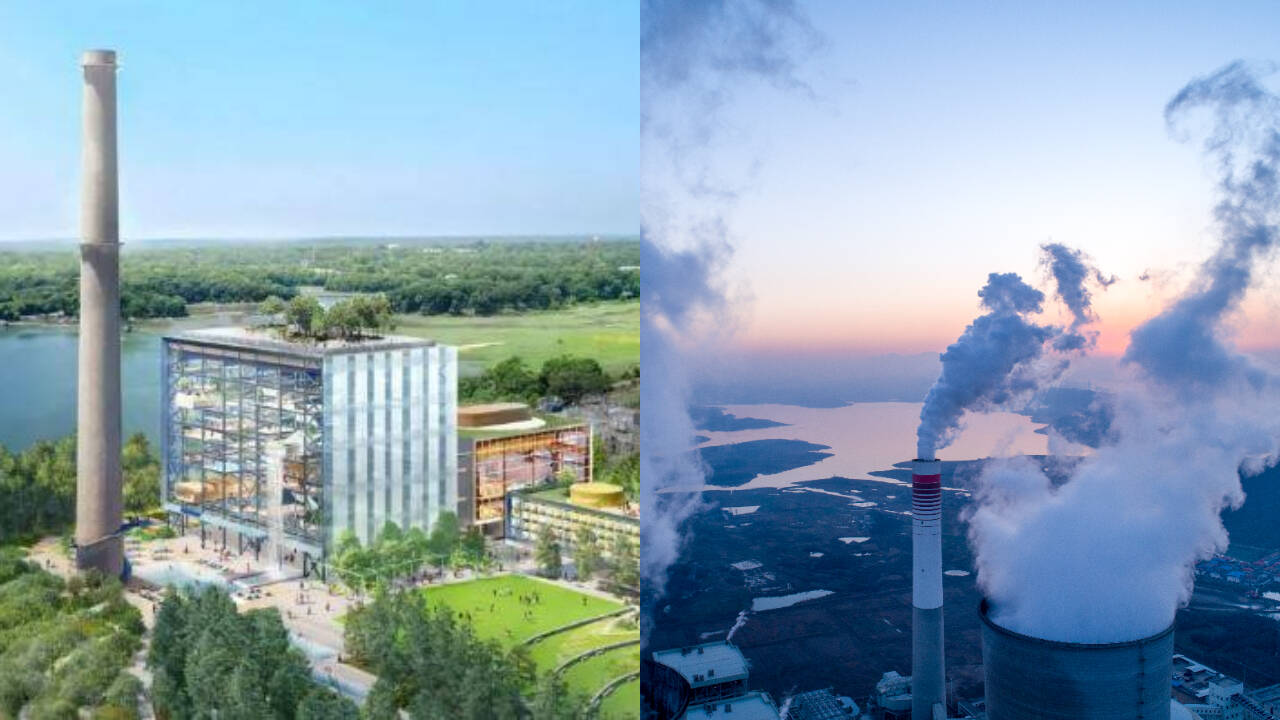
For more than half a century, the hulking silhouette of the Bridgeport Harbor Station defined the industrial edge of Long Island Sound. Built to burn coal and oil, its massive red-and-white smokestack served as a blunt reminder of New England's fossil-fuel dependence, pumping particulate matter into a low-income neighborhood while locking away prime coastal acreage behind chain-link fences. Now, a $410 million redevelopment plan aims to dismantle that industrial legacy and replace the retired facility with a sprawling public waterfront park, mixed-use amenities, and climate-resilient infrastructure.
It is an audacious pitch. On paper, turning a shuttered coal plant into green space solves multiple urban headaches at once, addressing environmental justice, coastal flooding, and economic stagnation in Connecticut's largest city. Yet anyone who has covered post-industrial real estate along the Northeast corridor knows that the distance between a glossy architectural rendering and a ribbon-cutting ceremony is paved with toxic soil, bureaucratic turf wars, and eye-watering budget overruns.
The Anatomy of a Post-Industrial Overhaul
The site in question sits on the Pequonnock River where it meets Bridgeport Harbor, a strategic chokepoint that made it ideal for receiving barges of coal when the plant first came online in the 1950s. When the final coal-fired unit was retired in 2021—making it the last operating coal plant in New England—it left behind roughly 30 acres of heavy industrial infrastructure.
The proposed $410 million transformation isn't merely a landscaping project. It is a multi-phase structural rebirth designed to reconnect Bridgeport's South End with the water. Developers and municipal planners envision a continuous public promenade, restored coastal wetlands capable of absorbing storm surges, recreational fields, and commercial spaces intended to generate tax revenue to offset the loss of utility payments.
To understand why the price tag sits north of $400 million, you have to look beneath the surface. You cannot simply bulldoze a power plant and roll out sod.
What Lies Beneath the Concrete
Decades of burning coal and heavy fuel oil leave an unmistakable chemical signature. Coal ash—laden with heavy metals like arsenic, lead, and mercury—alongside decades of industrial lubricants, polychlorinated biphenyls (PCBs), and asbestos insulation embedded in the turbine halls, turns demolition into a surgical hazard-mitigation exercise.
- Structural Abatement: Before a single wrecking ball swings, crews must seal off the interior of the main boiler house to strip out miles of asbestos-wrapped piping and lead paint.
- Subsurface Remediation: Groundwater monitoring wells must be drilled across the peninsula to track plumes of legacy hydrocarbons and heavy metals, often requiring millions of tons of contaminated soil to be excavated and hauled to licensed out-of-state landfills.
- Seawall Reconstruction: Because the site sits barely above high tide, federal and state flood standards mandate raising the grade of the land and reinforcing the bulkhead against a 100-year storm event.
In brownfield redevelopment, environmental remediation routinely consumes 30 to 40 percent of the total capital budget before a single public bench is installed. If contractors hit an undocumented pocket of coal tar or a failing underground storage tank, that $410 million figure becomes a floor, not a ceiling.
Follow the Money Behind the $410 Million Price Tag
Public-private partnerships of this scale rarely rely on a single checkbook. Instead, they are assembled like complex financial mosaics, cobbling together corporate decommissioning reserves, federal infrastructure grants, state brownfield funds, and private equity.
When utility operators retire aging fossil-fuel assets, they are legally obligated to fund basic site stabilization and safe closure. However, basic closure usually means capping the dirt with asphalt and leaving a fenced-off vacant lot—a outcome Bridgeport officials fought aggressively to avoid. Pushing the project from "safe closure" to "public waterfront park" requires bridging a massive valuation gap.
Federal programs, including grants from the Environmental Protection Agency (EPA) and resilience funding from the Department of Transportation, have become the primary lifelines for these transitions. Connecticut's Department of Economic and Community Development (DECD) has also leaned heavily into brownfield remediation grants to de-risk contaminated coastal parcels for private developers.
Still, taxpayers carry indirect exposure. When a city trades an active power plant for a public park, it absorbs an immediate hit to its grand list—the municipal tax base. Even if adjacent commercial parcels eventually appreciate in value, there is often a five-to-seven-year dead zone where the city loses utility tax revenue while taking on the long-term maintenance liabilities of a brand-new waterfront park.
The Environmental Justice Reckoning
Bridgeport's South End has historically borne the brunt of the region's industrial footprint. Surrounded by a wastewater treatment facility, scrap metal yards, interstate highway corridors, and the power plant itself, residents have endured asthma rates and heat-island effects well above the state average.
For local environmental advocates, tearing down the plant is a hard-won victory. Removing the smokestack eliminates a prominent symbol of environmental racism. Yet community leaders remain skeptical of grand waterfront announcements, and for good reason.
Across the Northeast, waterfront greening frequently triggers green gentrification. As polluted industrial zones are converted into manicured parks with harbor views, property values in adjacent neighborhoods spike. Landlords raise rents, property taxes climb, and the very residents who suffered through decades of coal dust find themselves priced out just as the air finally clears.
The Access Trap
A park is only truly public if the surrounding neighborhood can safely reach it. Currently, the Bridgeport Harbor site is severed from residential blocks by elevated highway ramps, freight rail lines, and wide, truck-heavy industrial avenues.
Without concurrent investments in pedestrian bridges, protected bike lanes, and traffic calming along Main Street and Broad Street, the new waterfront risks becoming an isolated enclave—accessible primarily by car to visitors driving in from wealthier Fairfield County suburbs, rather than the families living four blocks away.
Climate Reality Check on Long Island Sound
Building a $410 million park on a low-lying peninsula in 2026 requires designing for a coastline that will look radically different by 2060. Long Island Sound is warming faster than the global ocean average, and sea-level rise projections from the Connecticut Institute for Resilience and Climate Adaptation (CIRCA) warn of up to 20 inches of water rise by mid-century.
Traditional hard engineering—pouring taller vertical concrete seawalls—often backfires during major hurricanes by deflecting wave energy into neighboring properties. Consequently, modern waterfront parks rely on living shorelines and terraced floodplains.
In a terraced design, the lower edge of the park is deliberately engineered to flood during severe storm surges. Salt marshes, oyster reefs, and native coastal grasses act as natural speed bumps, dissipating wave energy before it reaches the elevated inland sections where permanent structures sit. It is smart engineering, but it comes with a maintenance catch. Living shorelines require constant ecological management, invasive species removal, and post-storm dredging—costs that cash-strapped municipal parks departments routinely underestimate.
Lessons From Other Waterfront Conversions
Bridgeport is hardly the first city to attempt an industrial waterfront makeover, and the track record across the country offers sobering lessons.
Consider a hypothetical comparison based on standard Northeast brownfield timelines: if a developer locks in construction financing in year one, permitting through the Army Corps of Engineers for any work touching navigable waters can easily add 18 to 24 months to the schedule. Supply chain bottlenecks for specialized marine-grade steel and custom floodgates add further drag.
In New York, the transformation of industrial piers into Brooklyn Bridge Park succeeded brilliantly as an urban amenity, yet it required generating revenue from luxury residential towers built within the park's footprint to pay for ongoing maintenance—a compromise that sparked years of fierce litigation from neighborhood groups. Conversely, smaller industrial cities that relied purely on municipal budgets to maintain converted waterfronts have watched expensive boardwalks rot and lighting systems fail within a decade due to deferred maintenance.
Bridgeport's planners have to thread that exact needle. They need enough commercial activity on or adjacent to the site to fund perpetual upkeep, without turning a public asset into a privatized playground.
The Regulatory Gauntlet Ahead
Before the first acre of grass takes root, the project must survive a gauntlet of state and federal oversight. Under Connecticut's Transfer Act and its evolving release-based cleanup regulations, every square foot of contaminated soil requires sign-off from Licensed Environmental Professionals (LEPs) and the Department of Energy and Environmental Protection (DEEP).
At the same time, utility regulators must ensure that the complete retirement of the legacy footprint does not compromise grid stability during peak winter heating spells or summer heatwaves. While a newer, cleaner natural gas facility operates nearby to handle regional load, the transmission interconnect infrastructure crisscrossing the site cannot simply be severed overnight. Rerouting high-voltage subterranean lines adds tens of millions of dollars and months of delicate engineering to the timeline.
What Actually Determines Success
Strip away the press releases and the sunlit architectural renderings, and the fate of Bridgeport's $410 million waterfront gamble hinges on three unglamorous realities:
- Guaranteed Maintenance Endowments: A capital grant builds a park; an operating endowment keeps it alive. Unless a dedicated, legally ring-fenced funding stream is established upfront to pay for landscaping, security, and storm repairs, the park will inevitably deteriorate.
- Binding Community Benefits Agreements: Verbal promises of local hiring and affordable housing protections mean nothing in commercial real estate. Developers must sign legally enforceable agreements mandating prevailing wages, local apprentice quotas during demolition, and anti-displacement protections for South End tenants.
- Phased Public Access: Waiting ten years for the entire 30-acre master plan to finish before opening the gates kills civic momentum. Opening smaller, remediated parcels along the riverfront early builds public trust and creates immediate accountability for the developers.
The smokestack that defined Bridgeport's skyline for generations is coming down, taking with it a relic of an era that treated urban coastlines as industrial dumping grounds. Whether its $410 million replacement becomes a genuine engine of equity for the city—or just an expensive monument to good intentions—will be decided in the fine print of the remediation contracts and maintenance budgets signed over the next twenty-four months.