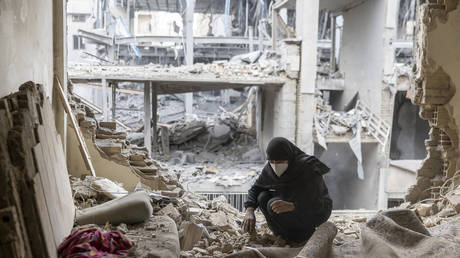
Distance is a strange filter. When numbers cross a desk in a briefing room, they lose their temperature. Fifty meters. It is a measurement that sounds precise, clinical, and reassuringly distant on a map. To a strategist, it is a buffer zone. To a pilot or a software engineer writing guidance algorithms, it is an acceptable margin of error.
Quiet.
Then comes the other side of that distance.
Imagine, for a moment, a specific morning in a neighborhood that has known too many mornings like it. This is a hypothetical scenario built upon verified operational patterns, but the dust settling on the lintel is real enough. The kettle is on. The sound of traffic rises through a cracked window. A sudden, tearing roar rips the sky open, faster than thought, faster than sound can warn the ear.
There is no time to be afraid. There is only the concussion.
When the smoke clears fifty meters away from the actual point of impact, the physics of modern weaponry reveal their true, brutal poetry. A missile strike is never just a pin on a digital display. It is an expansion of kinetic energy that does not care about masonry, kitchen tables, or the fragile architecture of a human lung. The shockwave travels outward, a wall of compressed air carrying fragments of steel and shattered concrete.
We talk about precision munitions as if they possess a moral compass. We are told that modern technology has sanitized conflict, turning war into a surgical procedure performed by laser and satellite. But steel tearing through flesh fifty meters from a target zone does not look surgical. It looks like chaos.
History is littered with the ghosts of collateral damage. Every major military escalation carries a ledger written in fractions of a second and yards of deviation. When the United States launched a new missile strike in the ongoing shadow war with Iran and its regional proxies, the headlines focused on the hardware. They analyzed the payload, the trajectory, the strategic messaging sent to Tehran. They debated whether the strike would deter further militia attacks or ignite a wider regional conflagration.
They forgot to stand in the kitchen fifty meters away.
Consider what happens when policy is translated into high explosives. A weapon system is designed to achieve a specific political or military objective. It travels thousands of miles guided by constellations of satellites, micro-chips, and human operators sitting in air-conditioned containers half a world away. Every engineering choice is optimized for lethality and accuracy. Yet, the real world is messy. Wind shear, minor targeting miscalculations, or the sudden movement of a vehicle can shift the vector of destruction by a fraction of a degree.
At the end of that tiny fraction lies a human life.
I remember talking to veterans who stared at screens showing similar impacts years ago. They spoke about the disconnect. When you watch a screen, the explosion looks small, almost abstract, like a flash of light in a video game. You do not smell the burning rubber. You do not hear the silence that follows the screaming. The distance between the operator and the target creates an empathy vacuum. It allows decision-makers to weigh the utility of a strike without feeling the concussive weight of its aftermath.
That is the hidden cost of our technological age. We have perfected the art of waging war from a distance, which makes it infinitely easier to start and dangerously easy to misjudge.
When a civilian dies fifty meters from a targeted site, it is categorized as an unfortunate anomaly, a regrettable deviation from the plan. But to the family standing in the rubble, that anomaly is their entire universe. It changes the political equation on the ground in ways that no strategist sitting in a capital city can model. Every casualty creates a network of grief, and grief in a volatile region is the primary fuel for the next cycle of violence.
The missile worked as intended. The target was struck. But the calculation missed the human variable. It always does.
We are living through an era where power is increasingly measured by how cleanly it can be delivered across borders. Drones, cruise missiles, and cyber-attacks allow nations to project force without putting boots on the ground, minimizing domestic political costs. But this antiseptic approach to warfare creates a dangerous illusion. It suggests that force can be applied with surgical perfection, that you can strike an adversary without leaving a mark on the innocent bystanders caught in the crossfire of geography.
The reality on the ground refuses to cooperate with this fantasy.
Fifty meters is the length of a swimming pool. It is the distance between two opposing goalposts on a soccer field. It is a mere step in the grand theater of geopolitics. Yet, within that microscopic span, the boundary between a targeted military asset and an innocent life vanishes entirely.
As the smoke lifts over the latest strike, the diplomats will issue statements, the analysts will parse the strategic signals, and the cycle will grind forward. But somewhere in that neighborhood, a door hangs off its hinges, and a silence settles in that no amount of technology can ever explain away.
The dust continues to fall, long after the screens have gone dark.