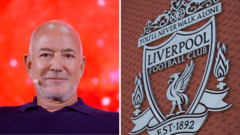
The Strategic Imperative: Capital Restructuring at $6 Billion
Fenway Sports Group (FSG) operates on a capital preservation model that prioritizes self-sustainment over unconstrained equity injection. Liverpool Football Club’s financial architectural baseline relies on operating cash flows to fund both capital expenditures—such as the Anfield Road Stand expansion—and squad re-engineering.
The recent pursuit of a strategic minority stake valuation topping $6 billion introduces an acute structural shift. This valuation trajectory represents a nearly 20-fold expansion on FSG’s initial £300 million purchase price in 2010. However, maintaining global competitiveness against state-backed or hyper-capitalized peers without diluting operational control demands sophisticated syndicate engineering.
To evaluate the current investor discussions surrounding Liverpool FC—including the approach toward Amazon founder Jeff Bezos by an Amit Bhatia-led syndicate—we must unpack three core mechanics: valuation mechanics, corporate governance structures, and capital deployment pathways.
FSG Primary Holding (70-70%+)
│
├── Existing Minority Partners (e.g., Dynasty Financial, RedBird Capital)
│
└── Proposed Strategic Syndicate (Up to 30%)
    ├── Syndicate Lead: Amit Bhatia / Mittal Family Trust
    └── Co-Investors (e.g., Bezos/Family Office Capital)
Anatomy of the Bhatia-Bezos Syndicate
Reports surrounding an equity sale center on a proposed acquisition of up to 30% of Liverpool FC by an investment group organized by Amit Bhatia and supported by the Mittal steel family. The inclusion of high-net-worth liquidity, specifically the exploratory engagement of Jeff Bezos, shifts the conversation from standard private equity recapitalization to ultra-high-net-worth (UHNW) platform building.
The Three Drivers of Minority Consortium Capital
- Balance Sheet recapitalization: Private equity capital allows FSG to de-risk its asset exposure while establishing a liquid market anchor at the $6 billion threshold without relinquishing operational oversight.
- Media and Infrastructure Convergence: High-profile technology and media investors bring distribution scale, streaming expertise, and global monetization pathways that traditional sports management firms lack.
- Arbitrage on European Football Valuations: Premier League franchises consistently trade at lower revenue multiples compared to US franchises in the NFL and NBA, providing institutional investors an asset class with structural upside.
+--------------------------+-------------------------------+---------------------------------------+
| Strategic Investor Category | Operational Mandate            | Economic Alignment                    |
+--------------------------+-------------------------------+---------------------------------------+
| Controlling Owner (FSG)  | Governance & Strategic Direction | Majority Equity & Terminal Value      |
| Anchor Minority (Bhatia) | Capital Mobilization          | Strategic Alignment & Board Seat      |
| Tech/Media Co-Investor   | Direct Monetization Scale     | Yield & Strategic Synergy             |
+--------------------------+-------------------------------+---------------------------------------+
The Strategic Cost Function of Sovereign vs. Private Capital
Liverpool's capital model faces a structural fork. Sports assets can be funded through state-aligned wealth vehicles, institutional private equity, or ultra-high-net-worth syndicates. Each vector carries distinct return hurdles and operational friction points.
1. State-Backed Capital
- Return Horizon: Perpetual or indefinite.
- Cost of Capital: Extremely low; economic ROI is secondary to geopolitical and branding positioning.
- Strategic Risk: High regulatory scrutiny, fan pushback, and potential governance paralysis due to geopolitical developments.
2. Institutional Private Equity (e.g., RedBird, Dynasty)
- Return Horizon: 5 to 7 years.
- Cost of Capital: High target internal rate of return (IRR), typically 12–15%.
- Strategic Risk: Friction over dividend extractions, strict exit liquidity mandates, and financial discipline that can limit transfer window flexibility.
3. UHNW Syndicate / Tech Magnates (e.g., Bhatia-Bezos Lead)
- Return Horizon: Multi-decadal / Generational.
- Cost of Capital: Moderate; capital appreciation dominant over short-term dividends.
- Strategic Risk: Asymmetry of incentives between minority pass-through investors and majority operational controllers.
Operational Mechanics: Where New Liquidity Deploys
A 30% minority investment at a $6 billion valuation yields up to $1.8 billion in top-line transaction value. How that cash flows determines whether the transaction acts as a secondary cash-out for existing owners or a primary growth injection for the club.
Transaction Value: $1.8B (30% Equity Stake at $6B Valuation)
│
├── Secondary Proceeds (Liquidity to Selling Shareholders / FSG Recapitalization)
│
└── Primary Capital (Direct Enterprise Cash)
    ├── Squad Re-engineering & Amortization Capacity
    ├── Stadium & Physical Infrastructure Real Estate
    └── Digital Distribution & Global Commercial Franchising
When primary equity enters the operational balance sheet, it expands squad building capability through straight-line player registration amortization under Financial Fair Play (FFP) and Premier League Profitability and Sustainability Rules (PSR).
An injection of $200 million in primary equity capital does not simply buy $200 million worth of players today. Under standard five-year contract accounting, that primary capital amortizes at $40 million per year. This allows the financial architecture to absorb significantly higher player acquisition costs without breaching regulatory expenditure ceilings.
Governance Hurdles in Minority Equity Sales
Sellers of minority stakes face a liquidity friction point: how to attract top-tier global capital while retaining 100% of voting control over operational decisions.
Minority investors entering at a $6 billion valuation will push for contractual protections to mitigate downside risk.
- Tag-Along Rights: Ensuring minority buyers can participate on identical terms if FSG subsequently sells its majority stake.
- Governance Observers: Securing non-voting seats on the board to audit commercial operations and tactical strategy.
- Pre-emptive Liquidity Triggers: Defining clear capital redemption windows or IPO mandates if no control transaction occurs within a 7-to-10-year period.
FSG must navigate these demands while preserving its data-driven, margin-conscious operating model. A misalignment between syndicate members seeking aggressive spending and an owner managing for long-term equity growth can generate board-level deadlock.
The Strategic Execution Plan
For Liverpool FC to convert current investor interest into long-term competitive leverage, management must execute a three-step framework:
- Ring-Fence Primary vs. Secondary Capital: Mandate that a fixed minimum percentage of any transaction (e.g., 25–30%) enters the club directly as primary capital reserved for capital projects and amortized squad investment, rather than serving purely as secondary liquidity for existing partners.
- Uncouple Commercial Governance from Football Operations: Limit minority syndicate involvement strictly to commercial expansion, international media rights, and digital monetization. Ensure sporting strategy—led by football leadership and analytical models—remains entirely isolated from investor influence.
- Structure Pre-Negotiated Liquidity Milestones: Establish explicit exit horizons for incoming syndicate partners through pre-set buyback options or structured secondary transfer mechanisms to prevent future governance friction when minority funds reach the end of their investment cycles.