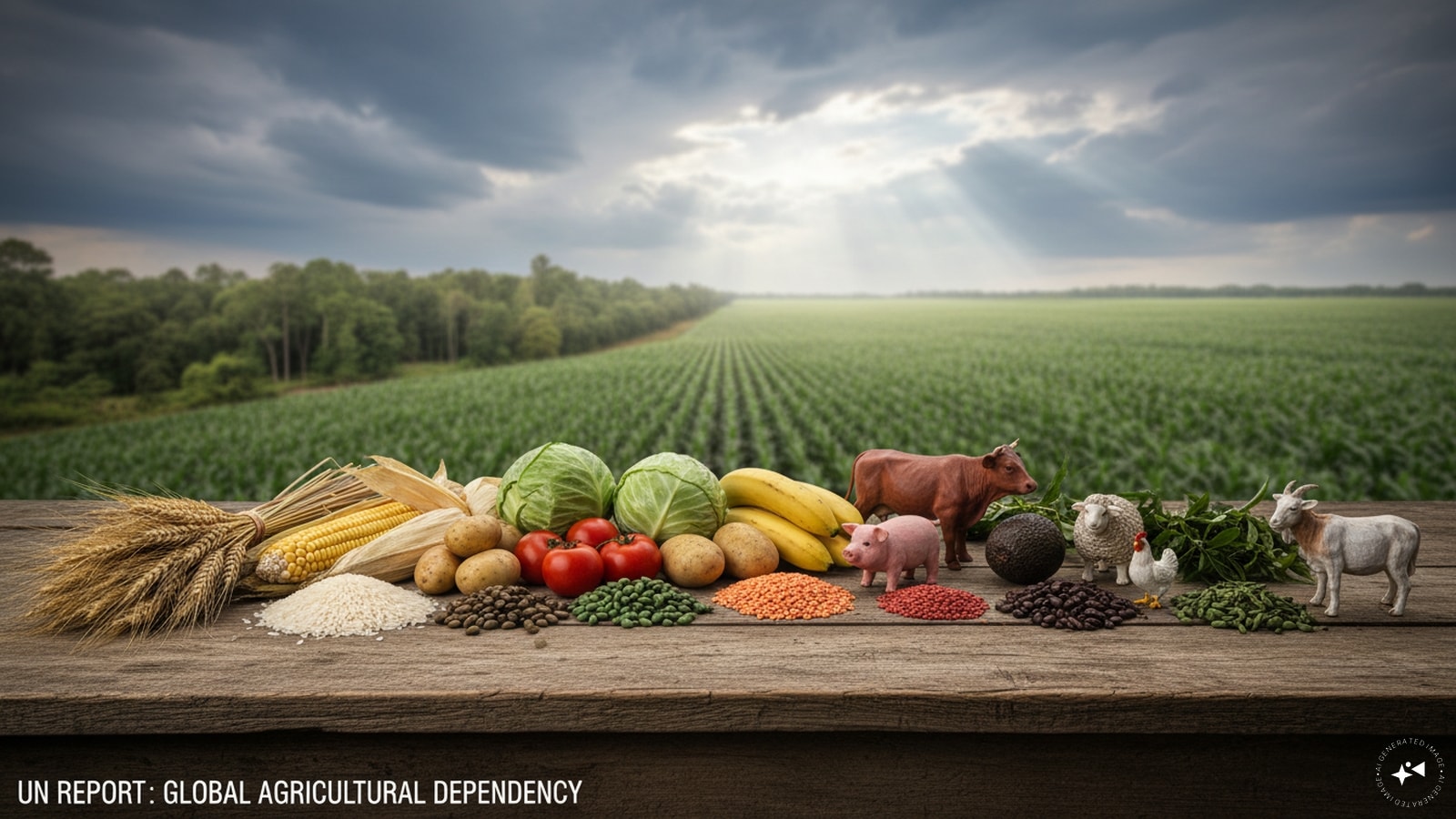
Global food security rests upon an extreme concentration of biological capital. While botanical diversity encompasses hundreds of thousands of edible species, contemporary caloric intake relies on a minute fraction of available agricultural inputs. Specifically, approximately seventy-five percent of the world's food supply originates from merely twelve plant species and five animal species. This narrow structural base creates a high-risk operational environment, exposing supply chains to systemic vulnerabilities, pathogen shocks, and climatic volatility. Deconstructing this concentration reveals the economic incentives, evolutionary bottlenecks, and logistical trade-offs that drive modern agriculture toward monocultural dependency.
The Taxonomy of Agricultural Concentration
The food system operates on an efficiency-driven paradigm that prioritizes high-yield output over biological redundancy. To understand how a global population relies on such a limited biological portfolio, the agricultural architecture must be divided into three primary resource vectors: staple grains, secondary caloric amplifiers, and animal protein sources.
Staple grains form the foundation of human consumption. Three grasses—rice, wheat, and maize—account for the majority of plant-derived caloric intake across international markets. These species were selected over millennia for predictable growth patterns, high harvest indices, and responsiveness to synthetic fertilizers. However, their genetic uniformity represents a major systemic vulnerability.
Secondary contributors include tubers such as potatoes and cassava, and oilseeds such as soybeans and palm oil. These crops supplement global caloric and lipid requirements. Yet, their cultivation relies heavily on industrialized farming models that demand intensive chemical inputs and uniform land management.
Animal protein concentration mirrors this botanical bottleneck. Global livestock production is dominated by five primary species: cattle, swine, sheep, goats, and chickens. Within these categories, intensive breeding programs have drastically reduced genetic diversity. Modern poultry and swine populations, for example, consist of highly specialized commercial lines bred for rapid growth and feed conversion efficiency, often at the expense of immunological resilience.
Global Caloric Input Pyramid
[Top 12 Plants + 5 Animals] ---> [Industrial Monoculture] ---> [Global Food Distribution]
            ^                                                           |
            |--- Vulnerability: Genetic Uniformity & Pathogen Risk -----|
The Economic Mechanics of Monoculture
The dominance of a few species is not an accidental historical artifact; it is the logical outcome of market economics. The cost function of global agriculture heavily favors standardization.
Standardization reduces transaction and processing costs across the entire supply chain. When a grain elevator, milling facility, or distribution network handles a single uniform variety of maize or wheat, capital expenditures on specialized machinery are minimized. Storage protocols remain identical, moisture-content thresholds are standardized, and global commodity trading platforms can price the asset efficiently without quality-assessment friction.
Conversely, integrating neglected or underutilized crops introduces massive inefficiencies. Supply chains lack the processing infrastructure for non-standard grains. Farmers face prohibitive input costs because seed distribution networks do not support minor crops at scale. Consequently, a positive feedback loop solidifies dominant species: market scale lowers unit costs, which deters investment in alternative crops, further reinforcing the reliance on the top twelve plants and five animals.
Pathogen Exposure and Environmental Feedback Loops
Concentration breeds systemic fragility. In biological systems, genetic diversity acts as an immune buffer against environmental stressors and pathogen mutation. Monocultures eliminate this buffer.
When millions of hectares are planted with genetically uniform crops, pathogen evolution accelerates through a process analogous to antibiotic resistance. A fungus, bacterium, or insect vector that successfully breaches the defense mechanism of a dominant crop variety can sweep unchecked across entire continents. Historical precedents, such as the Irish potato famine or the vulnerability of the Gros Michel banana to Panama disease, demonstrate that biological uniformity invites systemic collapse.
Climate change introduces an additional vector of instability. The twelve dominant plant species evolved under specific temperature and precipitation ranges. As weather patterns destabilize, agricultural yields for staple crops face unprecedented volatility. The absence of locally adapted, resilient crop alternatives in mainstream commercial markets means that regional crop failures translate directly into global supply shocks and price inflation.
Logistical Vulnerability and Distribution Bottlenecks
The concentration of agricultural output dictates the mechanics of global trade. Because production is localized in specific high-yield regions, food distribution relies on long, complex supply chains.
A disruption at key maritime choke points, rail hubs, or processing facilities can strand millions of tons of staple commodities. Furthermore, the reliance on a narrow basket of commodities means that trade restrictions or geopolitical conflicts involving a small number of exporting nations can destabilize food security worldwide.
The second limitation of this centralized model is its extreme dependence on synthetic inputs. Dominant high-yield crops are chemically dependent plants. They require massive inputs of nitrogen-based fertilizers, chemical pesticides, and fossil-fuel-driven irrigation. When energy prices spike or supply chains for chemical precursors fracture, the entire production model experiences acute cost pressures that ripple downstream to consumer markets.
Diversification Mechanics and Systemic Hedging
Resolving the structural risks inherent in a twelve-plant, five-animal food system requires intentional diversification at the production and market levels. However, diversification cannot be achieved through moral appeals to biodiversity; it requires altering the economic incentives that govern agricultural investment.
Policy interventions must focus on reducing the transaction friction of alternative crops. This involves capital allocation toward regional processing facilities capable of handling a wider variety of grains and legumes, as well as updating commodity grading standards to accommodate heirloom and regionally resilient varieties.
Agroecological integration offers a framework for stabilizing yields without sacrificing productivity. By implementing polyculture systems, crop rotations, and integrated pest management, agricultural producers can build ecological resilience into the soil matrix. While these methods may require higher initial labor inputs, they decrease long-term exposure to chemical price volatility and pathogen epidemics.
The ultimate strategic play is the systematic re-pricing of biological risk within global agricultural finance. As long as insurance markets and lending institutions treat monocultural efficiency as a risk-free baseline, the global food system will remain vulnerable to catastrophic tipping points. Integrating genetic diversity into credit risk models and supply chain accounting transforms biodiversity from an environmental talking point into a mandatory metric of corporate and national security.


