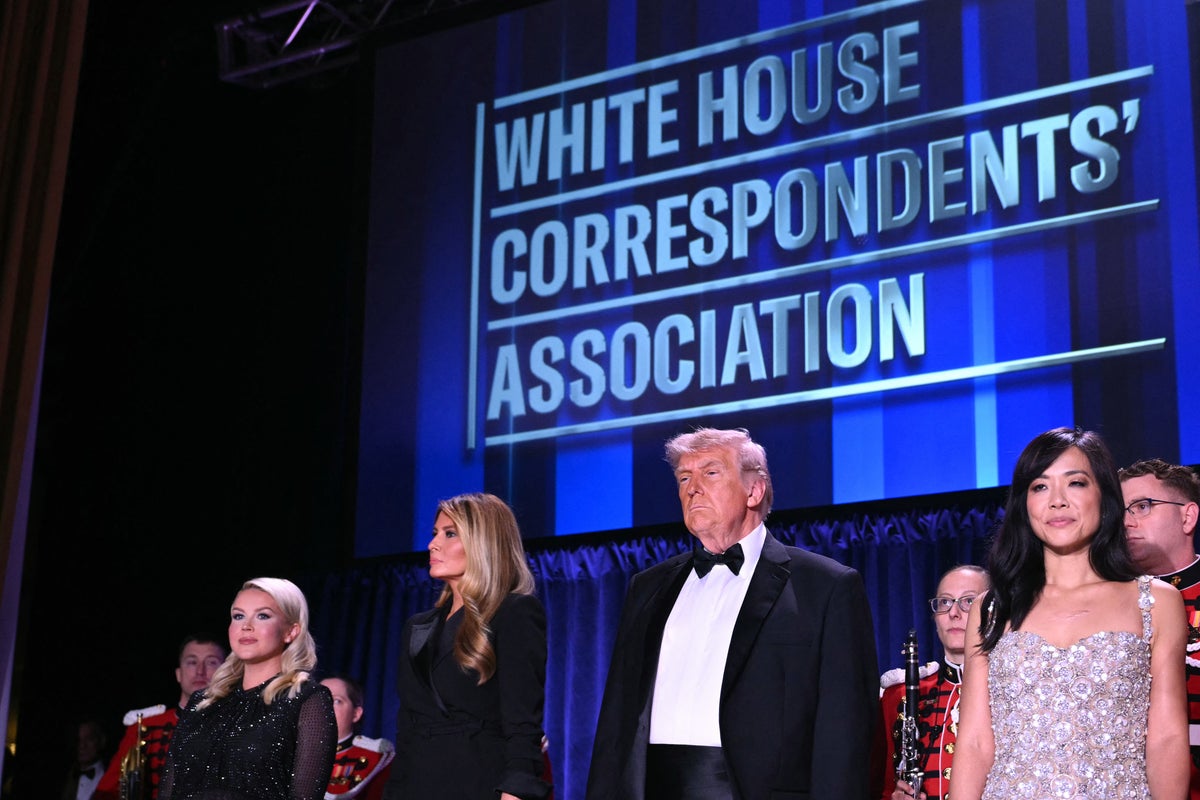
The modern American political theater just hit a fever pitch that traditional polling can no longer measure. When a focus group of voters who supported Donald Trump was recently asked about the shooting at the White House Correspondents' Dinner, the responses didn't just differ on policy or perspective. They revealed a fundamental break from the established timeline of reality. While traditional media outlets scramble to label these reactions as simple "conspiracy theories," a deeper investigation suggests something far more structural. We are witnessing the final collapse of the shared information floor, replaced by a self-sustaining ecosystem where skepticism is the primary currency and evidence is viewed as an ideological plant.
The core issue isn't just a lack of information. It is a surplus of conflicting narratives. These voters aren't necessarily "uninformed" in the classical sense; rather, they are hyper-informed by sources that operate outside the guardrails of traditional journalism. When news of the shooting broke, the immediate pivot to skepticism wasn't a fluke. It was a practiced defense mechanism.
The Architecture of Institutional Distrust
To understand why a focus group would immediately doubt the official account of a violent event, one must look at the preceding decade of institutional failure. From the shifting narratives of the pandemic to the botched intelligence reports regarding foreign conflicts, the "official story" has taken enough hits to leave a vacuum.
Into this vacuum flows the "skeptic-for-hire" industry. This isn't just about social media bots. It involves a sophisticated network of independent commentators, alternative news hubs, and community leaders who have built their entire brand on the idea that the truth is always hidden. For many in that focus group, believing the government or the mainstream press would be an act of intellectual surrender. They see themselves as the "real" investigators, sifting through raw footage and social media crumbs to find the "hidden hand."
This isn't a passive process. It is active, communal, and, for many, deeply rewarding. Finding a supposed "glitch" in a live broadcast or identifying a "crisis actor" provides a sense of agency to individuals who feel increasingly sidelined by a rapidly changing economy and culture.
The Feedback Loop of the Echo Chamber
The focus group participants often cited specific technical "anomalies" that they believed proved the event was staged or redirected. To a trained investigator, these anomalies are easily explained by the physics of acoustics or the limitations of digital video compression. However, to someone already convinced of a cover-up, they are "smoking guns."
The digital architecture of current information consumption ensures that once a user engages with one of these theories, the algorithms provide an endless stream of reinforcement. If you search for "shooting anomalies," you won't find a physics lecture. You will find a curated list of videos designed to deepen your suspicion.
The Death of the Local News Anchor
One overlooked factor in this crisis is the decline of local, trusted information sources. Thirty years ago, a voter might not trust the national evening news, but they trusted the local anchor who lived in their zip code. As private equity firms gutted local newsrooms, that middle layer of trust vanished. Voters were left with a choice: the "elite" national media or the "authentic" voices they found on the internet.
The internet won because it spoke their language. It validated their fears instead of dismissing them as "misinformation." When the focus group was asked why they didn't trust the reports coming from the scene, their answers frequently pointed back to this sense of being "talked down to" by major networks.
The Weaponization of Skepticism
Political strategists have realized that they no longer need to win an argument; they simply need to create enough doubt that the truth becomes a matter of opinion. By casting doubt on the motives of the reporters at the scene of the shooting, they effectively neutralized the impact of the event itself.
If the shooting is a "distraction" or a "false flag," then the political fallout is zero. This provides a massive incentive for political actors to lean into these theories. It isn't just a bottom-up movement of confused voters. It is a top-down strategy of narrative management.
The Cost of a Fragmented Reality
The danger here isn't just that people believe "weird things." The danger is that a democracy cannot function without a baseline of agreed-upon facts. If one side sees a tragedy and the other sees a movie production, there is no room for debate. You cannot debate the policy implications of an event that the other person refuses to acknowledge actually happened.
This fragmentation creates a "reality gap" that makes governance nearly impossible. Law enforcement agencies, medical professionals, and election officials all find themselves fighting a ghost war against narratives they cannot see or touch.
The Psychology of the Alternative Narrative
Psychologically, these theories offer comfort. A world where a shadowy cabal controls everything is, in a strange way, more organized than a world where a lone, disturbed individual can commit an act of random violence. The "conspiracy" provides a logic to the chaos. It suggests that there is a plan, even if that plan is malevolent.
When the focus group participants were pushed on the lack of evidence for their claims, they didn't double back. They moved the goalposts. This is a hallmark of the modern belief system: the absence of evidence is itself evidence of how deep the cover-up goes.
Rebuilding the Floor
Fixing this isn't about better "fact-checking." Fact-checking is an intellectual exercise that assumes the person on the other end values the same sources you do. If they don't, your fact-check is just more propaganda.
The path forward requires a radical restructuring of how we deliver and verify information. We need to move toward decentralized verification—systems where local communities have a stake in the truth again. We need to stop treating these voters as a laboratory experiment to be poked and prodded and start addressing the legitimate grievances that made them stop trusting the "official" version of reality in the first place.
Until then, every major national event will be processed through two entirely different machines. One will produce a report based on evidence, and the other will produce a script based on suspicion. These two worlds are moving further apart every day, and the bridge between them is currently a pile of rubble.
Stop looking for a single technological fix to a problem that is fundamentally human. The focus group didn't fail a test; they reflected a society that has lost its connective tissue. You don't fix that with an algorithm. You fix it by making the truth more valuable than the lie.