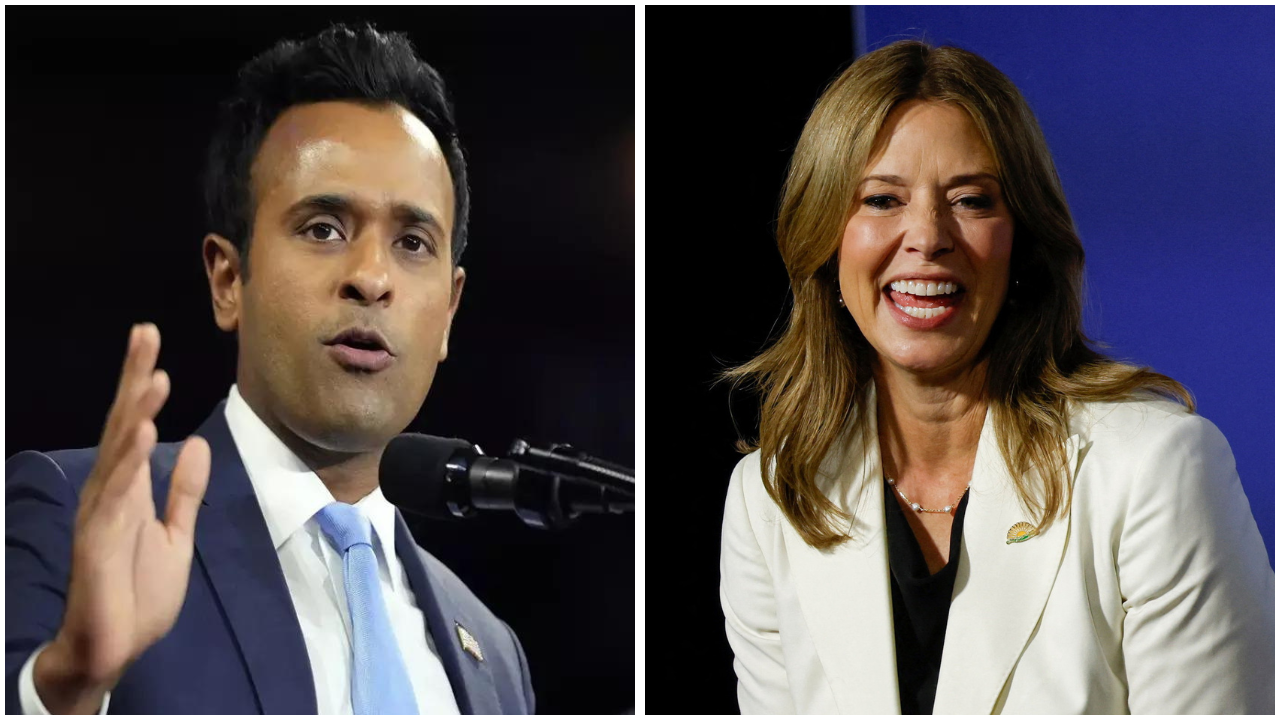
Recent polling data and electoral projections show former Ohio Department of Health Director Amy Acton defeating biotech entrepreneur Vivek Ramaswamy in the race for the Ohio governor's office, ending years of uninterrupted Republican control over the state's executive branch. For a state that has drifted steadily toward the political right over the past decade, a Democratic victory in Columbus represents a massive structural upset. It was not achieved through sudden demographic shifts or national wave dynamics, but rather through a localized battle over trust, institutional competence, and the limits of nationalized populist branding in a midwestern executive race.
To understand how a former public health official defeated one of the most recognizable figures in modern conservative politics, you have to look past the cable news headlines. National observers routinely misread Ohio as a monolithic red state because of its recent presidential margins. They miss the distinct, transactional nature of state-level politics in the Buckeye State, where voters evaluate governors differently than they evaluate senators or presidents.
The limits of national celebrity in Columbus
Vivek Ramaswamy entered the race with near-universal name recognition, deep personal pockets, and a finely tuned media apparatus forged during his 2024 presidential campaign. On paper, he possessed every modern advantage. Yet the very traits that made him a fixture on national television became liabilities when applied to the granular realities of running a state government.
Voters in Ohio have a long history of rewarding pragmatic, kitchen-table governance while viewing ideological crusaders with skepticism. When a candidate campaigns on dismantling federal agencies and waging broad cultural battles, the message plays well in a presidential primary. When that same candidate asks to manage state highway funds, Medicaid budgets, and local school district formulas, voters start asking practical questions.
Ramaswamy's campaign leaned heavily into national talking points, treating the Ohio governor's mansion as a staging ground for broader ideological warfare. In doing so, he left an enormous opening in the political center. Moderate Republicans in the suburbs of Columbus, Cincinnati, and Cleveland—voters who have grown weary of constant political theater—began looking for an exit ramp.
The primary hangover
Before facing Acton, Ramaswamy had to navigate a brutal Republican primary environment that pulled him further to the right. In Ohio GOP politics, winning the base often requires embracing positions on social issues, energy policy, and state preemption laws that alienate independent voters in November.
By the time the general election began, Ramaswamy was locked into a rigid ideological posture. Pivoting back to the center proved nearly impossible without alienating the very populist base he relied upon for turnout. Meanwhile, deep divisions within the state Republican party—lingering from years of legislative infighting and high-profile corruption scandals in Columbus—depressed enthusiasm among traditional party organizers.
Why Amy Acton's message connected
Amy Acton was an unconventional candidate by every standard metric. She had never held elected office prior to her run, and her public profile was defined entirely by her tenure leading Ohio's initial response to the COVID-19 pandemic in 2020. For years, conservative commentators assumed her association with pandemic restrictions would make her unelectable in a statewide race.
That assumption ignored how ordinary Ohioans actually remembered those months.
While political activists raged over mandates, a massive segment of the electorate remembered a calm, empathetic physician standing next to a Republican governor, explaining complex public health data in plain English. She did not sound like a politician. She sounded like a doctor trying to keep her neighbors safe under impossible circumstances.
Acton's campaign leaned directly into that contrast. Instead of running away from her past, she framed her experience as proof of steady leadership during a crisis. Her messaging avoided grand ideological abstractions in favor of concrete, localized concerns:
- Healthcare access and rural hospital closures: Drawing directly on her medical background, she highlighted the quiet collapse of healthcare infrastructure across Appalachian and rural counties, areas traditionally dominated by the GOP.
- Public education funding: She attacked years of state legislative policies that shifted taxpayer money away from local public schools, framing it as an assault on community stability.
- Institutional integrity: Following years of headlines surrounding the FirstEnergy bribery scandal, Acton positioned herself as an outsider untethered to the Statehouse lobbying apparatus.
The contrast was stark. Voters were presented with a choice between a billionaire venture capitalist talking about national culture wars and a local physician talking about why their county hospital was closing.
The suburban realignment in Ohio
You cannot win a statewide election in Ohio without dominating the three major metropolitan areas—Cuyahoga, Franklin, and Hamilton counties—while holding down margins in the surrounding collar counties. For the past decade, Republicans maintained power by running up massive margins in rural counties while keeping suburban losses manageable.
Polls tracking the Acton-Ramaswamy matchup revealed a sharp deterioration in GOP performance across the suburbs of Columbus and Cincinnati. Delaware County and Warren County, long reliable bastions of suburban conservatism, showed measurable movement toward Acton.
This shift was driven largely by college-educated women and independent voters who prioritized economic stability and reproductive freedom over populist grievances. Ohio voters had already demonstrated their willingness to break with Republican leadership on specific issues, having decisively passed constitutional amendments protecting abortion access and legalizing recreational marijuana in 2023. Acton successfully tied those ballot-measure coalitions to her gubernatorial campaign, convincing issue-oriented voters that the governor's veto pen was the only thing standing between their constitutional rights and a hyper-partisan state legislature.
The economic disconnect
Economy and jobs remain the bedrock of every Ohio election. Ramaswamy campaigned aggressively on deregulation, tax cuts, and energy production, arguing that his background in business made him uniquely qualified to accelerate state growth.
However, the economic message ran into a complicated reality on the ground. Ohio had already secured major manufacturing and tech investments—including massive semiconductor and battery projects—under the outgoing administration's bipartisan infrastructure and industrial policies. Voters were less concerned about theoretical deregulation and more focused on the immediate pressures of housing costs, utility bills, and childcare expenses.
Ramaswamy's background in pharmaceuticals and finance also provided fertile ground for opposition research. Critics zeroed in on his business deals, questioning whether his corporate track record aligned with the interests of blue-collar workers in Toledo, Akron, and Youngstown. When an opponent can frame a candidate as someone who made millions through financial engineering rather than building tangible products, the populist appeal begins to fracture.
What the polls actually captured
A closer look at the polling cross-tabs reveals the mechanics of the upset. It was not that lifelong Republicans suddenly became progressive Democrats. Rather, the data showed a classic split-ticket phenomenon.
Thousands of voters who backed Republican candidates down the ballot—or who had voted Republican in recent federal elections—either crossed over to vote for Acton or left the gubernatorial line blank. Dissatisfaction with the direction of the state legislature played a quiet but decisive role. After decades of single-party rule in Columbus, even conservative-leaning voters expressed fatigue with gerrymandered districts and unresponsive lawmakers. Acton effectively marketed herself as an institutional check and balance.
Consider a hypothetical voter in a place like Westerville or Mason: a small business owner who favors lower taxes, dislikes federal overreach, and voted Republican in the last two presidential cycles. When that voter looks at the state level, they care about property taxes, local school quality, and whether the state government functions without constant scandal. Faced with a choice between a polarizing media figure and a pragmatic former health director, that voter decided that dividing power in Columbus was the safest bet for their family's stability.
The governing reality ahead
Flipping the governor's office is one thing; governing Ohio as a Democrat is another matter entirely. Amy Acton enters the executive branch facing an entrenched, conservative supermajority in both chambers of the Ohio General Assembly.
Every major legislative priority she campaigned on—from expanding Medicaid programs to overhauling school funding formulas—will hit a brick wall in the legislature. Her power will not come from passing sweeping progressive bills. It will come from executive orders, agency appointments, budget negotiations, and the strategic use of the line-item veto.
She will also face immediate pressure from her own party's activist wing to take aggressive stands on social and environmental policies that could jeopardize her fragile suburban coalition. Balancing the demands of progressive donors in Cleveland against the expectations of moderate crossover voters in suburban Cincinnati will test her political instincts from day one.
For the Republican Party, the loss serves as a blunt warning about the limits of nationalizing local races. Relying on viral media moments and national conservative grievances cannot indefinitely mask local governance failures or alienate suburban moderates. In Ohio, politics remains stubbornly local, and voters just proved they are still willing to fire the party in charge when the message stops matching their reality.