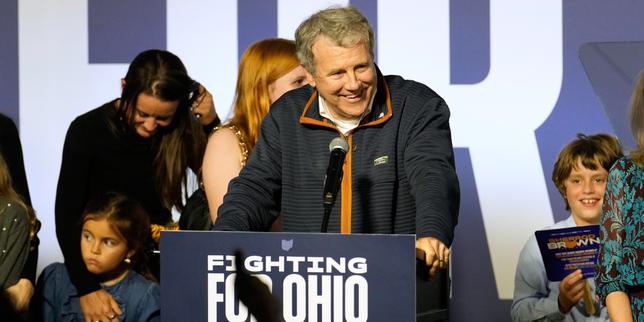
The Republican loss of J.D. Vance’s former U.S. Senate seat in Ohio during the November 2026 midterm elections was not an isolated political upset; it was the predictable output of a structural misalignment between campaign capital efficiency, incumbency mechanics, and midterm turnout elasticity. Democrat Sherrod Brown defeated appointed Republican incumbent Jon Husted by capturing 50.09% of the popular vote (2,323,001 votes) against Husted’s 45.07% (2,090,390 votes), reclaiming a presence in the upper chamber just two years after losing his own seat in 2024. Understanding this five-point swing requires stripping away partisan narratives and examining the underlying operational failures in candidate positioning, financial allocation, and geographic coalition rebuilding.
The Structural Vulnerability of Appointed Incumbency
Conventional political wisdom treats incumbency as a net asset, providing name recognition, institutional leverage, and fundraising advantages. In special elections triggered by executive vacancies, however, appointed incumbency frequently operates as a structural liability.
When J.D. Vance resigned from the Senate on January 10, 2025, to assume the vice presidency, Ohio Governor Mike DeWine appointed then-Lieutenant Governor Jon Husted to fill the vacancy until the November 2026 special election. This sequence created three distinct operational disadvantages for the Republican ticket:
- The Legitimacy Deficit: Unlike an elected incumbent who has survived a statewide primary and general election cycle for that specific office, an appointee enters the race without an organic voter mandate. Husted ran unopposed in the Republican primary, which conserved early primary cash but deprived his campaign of the voter-file stress-testing and grassroots activation that competitive primaries generate.
- Executive Tether Risk: As a sitting lieutenant governor elevated by the state's chief executive, Husted remained tied to the policy records of both the state administration and the federal executive branch. In a midterm cycle characterized by nationalized referendum voting against the party in power in Washington, an appointee lacks the independent brand equity required to decouple from national headwinds.
- Compressed Horizon: Because the special election determined who would serve out the remaining two years of Vance’s original six-year term (ending in January 2029), voters treated the ballot less as a generational ideological choice and more as a low-risk corrective mechanism.
In contrast, Sherrod Brown entered the race not as a conventional challenger, but as a three-term former senator with near-universal statewide name recognition. By losing his 2024 bid to Bernie Moreno by roughly 3.6 percentage points and immediately re-entering the arena in 2026, Brown retained an intact statewide field infrastructure. He became the first candidate since Slade Gorton in 1988 to win back a U.S. Senate seat immediately after suffering an electoral defeat, bypassing the typical cold-start problem that plagues non-incumbent campaigns.
Capital Allocation vs. Voter Conversion Efficiency
A breakdown of campaign finance disclosures reveals a sharp divergence between total capital deployed and actual vote yield. The 2026 Ohio Senate special election ranked among the most expensive races in the country, yet the distribution of funds exposed severe diminishing returns for Republican outside spending.
According to Federal Election Commission filings through mid-October 2026, direct candidate fundraising heavily favored the Democratic challenger:
- Sherrod Brown (D): Raised $68,409,200 and spent $63,956,397.
- Jon Husted (R): Raised $19,894,786 and spent $15,655,689.
To compensate for Husted’s 3.4-to-1 deficit in hard-dollar candidate fundraising, Republican-aligned Super PACs and outside groups injected over $200 million into the state, more than doubling the $97 million spent by Democratic outside groups. On paper, total spending across the race exceeded $380 million, with Republican-aligned entities holding a aggregate financial advantage.
In practice, this capital structure created an efficiency bottleneck. Under federal campaign finance regulations, candidate committees receive the lowest unit rate for broadcast television advertising, whereas independent expenditure groups pay premium commercial rates. Because Husted’s campaign lacked the hard dollars to saturate airwaves at discounted rates, Republican messaging relied disproportionately on high-cost, third-party negative advertising.
When we divide total estimated expenditure (candidate plus outside spending) by raw votes received, the cost-per-vote metric highlights the Republican inefficiency:
- Democratic Cost Function: Approximately $161 million in combined spending yielded 2,323,001 votes, equating to roughly $69.30 per vote.
- Republican Cost Function: Approximately $215 million in combined spending yielded 2,090,390 votes, equating to roughly $102.85 per vote.
The Republican apparatus paid nearly 48% more per vote than the Democratic operation while losing by more than 232,000 ballots. Excessive outside spending saturated the media market early, triggering voter fatigue and allowing Brown to frame the race around anti-corporate populism—explicitly targeting utility companies, data centers, and billionaire donors in his messaging.
The Mechanics of the Midterm Turnout Differential
The primary driver of the five-point shift between 2024 and 2026 was not mass ideological conversion, but differential turnout elasticity between presidential and midterm electorates.
In 2022, J.D. Vance won the seat by slightly over 6 percentage points against Tim Ryan. In 2024, Donald Trump carried Ohio comfortably, pulling Bernie Moreno over the finish line against Brown. However, the coalition that delivers Republican victories in Ohio during presidential years relies heavily on low-propensity, non-college-educated rural and exurban voters who turn out specifically when Donald Trump is at the top of the ticket.
In November 2026, without Trump on the ballot, two simultaneous demographic shifts occurred:
- The Exurban Drop-Off: Turnout in traditional Republican strongholds across rural Ohio contracted relative to 2024 baselines. President Trump himself acknowledged this structural vulnerability on election night, noting that his absence from the ballot altered the electorate's composition.
- Suburban and Industrial Realignment: While Republican turnout softened, Brown successfully rebuilt the northern and southwestern margins that had eroded two years prior. Precinct-level returns show that Brown reclaimed leads in counties he had won in 2018 but lost in 2024, including Wood County outside Toledo, Erie County along Lake Erie, and the northeastern industrial counties of Lake, Portage, Trumbull, and Mahoning. Simultaneously, he expanded his margins in the Columbus metropolitan area (Franklin County) and secured leads in the Cincinnati and Dayton corridors in southwestern Ohio—regions Trump had carried in 2024.
Third-party candidates further complicated the Republican math. Libertarian nominee William Redpath captured 129,435 votes (2.8%), and independent candidate Gregory Levy drew 94,857 votes (2.0%). Combined, minor-party candidates absorbed 4.8% of the electorate—nearly matching Brown's 5.02% margin of victory. While minor-party votes never transfer cleanly to a single major party, the presence of a Libertarian candidate pulling nearly 130,000 votes in a state where Husted failed to clear 46% prevented the Republican nominee from consolidating anti-incumbent or fiscally conservative protest votes.
Campaign Execution and Message Discipline
Beyond macro-level structural forces, tactical execution errors compounded the Republican deficit during the final stretch of the campaign.
Brown maintained strict message discipline centered on economic nationalism, labor protection, and institutional accountability—proposing a ban on congressional stock trading and positioning himself against corporate consolidation. This economic populism neutralized standard Republican attacks that sought to tie him to national Democratic social policies.
Conversely, the Republican campaign struggled to maintain control of the earned-media cycle. High-profile surrogacy became a distraction rather than a force multiplier. During an October 12 campaign rally in Ohio, President Trump departed from economic messaging to make repeated, viral remarks about Husted’s physical appearance and physique, comments that dominated regional and national news coverage for days. While such unscripted moments generate high engagement among base voters, they crowd out substantive policy contrast in swing suburban districts where undecided voters prioritize governance stability.
Further complicating the informational environment, intelligence assessments and election monitors flagged widespread foreign interference operations, specifically linked to Russian actors, aimed at boosting Husted's candidacy. Rather than aiding the Republican ticket, public exposure of external interference reinforced Democratic narratives regarding institutional integrity and alienated moderate voters in Cuyahoga, Franklin, and Hamilton counties.
Strategic Implications for 2028
The loss of Vance’s former seat contributed directly to Democrats flipping multiple Republican-held seats nationwide—including in North Carolina, South Carolina, Texas, Maine, Iowa, Kansas, and Alaska—allowing the Democratic Party to reclaim the Senate majority. However, the structural realities of the 2026 Ohio special election impose strict boundary conditions on how both parties must approach the state moving forward.
First, Democrats must recognize that Brown’s victory does not signal a permanent partisan realignment of Ohio. Brown won 50.09% of the vote in a favorable midterm environment, with massive name recognition, a $48.5 million hard-dollar fundraising edge, and an un-vetted appointed opponent. Because this was a special election to complete Vance’s unexpired term, the seat returns to the ballot in November 2028 for a full six-year term. In 2028, the electorate will revert to a high-turnout presidential cycle, eliminating the midterm turnout advantage that enabled Brown’s comeback.
Second, Republican strategists must abandon the assumption that Ohio is an automatic safe harbor that can be held through late Super PAC spending alone. Relying on outside groups to compensate for weak candidate fundraising creates an unsustainable cost-per-vote penalty and surrenders message control to third-party vendors.
To recapture the seat in 2028, the Republican Party must execute a three-part operational overhaul:
- Front-Load Hard-Dollar Infrastructure: Candidate committees must build small-dollar donor networks early in the cycle rather than relying on billionaire-backed Super PACs to rescue underfunded nominees in the final quarter.
- Enforce Competitive Primaries: Avoid clearing the field for consensus appointees. A rigorous primary forces candidates to sharpen message discipline and build ground-game telemetry in industrial counties like Mahoning, Trumbull, and Lorain before facing a general election.
- Localize Economic Populism: Counter Democratic anti-corporate messaging by directly addressing regional cost-of-living pressures—specifically utility rates, industrial energy consumption from data centers, and manufacturing supply chains—rather than running purely on nationalized partisan grievances.
Without structural reform to how Republican candidates raise hard capital and compete in northeastern industrial corridors, the party risks turning a reliably red presidential state into a recurring battleground every two years.



