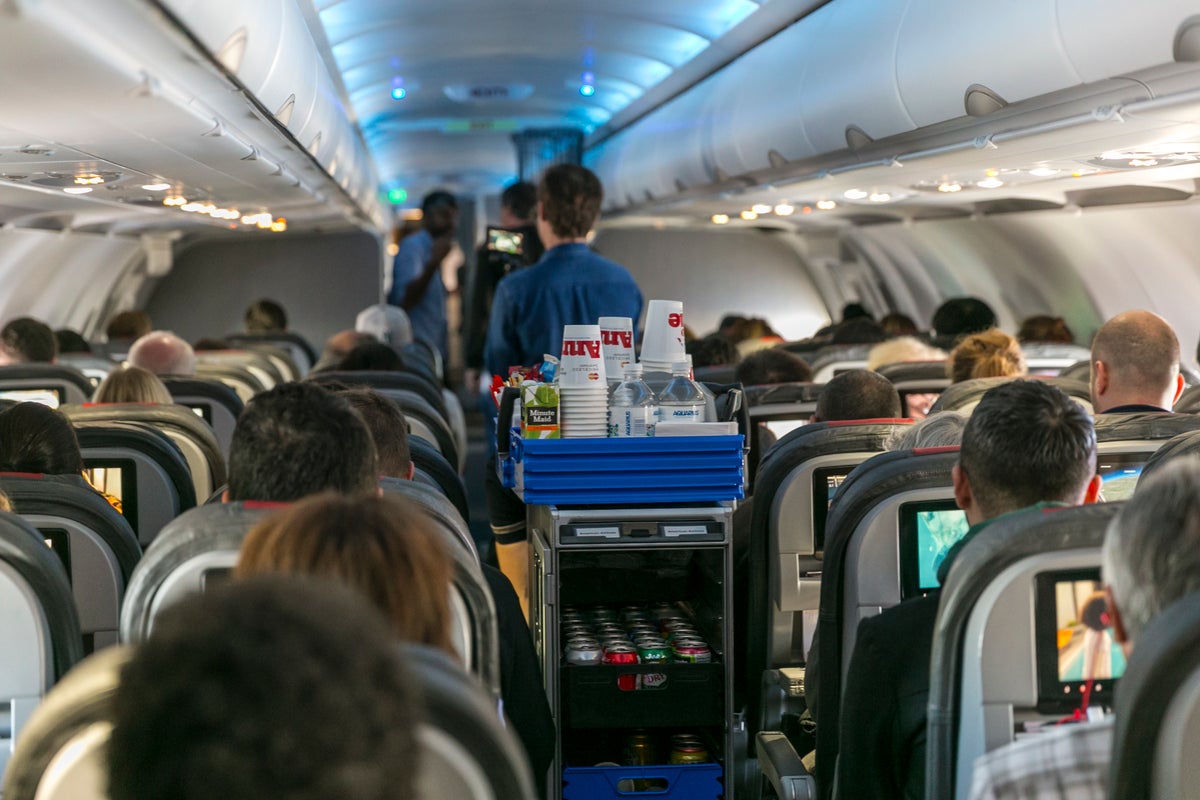
An unscheduled commercial airline diversion is an operational failure mechanism that triggers immediate, non-recoverable capital losses. When a Delta Air Lines pilot diverted a Fort Lauderdale-to-Los Angeles flight to Atlanta following an alleged physical assault on a flight attendant, the decision was not merely a punitive measure against an unruly passenger. It was the execution of a highly codified risk-mitigation protocol designed to protect the integrity of the aircraft's command structure. Commercial aviation treats cabin crew not as service staff, but as first responders and critical safety components; any degradation of their physical or psychological capability compromises the safety vector of the entire vessel.
Evaluating these incidents requires moving past the sensationalism of the underlying passenger behavior—in this case, an alleged physical battery over a skipped beverage service—and analyzing the cold mathematical and legal frameworks that govern commercial aviation.
The Economic Cost Function of an Unscheduled Diversion
Every minute an aircraft spends outside its optimized flight plan compounds exponentially across an airline’s network. When a flight is diverted, the carrier incurs immediate direct and indirect liabilities. The total cost function of an unscheduled diversion is defined by five primary operational variables.
$$C_{\text{diversion}} = F_{\text{fuel}} + L_{\text{fees}} + O_{\text{crew}} + P_{\text{compensation}} + N_{\text{recovery}}$$
Fuel Dumping and Volumetric Inefficiencies ($F_{\text{fuel}}$)
Commercial aircraft are bound by strict Maximum Landing Weight (MLW) limitations, which are significantly lower than their Maximum Takeoff Weight (MTOW). A flight routed from Fort Lauderdale to Los Angeles carries a heavy fuel load to sustain a cross-country trajectory. Forcing a landing early in the flight path requires either burning fuel systematically in a holding pattern or, in larger widebody aircraft, dumping fuel entirely to prevent structural damage to the landing gear upon touchdown. The unburned fuel required to taxi, climb back to cruising altitude, and resume the journey represents pure margin destruction.
Airport Landing and Handling Fees ($L_{\text{fees}}$)
Unscheduled arrivals at hub airports like Hartsfield-Jackson Atlanta International Airport incur emergency handling tariffs, gate utilization fees, and ground crew labor surcharges. Because the slot was not pre-allocated, the airline pays premium spot rates to secure tarmac space and baggage handling resources.
Crew Interruption and Duty Clock Expirations ($O_{\text{crew}}$)
Federal Aviation Administration (FAA) regulations dictate rigid maximum duty days and minimum rest periods for flight crews. An unexpected diversion stalls the clock. If the delay extends long enough to push the pilots or flight attendants past their legal duty limits, the crew "times out." The airline must then source a reserve crew, flying them into the diversion node or pulling them from hub reserves, which cripples localized staffing elasticity.
Passenger Compensation and Re-accommodation ($P_{\text{compensation}}$)
Missing downstream connections creates a cascading liability for missed flights. The carrier faces immediate out-of-pocket expenses for meal vouchers, hotel accommodations for hundreds of displaced travelers, and the labor costs associated with rebooking logistics.
Network Recovery Surcharges ($N_{\text{recovery}}$)
The specific airframe involved in a diversion is typically scheduled to perform subsequent routes later that day. When an aircraft is grounded in Atlanta instead of landing in Los Angeles on schedule, the downstream flights are delayed or canceled, creating a bullwhip effect that disrupts schedules across multiple geographic regions.
The Tri-Partite Legal Matrix of In-Flight Assault
The passenger at the center of the Delta incident, identified in federal court documents as Cody James Maluck, faces a severe legal apparatus designed specifically to insulate aviation environments from non-compliance. Airplanes operate within a distinct jurisdictional vacuum where standard domestic misdemeanor laws are superseded by federal statutes the moment the cabin doors close.
+-----------------------------------------------------------------+
|               FEDERAL JURISDICTIONAL APPARATUS                  |
|                                                                 |
|  [1. Title 49 U.S.C. § 46504] ----> Interference with Crew      |
|                                     (Up to 20-Year Sentence)    |
|                                                                 |
|  [2. Special Territorial] --------> FBI & Air Marshals Apprehend|
|      Jurisdiction                   at First Landing Point      |
|                                                                 |
|  [3. FAA Civil Penalty] ----------> Non-negotiable Fines        |
|                                     Up to $37,000 per Violation |
+-----------------------------------------------------------------+
The legal framework relies on three overlapping mechanisms:
- Title 49 U.S.C. § 46504 (Interference with Flight Crew): This federal statute is the primary tool used by prosecutors. It criminalizes assaulting, threatening, or intimidating a flight crew member to the extent that it interferes with the performance of their duties. Unlike a standard battery charge on land, which is often treated as a local misdemeanor, interference with a flight crew is a felony carrying a maximum penalty of 20 years in federal prison. The threshold for "interference" is met the moment a flight attendant must cease safety duties or service delivery to manage a physical altercation or address an emotional injury.
- Special Maritime and Territorial Jurisdiction: Under federal law, crimes committed on an aircraft in flight fall under the investigative purview of the Federal Bureau of Investigation (FBI) and Federal Air Marshals, rather than local municipal police. This guarantees that even if a passenger claims an action was an accident or merely an inappropriate attempt to gain attention—as the defendant asserted in this case—the evaluation is conducted by federal agents trained to protect systemic transportation infrastructure.
- The FAA Civil Penalty Framework: Separate from criminal prosecution, the FAA holds independent authority to levy severe civil administrative fines, capped at approximately $37,000 per violation. These fines do not require a criminal conviction; they require a preponderance of evidence showing that a passenger's behavior degraded cabin safety parameters.
Operational Risk Protocols: The Pilot’s Divert Threshold
A common misconception is that pilots divert aircraft as an emotional response to bad behavior. In reality, the decision matrix is dictated by clear operational risk parameters. When the lead flight attendant notified the captain of the physical assault in the cabin, the captain executed a risk calculation based on corporate policy and CRM (Crew Resource Management) principles.
The pilot must weigh the known financial penalties of an unscheduled landing against the unknown safety risks of continuing a multi-hour flight with an volatile element in the cabin. The presence of an uncooperative, physically aggressive passenger introduces an unacceptable level of operational variance. If the passenger's behavior escalates further while the aircraft is over a remote geographic area or at a high altitude, the risk to the aircraft's physical security escalates dramatically.
The second flight attendant on the Delta flight immediately suspended the beverage service to isolate the affected crew member from the disruptive passenger. This tactical withdrawal serves two functional purposes: it prevents further escalation of the immediate conflict, and it allows the crew to document witness statements from surrounding passengers, creating an objective data set for the flight deck to review.
Once the captain is informed that a physical boundary has been breached and a crew member's operational capacity is compromised, the threat level shifts from a customer service issue to a security breach. At that point, a diversion to the nearest suitable hub airport becomes the mandatory minimum risk-mitigation step.
The Structural Limits of Modern In-Flight Security
Despite rigid legal frameworks and severe financial consequences, commercial aviation remains structurally vulnerable to rogue passenger vectors due to the fundamental constraints of economy-class cabin design.
- Density Anomalies: High load factors compress hundreds of passengers into tight, physical proximity. This creates high psychological friction, which amplifies minor service variances—such as an inadvertently skipped drink order—into flashpoints for physical confrontation.
- Asymmetrical Enforcement: Flight attendants are trained primarily in safety management, evacuation logistics, and customer service. They are not law enforcement officers, nor are they equipped with physical restraints beyond basic zip-ties or standard onboard restraint kits. Their capacity to contain a physical threat relies heavily on voluntary compliance or the physical intervention of fellow passengers.
- The Communication Bottleneck: The physical barrier between the passenger cabin and the flight deck is reinforced by a locked, bulletproof cockpit door. While this design protects the command center from hijacking threats, it limits the flight deck's situational awareness. Pilots must make critical operational decisions based entirely on verbal or interphone reports from the cabin crew, creating an inherent lag in threat assessment.
To completely mitigate these vulnerabilities, airlines would need to implement drastic measures: reducing cabin density, deploying permanent air marshals on every domestic routing, or instituting hard physical barriers between service aisles and seating rows. Because the capital costs of those interventions far outweigh the statistical frequency of mid-air assaults, the industry tolerates the residual risk, relying instead on the deterrent effect of swift federal prosecution and lifetime no-fly bans.
The strategic play for commercial carriers moving forward is not found in soft customer relations campaigns or additional sensitivity training. Airlines must formalize a hard-line operational policy: treating any unauthorized physical contact with crew members as an automatic, non-discretionary command to land the aircraft at the nearest available airport, accompanied by immediate handover to federal authorities. By making the operational response entirely binary and removing pilot discretion, the aviation industry can convert its legal and financial liabilities into an absolute deterrent framework.


