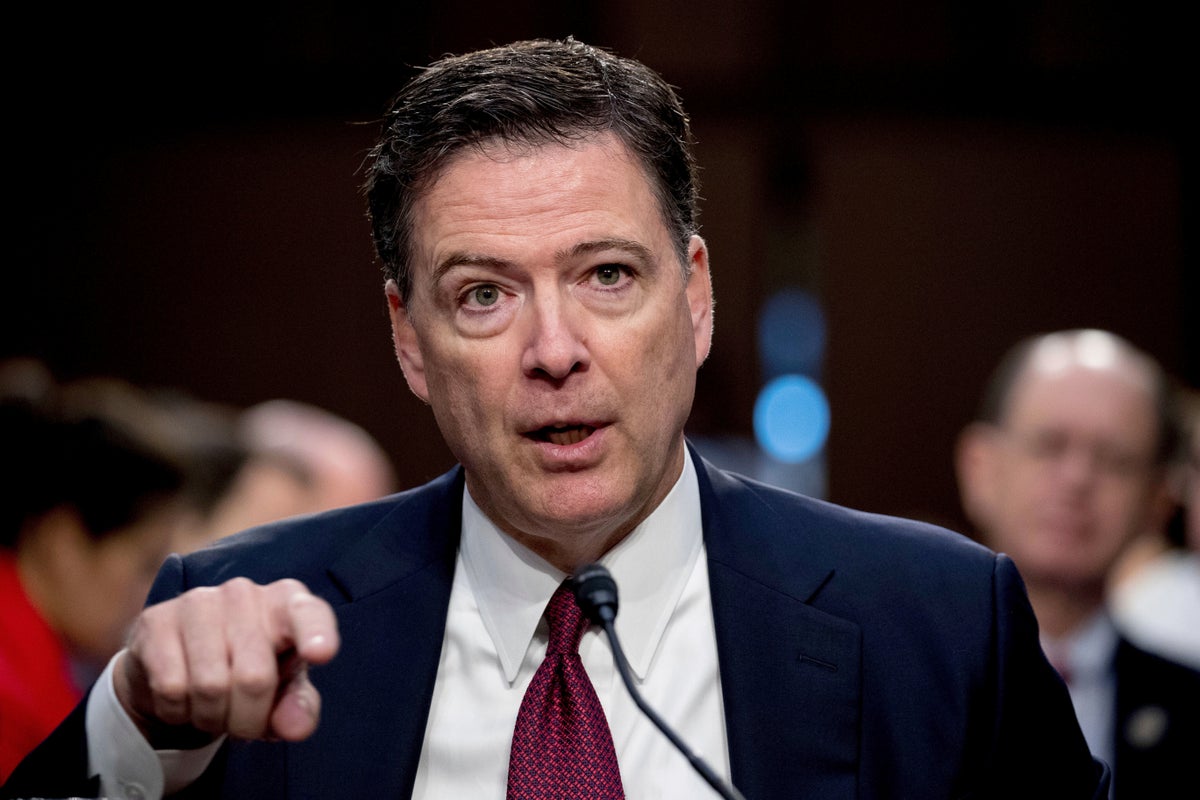
The threshold for establishing a criminal threat in digital environments hinges less on explicit language and more on the intersection of objective ambiguity and subjective interpretation. When prosecutors argue that a social media post constitutes a threat, they are performing a high-stakes calculation of intent versus plausible deniability. The ongoing case involving former FBI Director James Comey—specifically his 2025 Instagram post displaying seashells arranged as "86 47"—serves as a primary case study in how the state constructs a narrative of implied violence when direct evidence of intent remains circumstantial.
The Objective Ambiguity Framework
In legal proceedings involving electronic communications, the "true threat" doctrine requires that a reasonable observer would perceive the communication as a serious expression of an intent to commit an act of unlawful violence. The prosecution’s argument rests on a two-part analytical model: Building on this topic, you can find more in: Diplomatic Real Estate Economics Analyzing The New Singapore Chancery Project.
- The Semantics of Erasure: The term "86" is colloquially recognized as meaning "to eject," "to discard," or "to refuse service." Within the context of political discourse, specifically when paired with the numerical designation for the 47th President of the United States, prosecutors posit that the aggregation creates a clear, actionable directive: the removal of the executive.
- The Contextual Nexus: Communication does not occur in a vacuum. By identifying the subject as a sitting president, the "86 47" construction elevates the ambiguity from an abstract statement to a targeted message. The state contends that this constitutes a "reasonable person" standard of threat—that an objective viewer, absent any specific intent on the part of the author, would identify a call for physical harm.
The Defense Logic and Procedural Friction
The defense strategy operates on the principle of evidentiary insufficiency, targeting the state’s inability to demonstrate a specific mens rea (guilty mind). Their argument involves three distinct friction points:
- The Lack of Direct Association: The FBI’s internal database searches, which yielded no evidence linking Comey to the term "86" as a proxy for violence, serve as the defense’s primary leverage point. If no historical data suggests the defendant utilized this vernacular in a violent context, the inference of intent is weakened.
- The Reliability of Source Material: The defense claims the state’s investigative process was tainted by the omission of exculpatory evidence. By asserting that investigators submitted incomplete filings to federal magistrates, they shift the focus from the post itself to the structural integrity of the prosecution.
- The Standard of Recklessness: Prosecutors have pivoted toward a "reckless disregard" standard. They argue that even if the defendant did not explicitly intend to issue a threat, he consciously disregarded the substantial risk that his audience—numbering in the hundreds of thousands—would interpret the message as such. This shifts the burden from proving specific intent to proving gross negligence in digital conduct.
Operational Discrepancies in Physical Evidence
A critical component of this dispute involves the physical origins of the evidence. Comey’s account of finding the shells on a North Carolina beach is directly challenged by the state, which notes a four-mile geographic discrepancy between his claimed location and the specific area where such shells would be found. Experts at NPR have also weighed in on this trend.
This is not merely a detail; it is a tactical argument intended to destroy the defendant’s credibility. In legal strategy, if the foundation of a narrative—"I found these on a beach"—is proven to be a fabrication, the assumption follows that the entire post was a calculated performance rather than a spontaneous act. The state’s narrative posits that the photo was not a natural discovery but a staged production, timed precisely to coincide with the release of a fictional work that explores the intersection of social media influence and political violence.
The Commercialization Variable
The intersection of commercial interest and political communication creates a unique legal category. Prosecutors have noted that the defendant’s publishing agent described the ensuing controversy as "music to an agent's ears." This injects a secondary motive into the investigation: did the defendant leverage his platform to create a polarizing "viral" moment, even if that moment crossed the line into criminality?
When digital content acts as both speech and a marketing asset for a commercial product (the novel "FDR Drive"), the legal protection for the speech may be weighed differently than if it were purely expressive. The prosecution is essentially arguing that the defendant traded his responsibility to avoid inciting harm for the increased reach and financial benefit associated with high-engagement, inflammatory content.
Strategic Implications
The case establishes a precedent for how future digital threats will be adjudicated. If the state secures a conviction based on "reckless disregard" for how a coded message is interpreted by a massive, uncontrolled audience, the legal burden on public figures to sanitize their social media presence increases significantly.
The defense must continue to isolate the specific claim of intent. If they can force the court to focus exclusively on the absence of pre-existing, non-public evidence of intent, the prosecution’s reliance on "objective viewer" standards may fail. Conversely, the state will likely keep the spotlight on the staging of the photo and the commercial exploitation of the response, as these points make the defendant appear not as a victim of misinterpretation, but as a deliberate architect of an inflammatory signal. The case remains a conflict between the literal interpretation of symbols and the behavioral analysis of the individual who disseminated them.