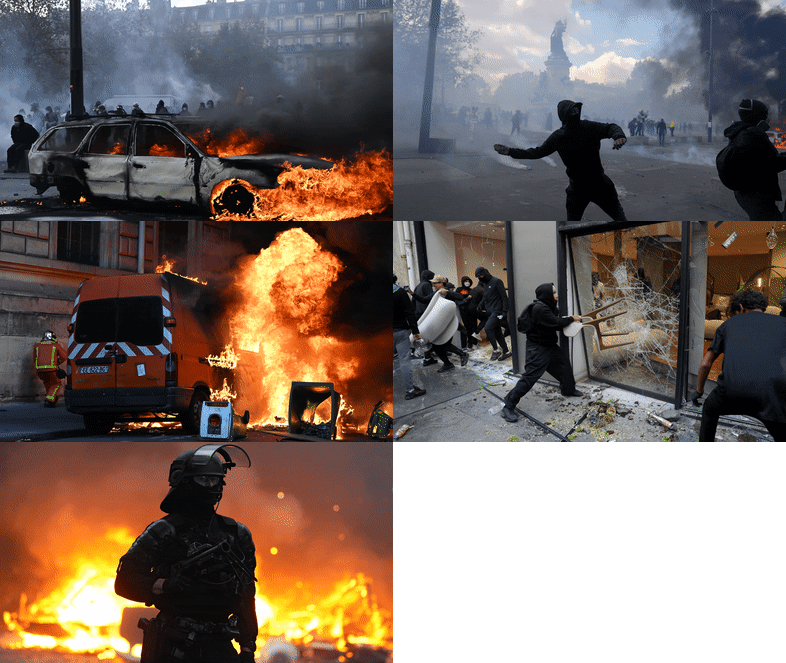
When high school students join broader street demonstrations in France and clashes with fires erupt, standard event reporting stops at the visible friction. A headline about scuffles and fires captures the immediate kinetic output of unrest, yet it leaves out the structural mechanics that turn localized school grievances into national street disorder. To understand why these movements escalate, why state responses either contain or amplify them, and what happens to public institutions and political alignment afterward, the events must be broken down into distinct analytical components rather than treated as a single undifferentiated spectacle.
The blueprint of this analysis rests on four operational pillars: Grievance Transmission, Coalition Mechanics, Escalation Dynamics, and Institutional Feedback. Each pillar explains a specific link in the chain between a localized classroom dispute and widespread urban confrontation. Rather than relying on surface impressions of anger or chaos, examining how grievances travel, how distinct groups converge, how street tactics interact with policing, and how political actors absorb the fallout provides a clear operating model for reading French protest cycles. For a different look, consider: this related article.
Mapping the Logic Behind Standard Protest Reporting
Conventional coverage of street unrest typically relies on an Event-Symptom Loop. It opens with dramatic scenes—barricades, tear gas, property damage, or school closures—and then inserts brief background paragraphs listing complaints such as staffing shortages, aging facilities, or contested policies. While that structure conveys urgency, it flattens cause and effect into a side-by-side list.
Three analytical blind spots appear repeatedly in surface-level accounts: Similar reporting on this matter has been published by The Washington Post.
- Conflating triggers with root causes: A visible spark—such as a specific school walkout, an unpopular administrative rule, or a clash outside a campus—is often treated as the sole explanation for nationwide mobilization. In practice, immediate sparks activate pre-existing friction points across schools, households, and municipal budgets.
- Treating crowds as monolithic actors: Calling everyone in or near a demonstration a single bloc obscures the sharp operational differences between high school students, university students, union members, ordinary bystanders, and agitators seeking confrontation or looting.
- Ignoring information distortion: Viral clips, recycled footage from earlier protests, and synthetic media frequently circulate faster than verified updates, shaping perceptions of scale and brutality before facts are established.
A known fact is that high school and youth demonstrations in France have repeatedly intersected with broader social and economic protests, producing both peaceful marches and violent incidents such as arson, property damage, and clashes with security forces. An educated hypothesis—requiring verification against specific event data rather than assumption—is that convergence between student grievances and broader economic discontent increases march turnout while raising the risk of tactical spillover when different groups share the same public spaces.
How Grievances Travel From Classrooms to the Street
Youth mobilization rarely starts with a grand ideological blueprint; it usually starts with concrete, daily friction inside schools. Students experience institutional strain directly: unfilled teaching positions, crowded classes, uncomfortable or poorly maintained buildings, rigid schedules, or stressful university placement mechanisms. When these day-to-day frustrations feel unresolved, a local walkout or blockade becomes a low-barrier way to register collective dissatisfaction.
The Grievance Transmission mechanism works through three reinforcing steps:
- Local friction becomes shared identity: A problem in one school or neighborhood resonates with peers elsewhere who face similar conditions, turning isolated complaints into a common generational or student narrative.
- Digital channels compress coordination time: Short-form video and messaging apps allow students to compare conditions, share blockade ideas, and schedule simultaneous actions across cities far faster than traditional student unions could alone.
- Institutional friction turns routine grievances into political demands: Once school disruptions draw administrative pushback, police presence, or ministerial statements, the dispute shifts from classroom logistics to questions of respect, fairness, and state responsiveness.
Consider a practical example from school operations. If a secondary school lacks replacement teachers for core subjects over an extended period, students do not merely lose instructional hours; they face anxiety over exams and future placement. If their initial complaints produce slow or bureaucratic answers, a single school blockade can quickly inspire copycat actions at neighboring campuses. Once multiple schools close or face cordons simultaneously, the issue crosses from local education management into national public order.
Coalition Mechanics When Students Join Broader Rallies
When students join wider demonstrations—whether organized around wages, cost of living, public spending, or anti-government sentiment—the movement's structure changes. A student walkout has narrow, recognizable targets tied to education. A multi-group rally aggregates many grievances into a single street footprint.
This convergence creates a Coalition Multiplier alongside a Coordination Tax. On the positive side for organizers, overlapping crowds increase visible numbers, broaden media attention, and pressure authorities across multiple ministries at once. On the operational side, bringing together groups with different tolerances for disruption makes message discipline difficult. Trade unions, families, students, activists, and opportunistic actors may all occupy the same march route with incompatible objectives.
The risk profile shifts sharply at the seams between groups. Peaceful marchers can march for hours without incident while smaller, more confrontational clusters test police perimeters, light street furniture or bins on fire, or target storefronts and public buildings. Even when violent actors represent a small fraction of the total crowd, their actions dominate visual coverage and force security commanders to treat the broader gathering as a high-risk public order event.
Escalation Dynamics and the Cost Function of Disorder
Street clashes and fires follow identifiable Escalation Dynamics rather than occurring at random. Once a protest reaches a flashpoint—such as a blocked intersection, a contested perimeter outside a school or civic building, or tear gas deployment—action and reaction feed each other in short feedback loops.
To evaluate these dynamics rigorously, analysts can look at the Cost Function of Disorder across three main actors:
- Demonstrators and students: Participation carries immediate physical risk from crowd crushes, projectiles, or policing tools, alongside legal exposure such as detention, fines, or school disciplinary consequences. For minors, arrest or injury also creates acute family and legal strain.
- Law enforcement and public authorities: Every major mobilization consumes policing hours, specialized units, and municipal repair budgets while risking officer injuries, legal complaints over force, and reputational damage when order breaks down.
- Local businesses, commuters, and residents: Fires, roadblocks, transit disruptions, and property damage impose direct economic and daily costs on people who may not be participating in the protest at all.
The first major bottleneck in de-escalation is attribution ambiguity. When fires break out or windows are smashed, officials, opposition politicians, and demonstrators often assign blame to different causes—pointing to fringe agitators, heavy-handed policing, political incitement, or deep-seated economic frustration. Until the facts of specific incidents are established, competing narratives harden positions on every side.
The second bottleneck is media amplification. Dramatic footage of burning barricades or clashes travels immediately on social platforms, often stripped of time, location, or context. A single localized blaze can make an entire city appear engulfed, prompting over-broad security responses or misinformed commentary far from the scene.
Institutional Feedback and Political Realignment
Unrest does not end when streets clear; it feeds directly into institutional decisions and political positioning. Governments face a narrow balancing act. Purely punitive responses—heavy arrests, harsh rhetoric, or blanket blame—can inflame grievances and turn moderate students against the state. Conversely, concessions made solely under the pressure of street violence risk signaling that disruption is the only reliable way to move policy.
Opposition parties and political movements routinely attempt to read or ride the momentum. Some seek to claim alignment with youth frustration or broader economic anger, while ruling coalitions try to separate legitimate grievances from unlawful violence. Yet street intensity does not automatically translate into durable electoral gains. Voters often distinguish between sympathy for underlying issues—such as better schools or lower living costs—and disapproval of destructive tactics or prolonged instability.
Operational Limits of Standard Interventions
Any strategy aimed at preventing or managing student-linked unrest faces clear constraints. Policy announcements alone rarely calm an active street dynamic if students view promises as vague, delayed, or disconnected from daily realities. Likewise, relying primarily on containment and deterrence carries high political and social costs, especially when large numbers of young people or bystanders are caught in tense encounters.
There is no single lever that eliminates both the underlying grievances and the risk of street spillover simultaneously. Structural fixes in education, staffing, infrastructure, and scheduling take time and budget discipline, while crowd management must operate in real time under incomplete information. Analysts and decision-makers who treat either policy reform or public order as a standalone cure miss how tightly the two tracks interact.
Strategic Play for Decision-Makers and Analysts
To separate noise from durable signal during future waves of student and street unrest, track three concrete indicators rather than headline crowd estimates alone: whether demands narrow into specific, verifiable policy deliverables, whether union and student organizers maintain separation from disruptive actors, and how quickly authorities pair clear perimeter control with transparent, non-performative negotiations. For policymakers, the highest-leverage move is to address high-friction school and economic bottlenecks early—before local frustration compounds into multi-group street coalitions—while maintaining strict, accountable distinction between peaceful assembly and destructive acts.