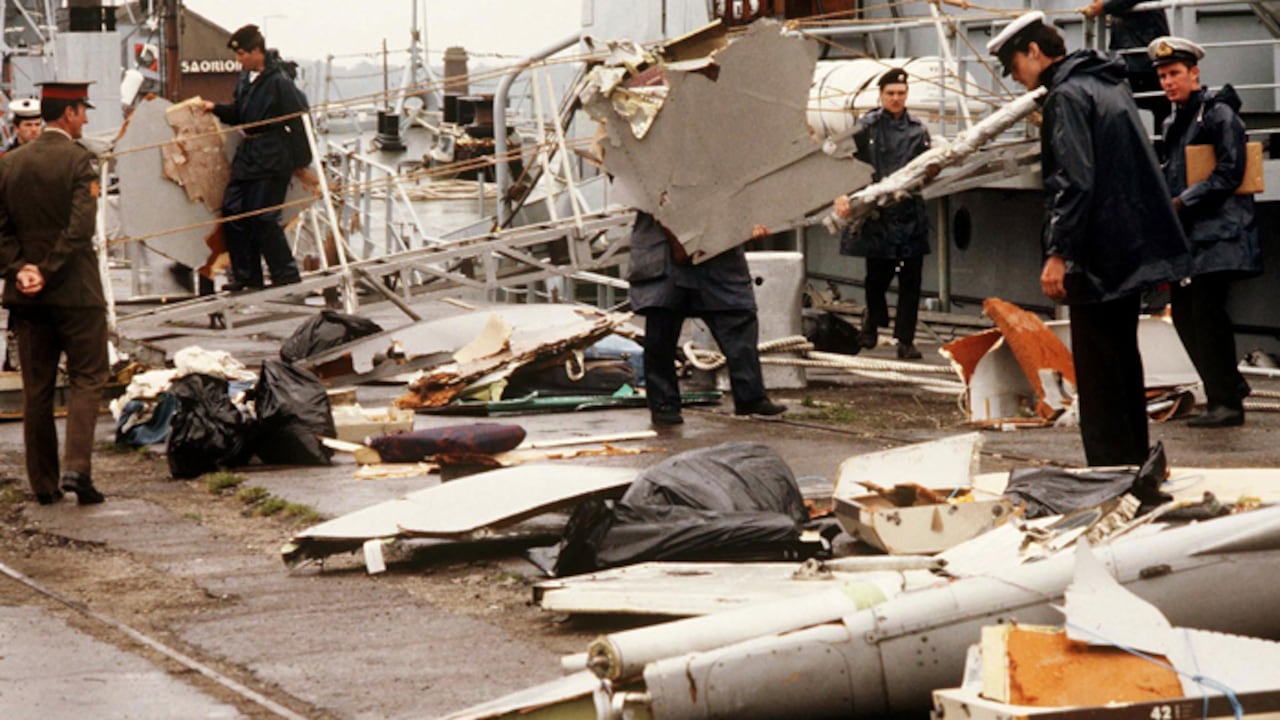
Four decades after the destruction of Air India Flight 182, the historical record surrounding the deadliest act of aviation terrorism prior to September 11, 2001, requires a clinical re-examination. The attack, which occurred on June 23, 1985, over the Atlantic Ocean near Ireland, resulted in 329 fatalities—primarily Canadian citizens of Indian descent. An associated detonation at Tokyo’s Narita Airport killed two baggage handlers, exposing a coordinated transnational plot.
The analytical gap in contemporary commentary lies in treating this event as an external geopolitical spillover rather than a systemic failure of domestic intelligence, law enforcement, and state recognition. Deconstructing this event requires analyzing three specific operational dimensions: institutional friction, the misclassification of domestic threats, and the structural degradation of evidence.
The Triad of Institutional Friction
The failure to prevent the bombing of Flight 182 was not a consequence of an absence of raw data, but a failure in the intelligence-to-execution pipeline. The structural breakdown can be isolated within three distinct nodes of the Canadian national security apparatus.
1. The Intelligence-Evidence Asymmetry
The Canadian Security Intelligence Service (CSIS), formed just one year prior to the bombing in 1984, operated under a mandate distinct from the Royal Canadian Mounted Police (RCMP). CSIS focused on threat acquisition and monitoring, whereas the RCMP required actionable, high-threshold evidence suitable for criminal prosecution. This structural divergence created an operational chasm. Information acquired via wiretaps and surveillance by intelligence officers was systematically siloed, withheld, or destroyed rather than translated into defensive law enforcement measures.
2. The Erasure of Primary Signals
The most glaring breakdown in the intelligence pipeline occurred when CSIS erased over 150 wiretap recordings of the primary conspirators, including Talwinder Singh Parmar, the leader of the Babbar Khalsa extremist faction based in British Columbia. This destruction of primary source material occurred despite explicit warnings from Indian intelligence agencies regarding an imminent threat to Air India flights. The erasure compromised the subsequent decades-long criminal investigation and demonstrated an institutional failure to understand the evidentiary standards required for counter-terrorism prosecution.
3. Inter-Agency Information Asymmetry
Days before the attack, CSIS surveillance teams observed the conspirators testing an explosive device in the woods near Duncan, British Columbia. The loud detonation was misinterpreted as a "gunshot." The failure to rapidly synthesize this operational observation with concurrent airline reservation anomalies blocked the intervention that would have stopped the bombs from being loaded onto Canadian Pacific Airlines feeder flights in Vancouver.
The Cost Function of Threat Misclassification
A foundational error made by the state apparatus was the geopolitical misclassification of the adversary. Throughout the early 1980s, the violent campaign for an independent state called Khalistan in the Punjab region of India was viewed by Western intelligence agencies as a distant, foreign security issue.
[Threat Vector Misclassification]
   Foreign Geopolitical Grievance ──> Viewed as Low Domestic Risk ──> Under-allocation of Surveillance
   Domestic Execution Capability  ──> Masked by Diasporic Protections ──> Failure to Prevent Border Breach
This classification error created a blind spot. Conspirators leveraged the domestic protections of Canadian citizenship and legal frameworks to finance, plan, and manufacture explosive devices on Canadian soil. Because the state evaluated the threat vector by its target (the Indian state) rather than its origin (domestic radical cells), security protocols at major transportation hubs remained baseline.
The passenger manifest anomalies on June 22, 1985, illustrate this structural vulnerability. A conspirator using the alias "M. Singh" checked a suitcase containing the bomb onto a flight from Vancouver to Toronto, insisting that the luggage be interlined to Air India Flight 182, despite holding an unconfirmed waitlist ticket. The reservation agent bypassed strict security rules regarding unaccompanied baggage due to procedural complacency and a lack of specific high-threat alerts from federal agencies. A parallel lapse allowed a second bomb, checked by "L. Singh," to transit toward Tokyo.
Strategic Realignment and Accountability Limitations
The formal recognition that the Air India bombing was a domestically executed plot by extremist networks operating within Canada took decades to fully crystallize within institutional statements. Early political rhetoric frequently framed the event as a foreign tragedy, a narrative choice driven by the ethnic makeup of the victims. This stance created an enduring alienation between the state and the victims' families.
The structural reforms enacted post-1985 reflect a forced adaptation to these failures:
- Mandatory Passenger-Baggage Reconciliation: The implementation of rigid protocols preventing luggage from flying without its corresponding passenger boarding the aircraft.
- The Air India Commission of Inquiry (2006–2010): A forensic evaluation led by John Major that explicitly labeled the bombing a "Canadian catastrophe" and identified the relationship between CSIS and the RCMP as pathologically dysfunctional.
- Integrated National Security Enforcement Teams (INSETs): The creation of co-located intelligence and policing units designed to eliminate the information friction that led to the 1985 data silos.
The primary limitation of these structural interventions remains their historical reactivity. The intelligence apparatus solved the vulnerabilities of 1985 but remains vulnerable to contemporary asymmetric threats, including digital radicalization and foreign interference networks that exploit similar legal and institutional boundaries. The formal recognitions offered during the 40th anniversary milestones serve as a political acknowledgment of past failures rather than an assurance of future operational immunity.