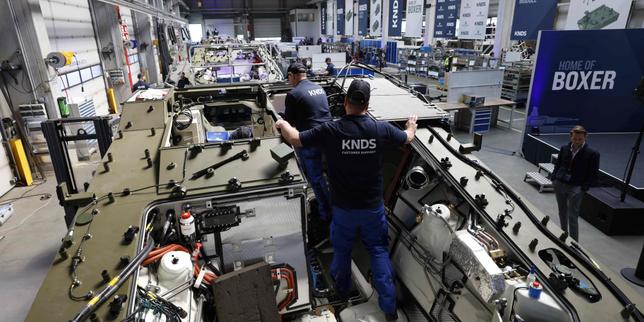
The impending initial public offering (IPO) of KNDS, targeting a market valuation between €12 billion and €15 billion, highlights a fundamental structural shifts in European defense equities. Superficially, the recent contraction in the share price of its primary listed peer, Rheinmetall AG—which dropped 13% in a single trading session and shed roughly 25% of its value year-to-date—appears to create a direct valuation drag for KNDS via comparable company analysis.
A deeper examination of the transactional architecture reveals that this market correction is not merely a macro-driven down-cycling. Instead, the compression of Rheinmetall’s valuation is the direct consequence of a state-intervener model that simultaneously eliminates Rheinmetall's long-term growth options while fundamentally altering the capital structure and strategic autonomy of KNDS.
The Dual-State Ownership Framework as a Valuation Anchor
The pricing of KNDS cannot be modeled purely through standard enterprise-value-to-EBITDA multiples due to the sovereign constraints embedded in its capital structure. The transaction structure finalized by Paris and Berlin establishes a rigid, symmetrical ownership framework:
- The German Sovereign Accumulation: Through the Kreditanstalt für Wiederaufbau (KfW), the German federal government is acquiring a 40% equity position directly from the private founding families (Wegmann, Bode, and Braunbehrens), who are exiting the capital structure entirely.
- The French Equilibrium: France reduces its current holding via Giat Industries from 50% to 40%, matching the German position.
- The Institutional Free Float: Only 20% of the aggregate capital will be floated publicly on Euronext Paris and the Frankfurt Stock Exchange.
This 40-40-20 capital distribution introduces distinct mechanical headwinds for public market valuation. The primary structural limitation is the restricted free float. A 20% public float significantly reduces trading liquidity, creating an institutional liquidity discount. Large-scale asset managers face execution friction when accumulating or liquidating positions, which historically compresses trading multiples relative to fully floated peers.
Furthermore, a 20% free float prevents KNDS from meeting the inclusion criteria of major benchmark equity indices. This exclusion eliminates programmatic, passive inflows from Exchange-Traded Funds (ETFs) and index-tracking institutional funds, isolating the stock from broader equity market momentum.
The second valuation constraint is the structural asymmetric governance risk. With France and Germany each commanding 40% of voting rights, strategic decision-making—particularly regarding manufacturing footprints, intellectual property allocation, and export approvals—will be governed by bilateral political consensus rather than capital efficiency. In defense economics, state-co-ownership acts as a margin ceiling; capital allocation decisions are frequently optimized for domestic employment and sovereign security posture rather than return on invested capital (ROIC).
The Rheinmetall Squeeze: Stripping the Growth Options
To understand why Rheinmetall’s equity value collapsed precisely as the KNDS IPO parameters solidified, one must map the cross-dependencies between the two entities. Rheinmetall’s premium valuation over the past 24 months was fundamentally predicated on two strategic growth options: the potential consolidation of KNDS under its own corporate umbrella, and its unilateral capture of the Main Ground Combat System (MGCS) program. The Franco-German state intervention has systematically dismantled both options.
The first blow is the structural lockout of corporate buyers. Rheinmetall had positioning strategies designed to acquire an equity stake in KNDS during any eventual public exit by the private German families. By utilizing KfW to absorb the 40% family stake at the IPO valuation without a control premium, Berlin explicitly blocked Rheinmetall from executing a consolidating M&A strategy. This intervention deprives Rheinmetall of the scale efficiencies and monopoly pricing power it would have achieved by unifying European heavy armored vehicle production.
The second catalyst for Rheinmetall’s equity repricing is the rebalancing of the MGCS program. The institutionalization of the 40-40 state structure at KNDS provides a sovereign backstop to the joint venture's land-systems architecture. This structural alignment reduces the probability that Rheinmetall can re-engineer the MGCS procurement contract to favor its proprietary platforms over the integrated KNDS solutions (such as the Leopard 2A8 and the EMBT platforms displayed at Eurosatory).
The operational impact of this state-led isolation was compounded by Berlin's cancellation of Rheinmetall’s multi-billion-euro F126 frigate program—previously projected as a cornerstone of Germany's naval modernization—in favor of ThyssenKrupp Marine Systems (TKMS). This contract shift underscores a broader regulatory transition. Germany’s Monopolies Commission has actively cautioned that domestic defense procurement has concentrated within too few industrial suppliers, creating a procurement bottleneck that inflates capital costs. The state-backed emergence of a publicly traded KNDS delivers the exact policy tool the commission sought: a direct, liquid benchmark to police Rheinmetall's order momentum and operating margins.
Fundamental Economics of Land Defense Platforms
Despite the market friction generated by its corporate governance model, KNDS possesses underlying operational mechanics that contrast sharply with Rheinmetall’s capital profile. Evaluating KNDS requires analyzing its core back-end financial metrics:
[2025 Revenue: €4.4 Billion (+16% YoY)]
               │
               ▼
[Order Backlog: €33.1 Billion] ──► [Book-to-Bill Ratio: 7.52x]
A book-to-bill ratio of this magnitude indicates exceptional long-term revenue visibility, effectively insulating the company’s manufacturing lines from short-term fiscal volatility. This backlog is underpinned by structural replacement cycles. European land forces are undergoing wholesale modernization to replace legacy fleets transferred to Ukraine. The production pipeline for heavy armored platforms operates on multi-year lead times due to specialized supply chain constraints (e.g., heavy ballistic steel casting and complex optical integration), creating a defensive moat around the order book.
However, the margin profile of a land-defense platform manufacturer behaves differently than that of a pure-play ammunition producer like Rheinmetall. Ammunition manufacturing features highly scalable, volume-driven operating leverage; asset utilization scales rapidly during a high-intensity munitions shortage, driving rapid margin expansion.
Conversely, heavy land platforms (tanks, tracked artillery, robotic combat vehicles) are capital-intensive, low-volume assemblies characterized by significant engineering overhead and strict compliance frameworks. KNDS's margins are bound to the execution efficiency of these complex platforms. If bilateral political friction between Paris and Berlin disrupts supply chain rationalization, operational margins will compress despite the nominal size of the backlog.
Strategic Asset Management Directive
For institutional capital evaluating the European defense sector, the public market debut of KNDS requires an immediate rotation strategy. The historical approach of treating Rheinmetall as a proxy for continental land defense spending is obsolete.
The optimal asset allocation play is to treat the KNDS listing as a structural margin cap on Rheinmetall. Investors should short or underweight Rheinmetall relative to its historical peaks, as its premium valuation multiples decouple from its structural growth options. Concurrently, capital should be deployed into KNDS upon listing only if the initial pricing reflects a deep discount—specifically targeting the lower bound of the €12 billion range. This entry point accounts for the 20% free-float liquidity penalty and the operational friction inherent in its dual-state governance model.
The final strategic reality is clear: KNDS represents a highly stable, sovereign-backed utility-style defense asset with absolute revenue visibility, while Rheinmetall has transitioned from an unconstrained consolidator into a politically contained component supplier.