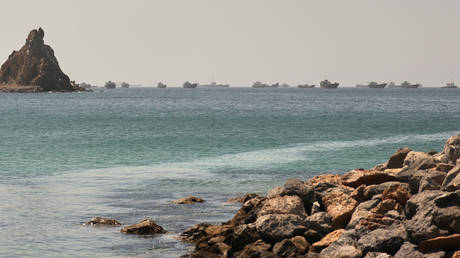
Geopolitical volatility in maritime energy corridors follows strict economic and logistical laws. When a commercial carrier is struck by an unidentified projectile near the Omani coastline in the Strait of Hormuz, the incident represents more than an isolated security failure. It exposes the structural fragility of global supply chains operating under military duress. The convergence of executive ultimatums regarding leadership neutralization, known in strategic doctrine as decapitation threats, and active kinetic disruptions in a chokepoint handling roughly one-fifth of global petroleum liquids creates an immediate pricing shock and forces a systemic reassessment of risk management for international shipping operators.
The Cost Function of Chokepoint Disruption
Global petroleum logistics depend entirely on the unobstructed flow through narrow maritime corridors. The Strait of Hormuz functions as a high-concentration choke point where physical geography forces millions of barrels of crude and refined products through a narrow navigable channel. When state-level conflict or asymmetric harassment interrupts this transit, the economic impact is governed by three primary variables:
- Alternative routing availability and the associated deadweight tonnage constraints.
- War-risk insurance premium spikes that alter cargo cost basis overnight.
- The velocity of military escorts and commercial vessel blockades managed by regional command structures.
When maritime monitoring agencies report unexplained projectile impacts on merchant vessels off the coast of Al Khasab, the reaction function of the insurance market shifts instantly. Underwriters reprice risk across the entire Persian Gulf basin. Shipowners face a binary choice: absorb prohibitive insurance surcharges or suspend transit. This dynamic directly explains why energy majors capture windfall margins while industrial consumers and logistics providers bear the underlying cost of supply constriction.
Strategic Mechanics of Executive Ultimatums
The deployment of high-stakes political rhetoric—specifically threats targeting the command structure of a sovereign adversary—serves a distinct function in statecraft. Rather than functioning merely as diplomatic signaling, these ultimatums attempt to compress the decision-making timeline of the opposing regime.
The mechanism operates through psychological and economic pressure loops:
- Phase One involves absolute demands for operational control, such as the immediate opening of contested waterways.
- Phase Two introduces the threat of severe kinetic escalation directed at leadership or critical infrastructure.
- Phase Three tests whether the adversary's domestic economic degradation outweighs their ideological resistance to terms.
The limitation of this strategy lies in its friction with local proxy actions. Even when central authorities signal a willingness to engage in diplomatic mediation or temporary transit arrangements through secondary channels, decentralized actors or tactical units can launch projectiles against commercial shipping. This disconnect shatters the coherence of high-level negotiations, forcing political leaders to repeatedly pivot between threatened escalation and sudden diplomatic resets.
Operational Realities for Commercial Fleets
Navigating a militarized maritime zone requires a quantitative assessment of exposure rather than reliance on political assurances. Commercial fleet operators must evaluate asset vulnerability based on hard operational metrics.
When military authorities institute naval blockades or redirection protocols—such as the repositioning of dozens of commercial vessels under central command supervision—schedule integrity collapses. The transit time between production hubs and destination refineries increases exponentially when vessels are forced to hug territorial waters or seek shelter in neutral ports like those of Oman.
The economic fallout cascades downstream. Refineries dependent on consistent crude feeds must draw down strategic inventories or bid aggressively for spot cargoes routed away from the Persian Gulf. This creates localized supply deficits that persist long after a specific maritime incident is resolved.
Deploy tactical asset protection by shifting long-term charter contracts toward vessels equipped with enhanced electronic counter-measures and pre-cleared military escort registry, while establishing dynamic routing algorithms that bypass high-risk zones entirely when sovereign friction metrics cross predefined thresholds.
Iran attacks oil tankers passing through Strait of Hormuz
This video provides visual context on the geopolitical tensions and maritime operations within the Strait of Hormuz.

.png?itok=1mb05mKJ)

