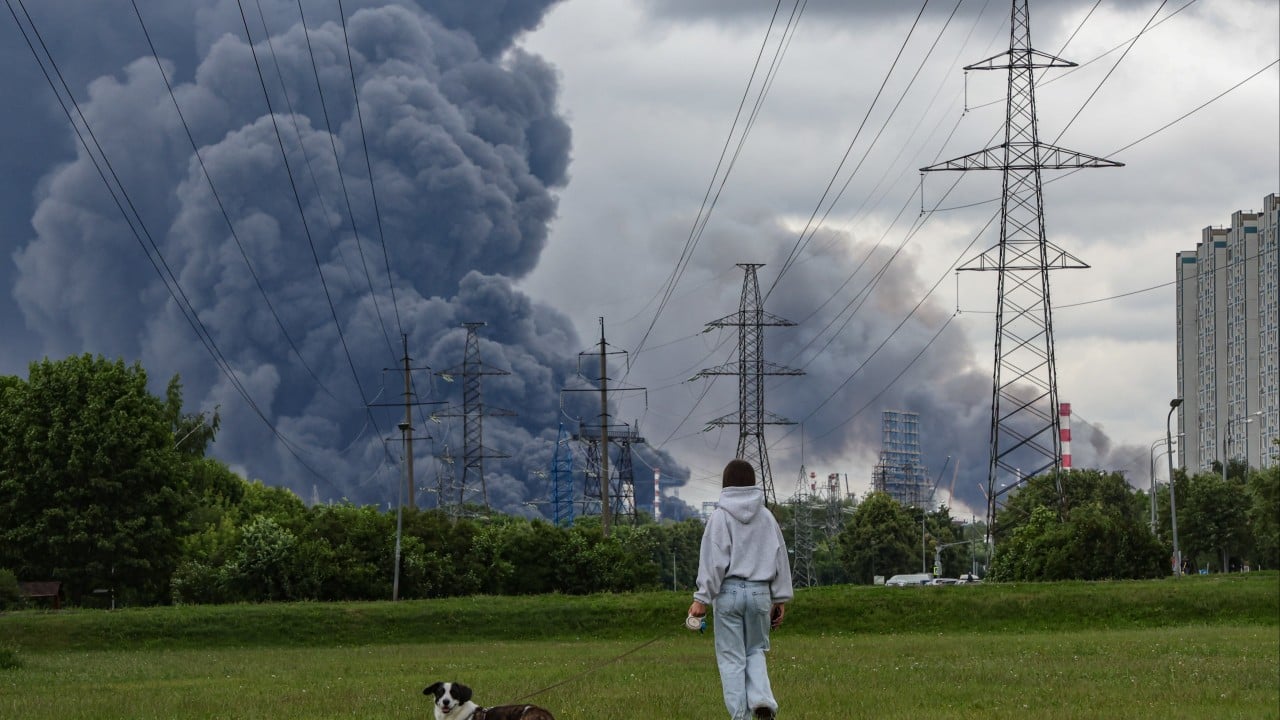
The deployment of 660 unmanned aerial vehicles (UAVs) in a single nighttime operation across 12 Russian regions and the occupied Crimean peninsula marks a structural shift in asymmetric attrition. While conventional state-media reporting frames these events through raw casualty counts and localized property damage, a rigorous systemic analysis reveals a calculated military strategy: the execution of a high-volume, multi-axis saturation campaign designed to exploit the physical and economic boundaries of modern air defense networks.
By analyzing the mechanics of the June 2026 strike—which eclipsed the previous record of 556 drones set on May 17—we can isolate the tactical variables driving this escalation. Ukraine's strategy does not rely on a single qualitative breakthrough. Instead, it leverages a quantitative cost asymmetry to force a structural degradation of Russian military logistics, energy refining capacity, and domestic air defense allocation.
The Mechanized Saturation Model: Overwhelming the Intercept Funnel
To understand why 660 drones were launched simultaneously, one must examine the operational limits of ground-based air defense (GBAD) systems. Every air defense architecture, including Russia’s S-400 and Pantsir-S1 batteries, operates under strict mathematical constraints dictated by three primary variables:
- Target Tracking Capacity: The maximum number of discrete radar tracks a single fire-control system can evaluate and engage concurrently.
- Cycle Time: The velocity of the look-shoot-look cycle, encompassing target acquisition, missile flight time, impact evaluation, and re-engagement.
- Magazine Depth: The physical inventory of ready-to-fire interceptor missiles loaded on launchers within a specific sector.
When a strike volume exceeds the local target tracking capacity or the absolute magazine depth of a defensive sector, the defensive perimeter suffers a state of saturation failure. Ukraine's deployment of 47 drones on a direct vector toward Moscow, alongside highly concentrated swarms directed at Crimea and industrial nodes like the Tula region, forces Russian command to make a zero-sum calculation regarding interceptor distribution.
The primary objective of these mass launches is not for every asset to reach its target. The initial waves function as kinematic decoys designed to exhaust the ready-to-fire missile inventories of localized Pantsir and Tor systems. Once a battery depletes its primary magazine, it faces a reloading bottleneck that can last from 20 to 45 minutes depending on the platform and crew proficiency. During this reload window, subsequent waves of the drone swarm achieve unhindered ingress to high-value infrastructure.
The Tula and Novomoskovsk Industrial Node: Target Selection Logic
The geographic distribution of the June strikes highlights an intentional shift toward targeting deep industrial supply chains. The Tula region, situated approximately 180 kilometers south of Moscow, contains highly sensitive chemical and energy production assets.
Initial operational data confirms impacts at an industrial facility in Novomoskovsk, widely identified as the Azot chemical plant, alongside a thermal power plant. The tactical logic of striking these specific facilities rests on two economic vulnerabilities:
Chemical Chain Disruptions
The Azot plant is an critical producer of nitrogen-based compounds and industrial chemicals. In a prolonged war of attrition, chemical manufacturing plants are high-leverage targets because their infrastructure relies on complex, continuous-flow chemical reactors and pressurized storage tanks. Shrapnel damage to a fractional distillation column or an ammonia synthesis converter cannot be bypassed or easily repaired. It forces a complete operational shutdown of the production line, creating a cascading supply shortage for downstream military and industrial manufacturing.
Thermal Energy Asymmetry
The fire at the Novomoskovsk thermal power plant, verified by thermal anomalies on NASA satellite imagery, directly impacts localized electrical grid stability. Striking generation infrastructure during seasonal peaks forces the diversion of emergency power, creates localized grid instability, and disrupts industrial machinery that relies on consistent voltage inputs. This forces Russia to decentralize its industrial operations or divert highly constrained tactical air defenses from active front-line sectors to secure domestic industrial zones.
The Crimean Maritime Bottleneck: Interdicting the Kerch Logistics Hub
Simultaneously with the deep-strike operations inside the Russian mainland, the campaign executed a high-density assault against the maritime supply architecture of the Kerch Strait and western Crimea. The Ukrainian Security Service (SBU) targeted naval reconnaissance assets, mine-laying vessels (specifically the Volga and the Vyatka), and the cargo-passenger ferry Petropavlovsk.
This maritime target selection is driven by the physical vulnerabilities of the southern theater's logistics lines. The military supply chain supporting Russian forces in southern Ukraine depends on a dual-redundant transit network: the Kerch Strait Bridge and the auxiliary ferry crossings.
Because the Kerch Bridge remains highly vulnerable to long-range missile strikes, the ferry network serves as a critical operational hedge for transporting heavy armor, ammunition, and hazardous fuel supplies that cannot safely transit the bridge structure. By targeting the Petropavlovsk ferry and the regional port infrastructure, the strike directly degrades the daily tonnage capacity of the Kerch logistics hub.
The strategic impact is compounded by the targeting of naval assets like the Volga and Vyatka. These vessels provide localized maritime domain awareness and defensive mine-laying capabilities designed to protect the Black Sea Fleet's remaining infrastructure from Ukrainian uncrewed surface vessels (USVs). Disabling these ships creates defensive gaps, widening the operational corridors available for future maritime drone operations.
The Cost Function Asymmetry: Financial and Material Depletion
The foundational metric governing long-range drone warfare is the exchange ratio of the cost of attack versus the cost of defense. This relationship can be expressed through a simple cost function:
$$\text{Efficiency Ratio} = \frac{\text{Unit Cost of Interceptor Missile} + \text{Opportunity Cost of Collateral Damage}}{\text{Unit Cost of Long-Range Attack UAV}}$$
Ukrainian long-range strike UAVs, such as the Lyutyi or Bober platforms, rely on off-the-shelf internal combustion engines, composite fiberglass hulls, and commercial-grade satellite navigation guidance packages. The estimated manufacturing cost ranges between $20,000 and $50,000 per unit.
Conversely, the kinetic interceptors required to down these assets are exponentially more capital-intensive:
- Pantsir-S1 (9M335/57E6 series missiles): Estimated at $100,000 to $150,000 per interceptor.
- Tor-M2 (9M338 series missiles): Estimated at $300,000 to $400,000 per interceptor.
- S-400 (48N6DM series missiles): Exceeds $1,000,000 per interceptor.
When Russia successfully intercepts 90% of a 660-drone wave, the financial calculation remains deeply unfavorable to the defense. Expending hundreds of tactical interceptors to destroy a low-cost drone swarm draws down finite, high-tech manufacturing inventories that rely on specialized electronic components.
The secondary effect of this asymmetry is the depletion of absolute interceptor stockpiles. Russia's defense industry faces a physical manufacturing ceiling for solid-fuel rocket motors and guidance systems. By forcing a high-frequency consumption rate of these missiles against cheap aerodynamic targets, the attrition strategy creates long-term structural vulnerabilities across the entire Russian air defense framework.
Strategic Outlook and Defensive Limitations
The escalation of drone mass from dozens to hundreds of units per operation indicates that Ukraine's domestic manufacturing base has achieved a continuous, high-rate production capacity. This development occurs alongside the announcement of an intensive 40-day influence operation intended to compel an end to the conflict by systematically targeting Russia's economic core.
The primary limitation of this strategic air campaign is its inability to achieve rapid, decisive battlefield results on its own. While drone strikes can choke regional fuel distribution—as evidenced by the temporary suspension of public fuel sales across Crimea following the targeting of the Kerch oil terminal—Russia's vast geographic depth and decentralized refining infrastructure allow it to absorb significant economic shocks.
However, the operational data demonstrates that the standard Russian doctrine of reliance on static, heavy air defense networks is facing a crisis of scale. To counter saturation tactics effectively, the defense must shift toward low-cost kinetic alternatives, such as electronic warfare jamming arrays, directed-energy weapons, or gun-based systems like the ZU-23-2 integrated with automated optical tracking. Until these low-cost countermeasures are deployed at scale across all 12 targeted regions, Ukraine's mass-saturation model will continue to inflict structural damage on Russian industrial outputs and military supply lines.