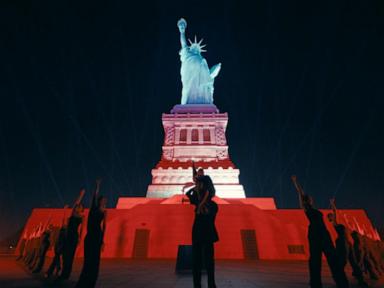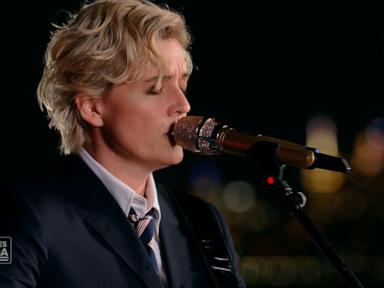
Cultural properties function as economic and political instruments when integrated into mass media broadcasts. When The Walt Disney Company deployed 11-time Grammy winner Brandi Carlile to perform "America the Beautiful" at the Statue of Liberty for its "Disney Celebrates America" broadcast, the event operated on a dual-axis framework. On the vertical axis, the performance served as a high-value content asset designed to anchors multi-platform distribution across ABC, Disney+, Hulu, FX, and ESPN. On the horizontal axis, it executed a precise rhetorical shift, substituting traditional, triumphalist nationalism with a calculated model of self-critical patriotism.
To understand why this performance succeeded as an optimization strategy for both the corporate broadcaster and the artist, one must analyze the structural mechanisms of the broadcast, the lyrical history of the chosen composition, and the deliberate sonic engineering utilized by the performance team.
The Dual-Axe Framework of Corporate National Events
The deployment of a major musical asset during a milestone broadcast, such as the lead-up to the American Semiquincentennial, relies on two distinct strategic vectors:
- The Corporate Distribution Vector: Broadcast networks face intense competition for linear and streaming audience retention during holiday programming blocks. By anchoring a 24-hour multi-platform event with high-prestige, localized artistic performances (e.g., inside and around the Statue of Liberty), a conglomerate maximizes cross-platform viewership metrics, driving active subscription counts for its streaming arms while securing premium ad-revenue margins for its linear properties.
- The Cultural Recalibration Vector: Standard patriotic properties frequently alienate modern, fragmented demographics due to histories of overt nationalism. To mitigate consumer friction, media entities increasingly select artists from historically marginalized communities. The inclusion of Carlile, an openly queer folk-rock artist, acts as a structural pivot. This selection broadens the consumer acquisition funnel by signaling inclusivity without alienating legacy audiences who demand traditional iconography.
The Structural Subversion of "America the Beautiful"
The choice of "America the Beautiful" over "The Star-Spangled Banner" reflects a calculated optimization of lyrical utility. National anthems generally rely on binary conflict narratives (e.g., surviving a bombardment, defeating an adversary). This creates a bottleneck for artists seeking to project nuanced or inclusive themes.
In contrast, "America the Beautiful" functions under an aspirational architecture. Written by Katharine Lee Bates in 1893, the text operates not as an endorsement of the historical status quo, but as a plea for systemic improvement, explicitly evidenced by the lyric: "America! America! God mend thine every flaw."
For an artist operating with a distinct moral imperative, this text provides a viable mechanism to engage with national imagery while maintaining ideological integrity. The song selection alters the emotional delivery from a boast to a collective petition. This shift allows the performance to bypass the political polarization that typically degrades the value of large-scale public broadcasts.
Sonic Engineering and Minimization of Accompanying Assets
The performance layout rejected the maximalist production models typical of stadium events, utilizing a minimalist asset allocation consisting exclusively of Carlile on acoustic guitar and the string duo SistaStrings. This production choice addresses specific technical and narrative requirements:
- Melodic vs. Rhythmic Domination: Stripping away a traditional percussion section shifts the acoustic focus from a rhythmic, march-like cadence to a fluid, melodically driven arrangement. This rhythmic deceleration creates space for vocal elongation, emphasizing text comprehension over physical momentum.
- Harmonic Tension and Resolution: SistaStrings provides a classical, non-synthesized harmonic floor. By substituting a full orchestra with a lean string duo, the arrangement generates deliberate sonic sparseness. The resulting gaps in the audio spectrum force the listener to focus entirely on the micro-tonal variations in Carlile's vocal delivery, magnifying the emotional resonance of the performance.
The operational limitation of this approach is its vulnerability to environmental audio interference and internal performance errors. In a highly stripped-back arrangement, vocal fluctuations, acoustic environment reflections, or slight tonal irregularities cannot be masked by studio production tricks or heavy instrumentation. The artist accepts a higher execution risk in exchange for raw authenticity metrics, which modern consumers index as high-value content.
The Strategic Alignment of Artist and Icon
The spatial placement of the performance at Liberty Island provides a final layer of symbolic reinforcement. Monuments like the Statue of Liberty are physical manifestations of historical policy and ideology. When an artist pairs an aspirational anthem with a symbol historically tied to immigration and international alliance, the performance recontextualizes the space.
This creates a self-reinforcing loop: the monument lends historical gravitas to the broadcast, while the performance modernizes the monument’s cultural relevance for a contemporary audience. The ultimate outcome is a highly sophisticated media product that converts raw patriotism into a nuanced, multi-layered consumer experience capable of commanding attention across a fragmented media environment.
Media networks attempting to duplicate this engagement model must abandon superficial, celebrity-driven casting in favor of systemic alignment. True audience retention during major civic milestones is achieved by matching an artist's personal narrative authenticity with an acoustic and lyrical framework that allows for structural self-critique. Future programming strategies must treat cultural assets not merely as filler entertainment, but as complex rhetorical devices capable of navigating deeply divided market demographics.