The survival of a sovereign state rests on its ability to maintain currency stability, physical security, and population metabolism. When the third pillar fails, the state enters a specialized phase of systemic degradation where mortality is driven not by clinical complexity, but by basic logistical failure. In South Sudan, the world’s youngest recognized country, the total evaporation of essential medicine presents an existential threat to governance.
While popular commentary characterizes this as a tragic consequence of regional instability, a rigorous structural evaluation reveals a predictable failure of macro-economic structures, donor dependencies, and distribution networks. This is not a passive tragedy; it is the logical consequence of a broken operational design.
The Tri-Partite Failure Framework
To understand why a country entirely runs out of frontline pharmaceuticals, the crisis must be separated into three distinct, compounding structural bottlenecks.
[Donor Financing Cliff] ──> [Capital Flight / Zero Reserve] ──> [Total Inventory Depletion]
                                      │
                       [Logistical Friction Point]
                                      │
                       ▼ [Black Market Arbitrage]
1. The Sovereign Capital Deficit and Donor Cliff
South Sudan’s domestic healthcare infrastructure does not possess a sovereign fiscal foundation. Historically, over 80 percent of all primary healthcare services and medical procurement within the state have been funded externally by international non-governmental organizations and multi-donor frameworks. This structure insulates the domestic government from developing national procurement capabilities and creates an extreme vulnerability to international policy shifts.
When major donor initiatives scale down operations, the state has no financial mechanism to absorb the shock. For instance, multi-donor programs like the Health Sector Transformation Project planned to subsidize 1,158 health facilities nationwide. Due to international funding reallocations and capital shortfalls, that target dropped to 816 facilities. This reduction caused 342 primary points of care to lose their entire procurement budget simultaneously.
Because the national treasury holds near-zero foreign exchange reserves and is choked by domestic hyperinflation, the state cannot step in as a buyer of last resort on the international pharmaceutical market. The sovereign purchasing power for essential drugs is effectively zero.
2. The Total Logistical Cost Function
In functional economies, the cost of a drug is determined by manufacturing and research margins. In an undeveloped territory, the price of delivery is governed by a punishing logistical cost function. The final physical delivery of a therapeutic asset to a clinic depends on three variables:
- Infrastructure Deficit: The nation possesses fewer than 200 miles of paved roads. During the protracted rainy season, unpaved supply arteries turn into impassable terrain, extending delivery timelines from days to months.
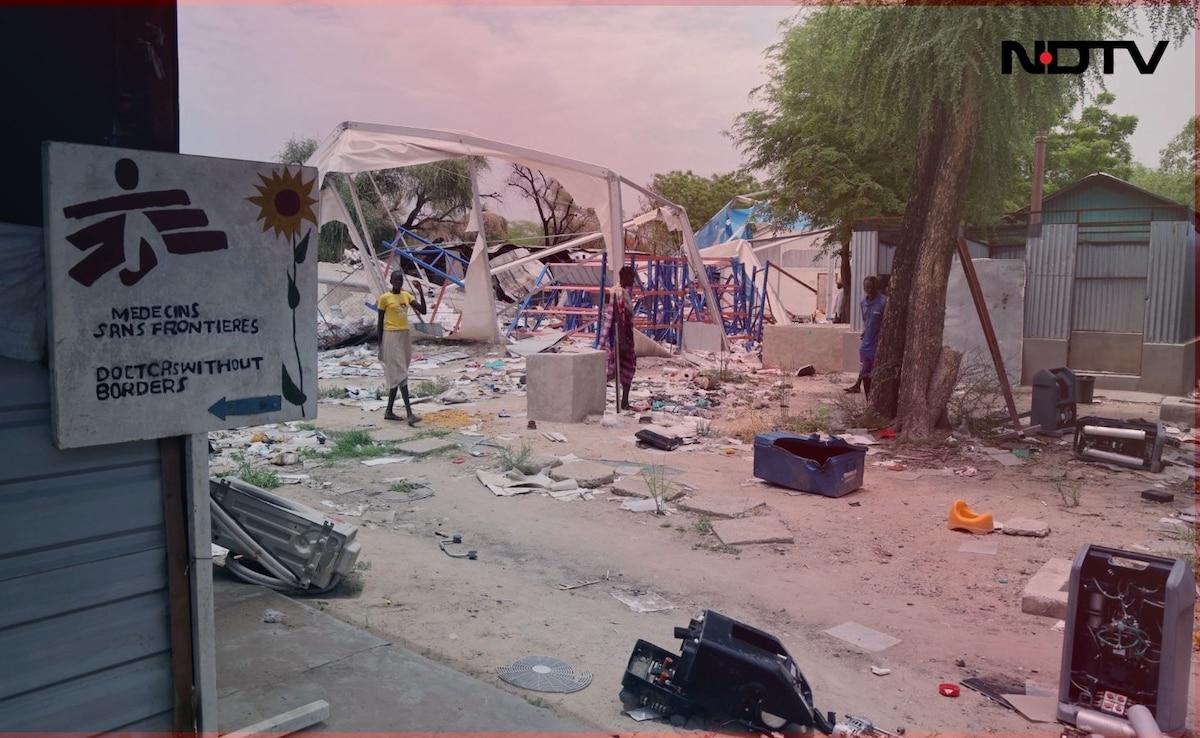
- Security Risk Premiums: Moving high-value cargo through contested regions requires active security detail or exposes the inventory to systemic looting. When clinics in conflict zones like Akobo County are entirely stripped or destroyed, the physical infrastructure of the supply chain is erased.
- Storage Degradation: Cold-chain integrity is non-existent outside major administrative hubs. Life-saving biologicals, vaccines, and liquid antibiotics degrade rapidly under high ambient temperatures, introducing an extreme spoilage rate into the volume equations of the supply chain.
The accumulation of these factors means that shipping an item from a central hub to a remote provincial outpost costs orders of magnitude more than the item's baseline manufacturing value. When transport costs exceed the marginal utility of the cargo, the formal supply chain collapses.
3. Black Market Extraction and Arbitrage
When legitimate procurement systems fail, market forces do not disappear; they migrate to informal networks. Pharmaceuticals imported via the remaining donor channels are systematically diverted.
Because local healthcare personnel face chronic salary delays, institutional inventory becomes an alternative currency. Stock is siphoned from public hospital storerooms and redirected into private clinics or black-market stalls in urban centers. This structural leaking ensures that whatever sparse inventory survives the logistical pipeline is extracted before it reaches vulnerable populations.
The Co-Morbidity Multiplier Effect
The complete absence of basic medication does not merely cause direct mortality from untreated diseases; it triggers a domino effect across the wider population. The clinical reality of South Sudan illustrates how a lack of simple pharmaceutical inputs causes larger structural collapses.
The Interdependence of Malnutrition and Pathology
Severe acute malnutrition cannot be solved by caloric intake alone. When a child experiences advanced wasting, their metabolic system suffers from severe immunodeficiency. In this state, common pathogens like malaria, dengue, measles, and rotavirus become highly lethal.
Therapeutic feeding programs rely entirely on a stable supply of antibiotics and antiparasitics to clear underlying infections so the body can synthesize nutrients. Without these foundational inputs, Ready-to-Use Therapeutic Food (RUTF) fails to achieve clinical efficacy. The lack of medicine turns a manageable malnutrition challenge into an untreatable metabolic crisis.
The Dynamics of Forced Displacement
When a regional primary health center runs out of medicine, it loses its operational purpose. The local population recognizes that staying in the region during an outbreak is a death sentence, triggering mass internal displacement.
Regional Stockout ──> Local Access Collapses ──> Mass Population Flight ──> Hub Contamination
Thousands of families travel immense distances toward central administrative hubs or cross-border refugee camps. This migration creates a secondary crisis. The sudden influx of thousands of displaced individuals strips the remaining stock from urban facilities, accelerating the collapse of the destination hub while spreading communicable diseases along the transit corridors.
The Limits of Existing Interventions
Current international strategies focus primarily on emergency project deployments. Organizations like Doctors Without Borders open short-term emergency projects to manage sudden spikes in cholera or malaria. While these actions save lives immediately, they do not resolve the underlying systemic failure.
The core limitation of emergency interventions is their transient nature. They act as localized patches on a system experiencing general grid failure. When an emergency project team leaves an area due to security threats or budget constraints, the local population is left with no residual infrastructure, no trained domestic personnel, and no sustainable supply lines. Emergency relief addresses the symptoms of a broken state apparatus but cannot replace the functions of a sovereign government.
Strategic Playbook for Supply Chain Stabilization
Resolving a systemic pharmaceutical collapse in an environment without infrastructure requires shifting away from traditional aid models. The following framework outlines the necessary tactical pivots required to build a resilient distribution model.
Decentralized Micro-Hub Architecture
Relying on a single centralized warehouse in an urban center creates a single point of failure that is vulnerable to institutional looting and transport blockages. Procurement must transition to a decentralized network of hardened micro-hubs located near regional borders. These micro-hubs must feature independent solar-powered cold storage units and be supplied via multi-modal transport strategies, including scheduled air-drops during the rainy season. This architecture limits the impact of a single regional disruption to a localized sector rather than cutting off the entire country.
Transition to Pre-Packaged Point-of-Care Kits
The traditional open-ordering system—where remote clinics request specific quantities of individual drugs—invites bureaucratic delay and inventory diversion. The system should switch exclusively to standardized, tamper-evident, pre-packaged clinical kits designed to treat fixed numbers of patients for specific endemic profiles.
These kits must be tracked using low-bandwidth ledger technology at the point of origin and verified via mobile networks at the final destination. Standardizing the units of distribution simplifies tracking, reduces transit times, and significantly lowers the opportunity for black-market diversion.
Formalized Training for Community Health Networks
Given the extreme shortage of certified medical doctors, clinical operations must be formally shifted to community health workers using structured diagnostic algorithms. These workers must be legally permitted and trained to dispense a limited formulary of frontline medications (such as antimalarials, oral rehydration salts, and broad-spectrum antibiotics). By expanding the clinical workforce to include trusted community members, the system can maintain delivery capabilities even when international personnel are forced to evacuate.