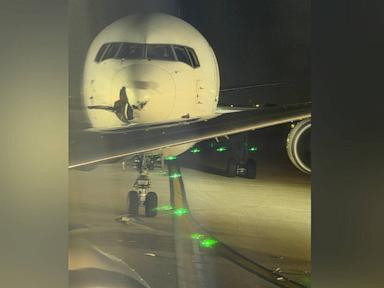
Ground collisions between commercial aircraft at major hubs rarely result from a single catastrophic failure. When a United Parcel Service (UPS) cargo aircraft and a Copa Airlines passenger jet make contact on a taxiway at Miami International Airport (MIA), the incident represents a predictable convergence of spatial compression, human visual limitations, and peak-hour ramp congestion. Rather than treating a wingtip strike as an isolated freak accident, aviation safety analysts categorize these events as systemic friction points where physical airport infrastructure meets maximum operational throughput.
The Operational Mechanics of Ground Incursions and Wingtip Strikes
To understand how two multi-million-dollar aircraft collide at speeds rarely exceeding fifteen knots, one must examine the geometry of modern airfield design. Airports like Miami International Airport operate under extreme space constraints, bounded by urban development and major highway arteries. As airlines deploy aircraft with wider wingspans to maximize fuel efficiency and payload capacity, the physical margin for error on legacy taxiways shrinks. Recently making headlines recently: The Soil Beneath South Carolina.
The mechanics of a taxiway collision rely on three primary operational variables:
- Cockpit Blind Spots and Wingtip Geometry: Flight crews sit dozens of feet forward and significantly higher than the aircraft's main landing gear and wingtips. On wide-body cargo jets—such as the Boeing 767 or Airbus A300 commonly operated by UPS at its Miami Latin American hub—the pilots cannot visually verify wingtip clearance from the flight deck. They rely entirely on painted yellow taxiway centerlines, airport signage, and ground control instructions. If an aircraft deviates even slightly from the centerline, or if an adjacent aircraft stops short of a designated hold-short line, the swept-back wing structure extends into the adjacent taxi lane.
- Mixed-Fleet Aerodynamics and Dimensions: Miami International Airport is unique in its heavy mix of international passenger carriers and massive cargo operations. Copa Airlines primarily operates narrow-body Boeing 737 variants (including the 737-800 and 737 MAX 9) to connect Miami with its Panama City hub. When a narrow-body passenger jet occupies a taxiway parallel or adjacent to a wide-body freighter, the disparity in fuselage height and wingspan creates complex spatial judgments for both pilots and Air Traffic Control (ATC) ground controllers.
- The "Hold-Short" and Intersection Bottleneck: Taxiway collisions overwhelmingly occur at intersections or apron entry points rather than straightaways. During pushback from gates or transitions from cargo ramps to active taxiways, aircraft must execute wide-radius turns. During a turn, the outer wingtip swings through an arc significantly wider than the path tracked by the nose wheel—a phenomenon known in ground operations as wingtip sweep.
Deconstructing the Miami International Airport Infrastructure Constraint
Miami International Airport serves as the primary cargo gateway between the United States and Latin America, handling millions of tons of freight annually alongside tens of millions of international passengers. This dual mandate forces distinct operational cultures to share finite asphalt. More insights into this topic are detailed by Associated Press.
Cargo operators like UPS run tightly synchronized "waves" of departures and arrivals, often clustered during late-night, early-morning, or mid-day sorting windows. Passenger carriers like Copa Airlines operate on hub-and-spoke bank schedules, pushing multiple flights out within narrow forty-five-minute windows to preserve connection integrity in Panama City. When a cargo wave overlaps with an international passenger departure bank, MIA's taxiway network reaches saturation.
Ground controllers manage this saturation by queuing aircraft nose-to-tail along parallel taxiways. In these high-density queues, ATC frequently issues conditional clearances—instructing one aircraft to pass behind another or hold at a specific intersecting taxiway. The system assumes strict adherence to Aircraft Design Group (ADG) separations established by the Federal Aviation Administration (FAA).
ADG standards classify aircraft by wingspan and tail height, dictating the minimum distance required between taxiway centerlines and fixed or movable objects. However, when congestion forces controllers to route aircraft through secondary taxiways or when flight crews misinterpret complex intersection markings, those engineered buffers vanish.
Known Facts Versus Investigative Hypotheses
In the immediate aftermath of a ground collision at a major commercial hub, aviation authorities separate verified physical evidence from causal theories. A rigorous assessment requires distinguishing between what is confirmed on the tarmac and what investigators from the FAA and the National Transportation Safety Board (NTSB) must reconstruct.
Established Operational Facts:
- Zero-Fatality Kinetic Profile: Taxiway collisions occur at low ground speeds. The primary energy transfer involves structural shearing of composite wingtips, winglets, or horizontal stabilizers rather than catastrophic fuselage rupture. Passengers and crew face minimal physical risk during the impact itself, though emergency evacuation procedures can introduce secondary injury risks if slides are deployed unnecessarily.
- Immediate Grounding and Inspection Protocols: Following any physical contact between two airframes, aviation regulations mandate an immediate halt to movement. Both the UPS freighter and the Copa Airlines jet are instantly removed from service. Even minor surface scrapes on a modern composite winglet require non-destructive testing (NDT), such as ultrasonic scanning, to ensure delamination has not compromised the internal spar structure.
- Regulatory Reporting Triggers: Any collision between two aircraft operating on an active movement area automatically triggers an FAA investigation and requires formal incident reporting, preserved cockpit voice recorder (CVR) data, and ground radar telemetry extraction.
Primary Investigative Hypotheses:
- Line-of-Sight Misjudgment During Taxi: Investigators evaluate whether one aircraft failed to hold completely clear of an intersecting taxiway, leaving its tail or wingtip protruding into the active lane used by the passing jet.
- ATC Conditional Clearance Ambiguity: Ground controllers at busy hubs use rapid-fire phraseology. An investigation examines whether a clearance to "give way" or "hold short" was misheard, read back incorrectly, or executed at the wrong painted intersection due to visual clutter from airfield lighting and signage.
- Ramp-to-Taxiway Transition Error: Because UPS operates out of dedicated cargo facilities on the perimeter of MIA, the transition from non-movement ramp areas (controlled by ramp towers or ground marshallers) to FAA-controlled movement areas represents a critical handoff point where situational awareness can degrade.
The Hidden Economic Cost Function of a Ground Collision
Surface-level news coverage focuses on flight delays and visible damage to winglets. For airline executives and logistics directors, a taxiway collision triggers a cascading financial loss that far exceeds the physical repair bill.
The true cost function breaks down across four distinct operational tiers:
- Direct Structural Repair and Recertification: Replacing a damaged winglet or repairing a leading-edge slat on a Boeing 737 or 767 costs hundreds of thousands of dollars in parts and specialized composite labor. Because structural repairs require FAA airworthiness sign-offs, the airframe remains dead weight on the tarmac for days or weeks.
- Aircraft-on-Ground (AOG) Opportunity Cost: Commercial aircraft only generate revenue while airborne. Removing a Copa Airlines jet from service at an outstation like Miami disrupts multiple downstream rotations through Panama City, forcing the carrier to cancel flights, rebook hundreds of connecting passengers, and absorb hotel and meal vouchers under international passenger rights frameworks.
- Supply Chain SLA Penalties: For UPS, an immobilized freighter threatens time-definite delivery guarantees. High-value perishables, pharmaceuticals, and industrial components moving through Miami's cold-chain and express networks miss sorting connections. UPS must either charter costly ad-hoc lift or absorb contract penalties from enterprise shippers.
- Insurance Deductibles and Fleet Utilization Drag: Hull insurance policies for commercial fleets carry substantial deductibles, often exceeding $500,000 to $1 million per incident. Airlines also absorb internal productivity losses as safety departments divert engineering and flight operations personnel to conduct internal root-cause audits.
Systemic Limitations of Current Surface Surveillance
The aviation industry relies heavily on technology to prevent runway incursions—collisions involving aircraft taking off or landing—but taxiway wingtip monitoring remains comparatively analog.
Major hubs like MIA utilize Airport Surface Detection Equipment, Model X (ASDE-X), a surface surveillance system combining surface movement radar, multilateration sensors, and ADS-B data. ASDE-X tracks aircraft positions on the airfield and alerts controllers to potential runway collisions. However, the system tracks the transponder return—typically located near the forward fuselage—rather than the exact physical perimeter of the aircraft's wingspan.
ASDE-X provides ground controllers with situational awareness, yet it cannot measure a two-foot wingtip overlap between two wide-body or narrow-body jets maneuvering on adjacent taxiways. Without automated wingtip proximity sensors—technology currently rare in commercial aviation due to weight, certification cost, and false-alarm rates in dense ramp environments—the system defaults entirely to human visual estimation and painted concrete lines.
Furthermore, painted airfield markings degrade under the intense ultraviolet exposure, heavy tropical rainfall, and rubber accumulation characteristic of South Florida's climate. During dusk, heavy rain, or nighttime operations, glare from wet asphalt reflects taxiway edge lights, obscuring the painted hold-short bars that define safe wingtip clearance zones.
Strategic Mitigation for High-Density Hub Operations
Preventing taxiway collisions at space-constrained gateways like Miami International Airport requires structural operational adjustments rather than simple reminders for pilots to "be careful."
Airport authorities and carriers operating in mixed passenger-cargo environments must enforce three specific controls:
- Dynamic Wingspan Restriction Routing: Air traffic control facilities at dual-use hubs should implement automated flight-strip alerts that flag incompatible wingspan pairings on parallel taxiways. When wide-body cargo waves are active, adjacent narrow-body taxi lanes should default to single-direction flow rather than two-way passing zones.
- Mandatory Wing-Walker Escorts at Movement Boundaries: The transition zone where cargo ramps meet active FAA taxiways requires physical human verification. Deploying trained marshallers with illuminated wands to visually clear wingtips across high-friction intersections eliminates cockpit blind-spot guesswork during peak congestion banks.
- High-Contrast Thermoplastic Markings and Embedded Stop-Bars: Airport infrastructure teams must replace standard painted hold-short lines at complex intersections with recessed, switchable red LED stop-bar lights interlocked with ground radar. Pilots instinctively halt at illuminated red pavement lights far more reliably than painted lines obscured by tropical rain glare.
Until automated wingtip collision-avoidance radar becomes standard equipment on commercial airframes, ground safety at saturated hubs depends entirely on enforcing rigid spatial buffers and eliminating two-way traffic bottlenecks where wide-body freighters and narrow-body passenger fleets intersect.