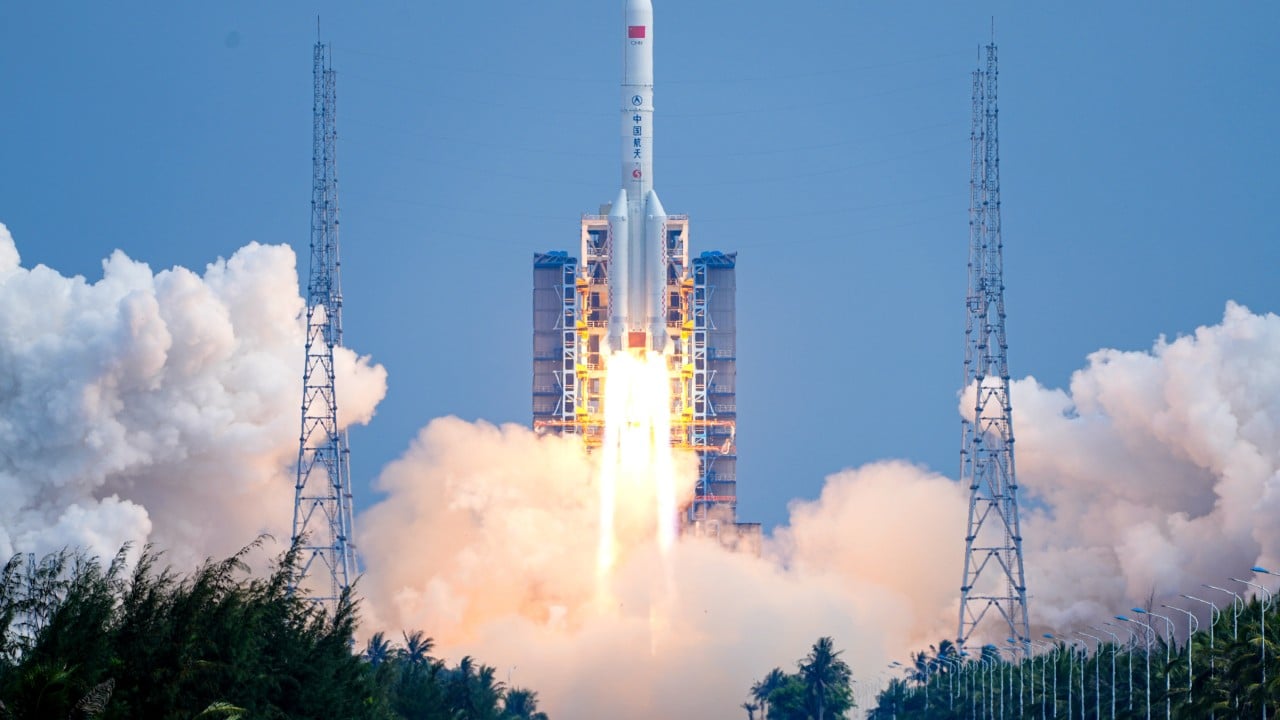
The deployment of China’s Communication Technology Demonstrator 25 satellite via a Long March 5 heavy-lift launch vehicle from the Wenchang Space Launch Site establishes a structural shift in the state's orbital communication strategy. While mainstream reporting frames this event as a routine incremental test of "high-speed communication technology," a rigorous analytical decomposition of the vehicle capacity, the physical mechanisms of multi-band validation, and the systemic architectural requirements of the space-ground interface reveals a broader operational blueprint. The integration of high-throughput satcom infrastructure serves as the fundamental catalyst for dual-use command network continuity and sovereign orbital spectrum dominance.
Understanding this trajectory requires moving past speculative policy commentary and focusing strictly on the technical bottlenecks of space-based telecommunications.
Orbital Economics and Payload Scaling Laws
The selection of the Long March 5 carrier rocket provides the first definitive quantitative indicator of the satellite’s structural scale and mission profile. Unlike low-Earth orbit (LEO) megaconstellation components—such as the China Mobile 02 or Guowang test units, which are optimized for mass production and deployed via medium-capacity liquid or solid fuel boosters—Communication Technology Demonstrator 25 demands a high-energy injection vector.
The payload capacity profile of the launch vehicle dictates the boundary constraints of the satellite bus:
- Geosynchronous Transfer Orbit (GTO) Threshold: Up to 14 metric tons.
- Low-Earth Orbit (LEO) Maximum Insertion: Up to 25 metric tons.
- Mass-to-Orbit Correlation: The utilization of an 877-ton liftoff-weight vehicle for an experimental communication payload demonstrates a significant mass envelope, characteristic of large-scale, high-power geostationary (GEO) or high-inclination platforms.
This scale is structurally necessary due to the physics of high-throughput satellite (HTS) links. To test multi-band, high-speed communication systems simultaneously, a satellite platform requires an unprecedented power budget to feed its traveling wave tube amplifiers (TWTAs) and solid-state power amplifiers (SSPAs). Solar array deployment size, thermal dissipation systems, and structural mass scale linearly with the transmission throughput. By deploying a high-mass platform into a high-energy orbit, the China Academy of Space Technology (CAST) is validating heavy-tonnage communication architectures capable of sustaining multi-gigabit backhaul links.
The Physics of Multi-Band Spectroscopic Validation
The stated objective of testing "multi-band and high-speed communication" addresses a core constraints problem in modern electromagnetic spectrum allocation: the structural bottleneck of Ka-band saturation and the atmospheric attenuation of extremely high frequency (EHF) regimes.
The validation architecture utilizes a three-tiered spectrum strategy designed to optimize throughput against environmental vulnerabilities.
[Q/V-Band: High Capacity / High Attenuation] ──► Gateway Backhaul (Trunking)
[Ka-Band: Medium Capacity / Moderate Attenuation] ──► Tactical/Fixed Terminals
[Ku/C-Band: Low Capacity / Low Attenuation] ──► Resilient Command & Control
The Ka-Band Legacy Framework
Prior high-throughput platforms, beginning with legacy systems like Shijian-13 (ChinaSat-16), proved the viability of multi-beam Ka-band architectures, achieving localized capacities of 20 Gbps by dividing geographic areas into narrow, high-gain spot beams. However, as terminal density scales, Ka-band spectrum allocation faces severe limits.
Q and V-Band Scaling Mechanisms
The transition to Q-band (33–50 GHz) and V-band (40–75 GHz) frequencies represents the true technical frontier of this mission. These bands offer vastly wider contiguous bandwidth chunks, allowing for exponentially higher data transmission rates without complex digital compression algorithms.
The Atmospheric Attenuation Bottleneck
The core challenge of Q/V-band operations is rain fade and atmospheric absorption, where gaseous molecules and precipitation scatter high-frequency millimeter waves. Validating these bands requires real-time testing of adaptive coding and modulation (ACM) algorithms. The satellite must dynamically alter its modulation schemes—shifting from high-order quadrature amplitude modulation ($64\text{-QAM}$) down to resilient quadrature phase shift keying ($\text{QPSK}$)—in response to localized atmospheric degradation detected at ground gateway stations.
Space-Ground Network Integration Architecture
High-speed orbital hardware is functionally useless without a corresponding evolution in network topology. The engineering objective of space-ground integration is to treat the satellite not merely as a passive bent-pipe transponder, but as an active routing node within a heterogeneous network.
Achieving this requires solving the three core pillars of orbital data routing:
1. Dynamic Resource Allocation via Phased Array Spot Beams
Traditional communication satellites utilize wide-area horn antennas that broadcast power uniformly over continental footprints, wasting energy on unpopulated or low-demand sectors. The current generation of validation hardware leverages active electronically scanned arrays (AESAs). These phased arrays synthesize dozens of narrow, steerable spot beams that dynamically shift power profiles to match instantaneous traffic spikes, such as maritime shipping corridors, high-speed rail lines, or concentrated military operations.
2. On-Board Processing (OBP) Switching Engines
To reduce latency and eliminate the traditional double-hop delay (Terminal $\rightarrow$ Satellite $\rightarrow$ Hub $\rightarrow$ Satellite $\rightarrow$ Terminal), the architecture implements digital on-board processing. The satellite demodulates, decodes, switches, and remodulates data packets entirely at the orbital layer. This turns the space platform into a flying packet-switched router, allowing direct terminal-to-terminal communication without routing traffic through a distant terrestrial master hub first.
3. Coherent Optical Inter-Satellite Links (ISLs)
While the primary payload focuses on radio frequency (RF) bands for Earth-to-space links, the structural backplane of high-speed space networks relies on laser communication for space-to-space trunking. Laser ISLs operate at terahertz frequencies, bypassing spectrum regulations entirely and delivering data rates exceeding 100 Gbps between orbital nodes. Testing the handoff mechanics between ground-based RF tracking systems and space-based optical tracking loops is a prerequisite for sustaining network throughput when a single node undergoes orbital maintenance or encounters localized jamming.
Systemic Risks and Architectural Limitations
A rigorous analytical assessment must account for the distinct failure modes inherent to complex, high-power space communications architecture.
The first limitation is thermal management. A heavy platform packing multi-band transmitters generates massive quantities of waste heat within the vacuum of space, where conduction is non-existent. If the loop heat pipes or deployable radiators experience even minor fluid dynamics degradation, the internal temperature of the processing units will breach operational tolerances, forcing automated payload shutdowns to prevent catastrophic component degradation.
The second bottleneck is terrestrial gateway density. High-frequency spot beams require an extensive network of highly distributed ground receiving stations to offload data. Because Q/V-band links cannot easily penetrate severe weather systems, the network's overall availability depends entirely on geographical diversity—having enough interconnected ground stations across varying climate zones so that traffic can be rerouted instantly to a clear gateway. Without this capital-intensive terrestrial footprint, the space assets remain structurally underutilized.
Strategic Playbook
Industrial and military planners must evaluate this deployment as an acceleration toward a resilient, non-terrestrial digital infrastructure designed to operate independently of western-controlled subsea fiber optic networks. The validation of high-capacity Q/V-band profiles combined with heavy lift-to-orbit capabilities indicates that the state is building out the backbone for a high-availability, jam-resistant global command network.
Organizations tracking aerospace developments must prioritize monitoring the satellite’s telemetry and signal propagation profiles during peak weather anomalies in the Asia-Pacific region. This real-time performance data will reveal the true efficiency of their adaptive modulation frameworks and indicate when this heavy-class architecture will transition from experimental validation to full-scale operational deployment.