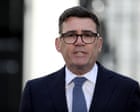
Rain slicked the pavements outside Manchester Town Hall on a Tuesday morning, the kind of grey northern drizzle that seems to seep into the bones of a city. Inside, a room full of local politicians, journalists, and policy staff sat in quiet anticipation. They had come to hear about appointments—names assigned to portfolios, bureaucracy shuffled into neat rows. But when Andy Burnham stepped up to the microphone, he offered something far less clinical.
He spoke about hope.
Hope is a dangerous word in modern politics. It sounds fragile, almost soft, especially to people who have spent years watching bus routes vanish, social housing queues grow longer, and local high streets quiet down into rows of shuttered storefronts. Promises are easy to print on glossy leaflets; rebuilding the social fabric of a region requires something far heavier.
When Burnham unveiled his top leadership team—his cabinet—he was doing more than handing out job titles. He was setting up a quiet wager against cynicism.
Beyond the Red Boxes
Politics at the national level often feels like a distant theater. Cabinet ministers in Whitehall move between grand offices, flanked by civil servants, isolated from the immediate friction of daily life. In regional government, the reality is starkly different.
If a bus does not arrive on time in Bolton, or if a family in Rochdale cannot find an affordable flat, the mayor and their cabinet hear about it directly. There is no curtain to hide behind. The decision to hand specific responsibilities—housing, transport, climate, economy—to particular regional leaders is not just a tactical reshuffle. It is an assignment of personal accountability.
Consider a mother waiting at a shelter in Stockport with two young children, watching the digital sign reset twice while the wind picks up. (This is a hypothetical scenario, but it reflects the daily experience of thousands across the region.) For her, regional policy is not an abstract debate over budgets. It is the cold bench she is sitting on and the thirty minutes she just lost from her evening. When a regional leader promises to overhaul public transport, they are promising that woman thirty minutes of her life back.
That is the stakes Burnham’s newly assembled cabinet inherits.
The Machinery of Local Power
For decades, decision-making was pulled toward London. Wealth concentrated in the southeast, while northern industrial hubs were left to manage decline with diminishing funds. The shift toward regional devolution—giving mayors real authority over budgets and infrastructure—was supposed to reverse that gravity.
Burnham’s team reflects a specific strategy: using local knowledge to solve local structural failures.
By putting key leaders in charge of integrated transport networks, housing standards, and green development, the goal is to create a joined-up system. In the past, if a young worker in Wigan wanted to take a job in Salford, they had to navigate competing private bus operators, unreliable schedules, and disconnected ticket systems. Connecting those dots requires a council of leaders who treat the ten boroughs of Greater Manchester as an interconnected organism rather than ten competing territories.
The new cabinet members take on portfolios that read like municipal administration on paper, but in practice, they are levers for social mobility.
- Transport Integration: Pulling buses back under public control to create a unified system with capped fares.
- Housing Reform: Cracking down on rogue landlords and funding new social housing developments.
- Economic Strategy: Investing in green industries and digital technology to build jobs that stay in the region.
When these pieces fit together, the impact is compounding. A reliable bus route makes a job accessible; a safe home makes steady work possible; local investment ensures the job exists in the first place.
The Friction of Expectation
It is easy to assemble a team and articulate a vision. Delivering on it within the confines of limited regional budgets is the hard part.
Every mayor faces the same cold arithmetic. Central government grants remain tight, inflation eats away at procurement costs, and public patience is thin. People are tired of hearing about ten-year plans when their immediate reality feels stagnant. Burnham’s call to bring back hope carries an implicit risk: if you promise hope and deliver delay, the resulting disappointment is twice as bitter.
Trust is not restored by a single press conference. It is built in increments—a bus that arrives on schedule, a new park opening on derelict land, a local apprenticeship scheme that leads to a real career.
The members of the new executive team know they will be judged not by their rhetoric, but by whether the everyday machinery of the city-region begins to run smoothly.
A New Contract with the Street
As the press conference ended and the room cleared, the rain was still falling over the cobbles. The headline off the wire was simple enough: a mayor announces his team and promises a brighter future.
The real story sits on the streets outside.
It is in the young person trying to figure out if they can afford to stay in the city they grew up in. It is in the small business owner hoping for foot traffic to return to the town center. Hope, in the end, is not a strategy or a slogan. It is the visible proof that things can work better than they currently do. Burnham and his cabinet have laid out their commitments. Now, the quiet work begins.