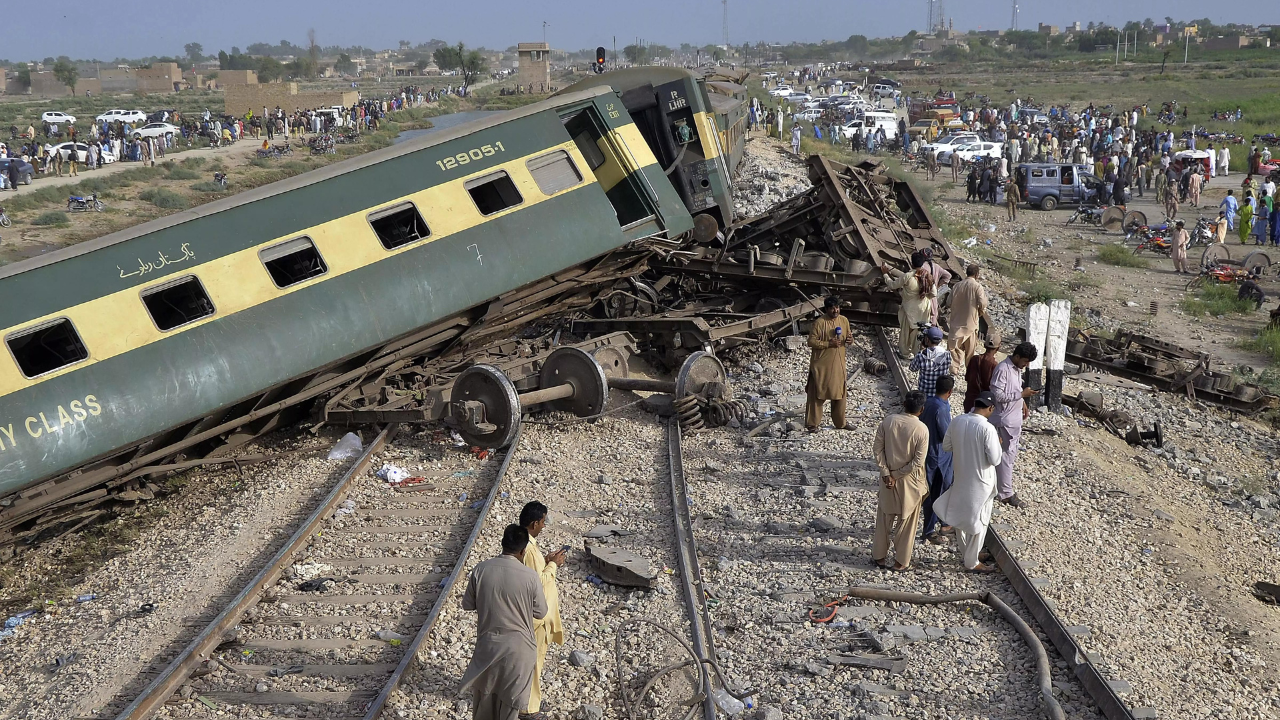
Infrastructure decay does not manifest as a sudden surprise; it functions as a predictable mathematical accumulation of deferred capital expenditure, material fatigue, and structural oversight. When the Rehman Baba Express derailed all fourteen of its carriages in the Multan district of Punjab, resulting in multiple fatalities and dozens of injuries, public discourse predictably centered on immediate operational friction. However, viewing such catastrophes as isolated anomalies obscures the underlying systemic variables that govern heavy rail transport networks.
To understand why high-capacity transit networks experience catastrophic loss of containment, the operational ecosystem must be dissected into three primary vectors: track geometry degradation, signal architecture obsolescence, and capital allocation inertia.
The Cost Function of Deferred Maintenance
Railway engineering relies on strict tolerances between wheelsets and rail geometry. Over time, heavy axle loads induce micro-fractures in rails and fatigue the ballast foundation supporting the sleepers. Without consistent ballast cleaning, tamping, and ultrasonic rail flaw detection, geometric deviations compound exponentially.
The economic trade-off facing national operators typically involves choosing between proactive capital reinvestment and reactive crisis response. When operating budgets face chronic constraint, preventive maintenance cycles are systematically lengthened. This introduces hidden liabilities into the system.
Deferred Maintenance + High Axle Load = Geometric Tolerance Breach = Catastrophic Kinematic Disruption
When track geometry degrades beyond critical thresholds, dynamic forces exerted by moving rolling stock exceed the lateral resistance of the fastening systems. The Multan incident highlights how a combination of aging infrastructure and high-capacity passenger loads creates an environment where minor track anomalies transform into systemic derailment events.
The Mechanics of Structural Propagation
A derailment of an entire 14-car formation is rarely caused by a single point failure. It indicates a progressive failure cascade.
- Initiation Phase: A localized failure occurs, such as a rail buckling under thermal stress, a gauge widening due to decayed sleepers, or a mechanical failure in a wheel bogie.
- Propagation Phase: As the lead locomotive or initial carriages encounter the compromised geometry, wheel-climb or rail-rollover occurs. The sudden deceleration of the front cars generates immense longitudinal compressive forces across the coupling mechanisms.
- Systemic Collapse: Because trailing carriages possess high kinetic momentum, they buckle outward or jackknife off the formation alignment, maximizing structural damage and personal injury across passenger compartments.
Capital Allocation and Institutional Inertia
The root cause of recurring rail failures in developing high-density corridors lies within institutional capital allocation models. State-owned or heavily subsidized passenger networks frequently prioritize low ticket pricing to maintain socio-economic mobility over commercial asset depreciation funding.
This pricing mechanism creates a structural deficit. When revenues fail to cover the lifecycle replacement cost of physical assets, the infrastructure physically degrades. Upgrading legacy systems requires heavy front-loaded capital expenditure, whereas maintaining status-quo operations defuses short-term political friction at the expense of long-term safety margins.
Strategic Operational Realignment
Mitigating the recurrence of high-consequence transit failures requires moving away from qualitative safety reviews and adopting quantitative structural health monitoring. Operators must implement continuous diagnostic track-recording cars, automate ultrasonic rail inspection intervals, and tie operational speed restrictions directly to real-time track geometry measurements rather than arbitrary historical schedules.
The transition from reactive emergency response to predictive asset management is the only operational path capable of altering the safety trajectory of legacy rail networks.