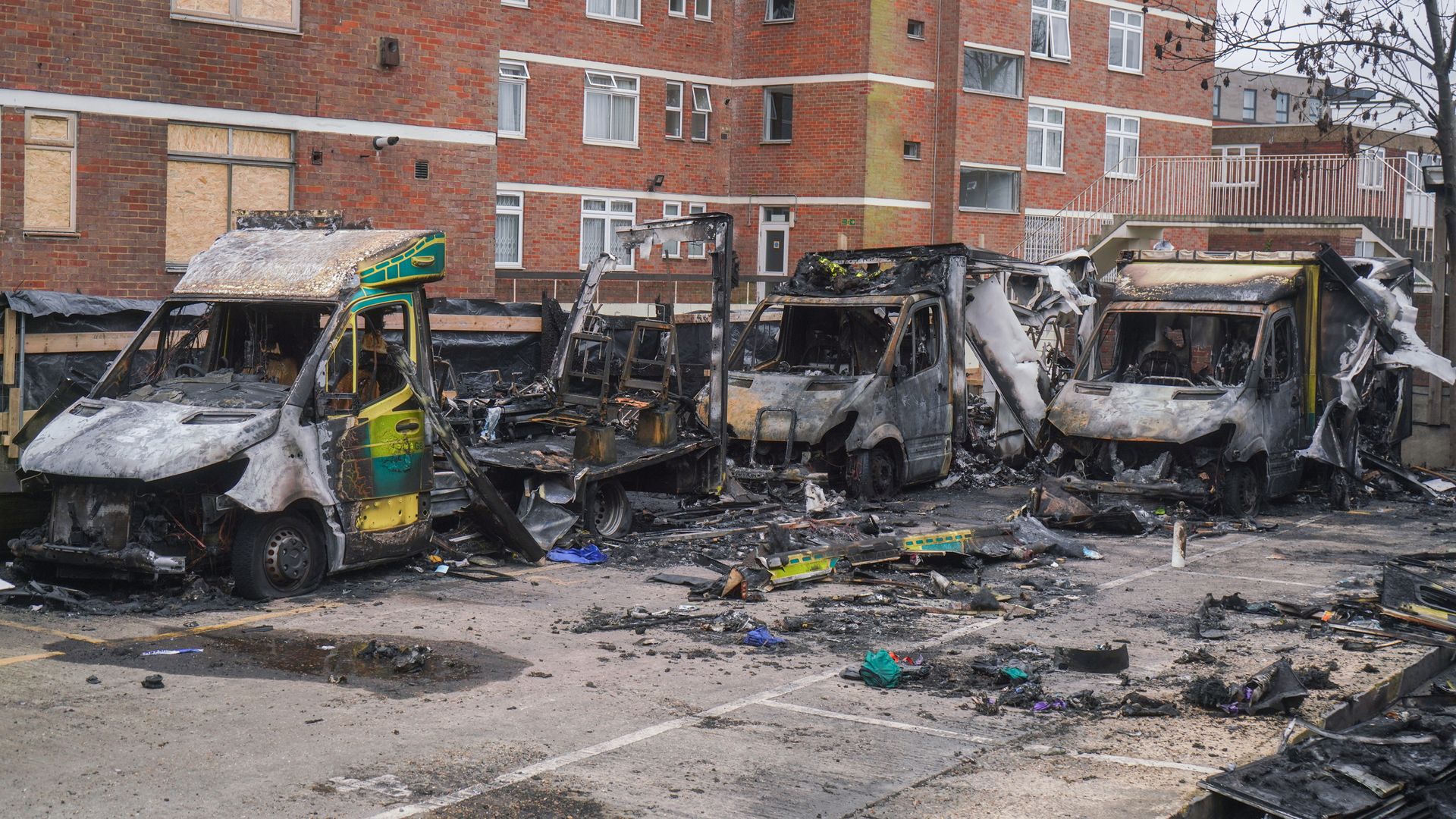
Charging a fourth person in the arson of Jewish charity ambulances might feel like a victory for the legal system, but it is a hollow one. The media fixates on the "who" and the "how" of the crime, treating every arrest like a definitive stop-gap against rising social friction. They are wrong. While the police pat themselves on the back for rounding up suspects, the actual machinery of community safety remains broken and unaddressed. This isn't just about a few charred vehicles; it’s about the total failure of our modern urban design to protect the very organizations that fill the gaps left by the state.
The Arrest Fetishism Trap
The standard news cycle follows a predictable, lazy script: a crime occurs, the public expresses outrage, and then a series of press releases announce charges. We are conditioned to believe that "justice" is a zero-sum game played out in a courtroom. If the perpetrators are behind bars, the problem is solved.
I have spent years watching policy-makers dump millions into reactive policing while ignoring the hardening of soft targets. Arresting four people does not magically un-burn an ambulance. It doesn’t replace the life-saving minutes lost when a fleet is sidelined. Most importantly, it doesn’t deter the next person who feels emboldened by the visibility of the act. We are obsessed with the aftermath because we are too cowardly to discuss the preventative reality.
The Logic of Targeted Infrastructure
Charity organizations, specifically those serving religious or ethnic minorities, operate under a constant, unspoken tax: the security tax. When a Jewish charity's ambulances are torched, it isn't just an act of property damage; it is a calculated strike against the mobility of a community.
The "lazy consensus" argues that this is a failure of social cohesion. The contrarian truth is simpler: it is a failure of logistical fortification. We treat ambulances like parked cars. They aren't. They are high-value, high-symbolism targets that require a level of protection that most non-profits simply cannot afford without stripping funds from their actual mission.
Imagine a scenario where we viewed emergency medical fleets with the same defensive priority as power substations. If the infrastructure is vulnerable enough that a small group of individuals can cripple a community's emergency response overnight, the arrest of those individuals is merely a footnote in a larger story of systemic negligence.
Why Community Resilience is Being Measured Wrong
People also ask: "How can we stop these attacks from happening?"
The honest, brutal answer is that you can’t—not through the legal system alone. The law is a lagging indicator. It tells you what happened, not what will happen. True resilience is measured by the speed of recovery, not the efficacy of the prosecution.
- Redundancy over Retribution: A community that relies on a single point of failure is a community waiting for a crisis.
- Decentralized Storage: Keeping an entire fleet in one location is an invitation to disaster.
- Privatized Intelligence: Relying solely on local police to monitor threats against specific cultural institutions is a proven losing strategy.
The High Cost of the Moral High Ground
We love to talk about "sending a message." The legal system thinks it sends a message through sentencing. The arsonist sends a much louder message through fire. While the courts move at the speed of bureaucracy, the psychological impact of the crime spreads at the speed of social media.
By the time the fourth suspect is charged, the initial trauma has already calcified into fear. This fear dictates where people live, how they volunteer, and how they interact with their neighbors. No amount of "community outreach" or "interfaith dialogue" can scrub away the sight of a melted medical vehicle.
The downside to my perspective? It’s cold. It suggests that we should stop mourning the loss of "social harmony" and start building better fences. It admits that some level of friction is permanent and that our energy is better spent on physical and digital hardening than on hoping people will just be better to one another.
Stop Asking Why and Start Asking How Fast
The media asks: "What was the motive?" This is a distraction. Whether the motive was hate, profit, or pure nihilism, the result is identical. Motive is for the courtroom; impact is for the real world.
If we want to protect the organizations that actually do the heavy lifting in our cities, we have to stop treating these events as isolated criminal acts. They are strategic disruptions. When you treat a strategic disruption as a simple crime, you have already lost the war.
Charge the suspects. Throw the book at them. But don't for a second believe that the smoke has cleared. The vulnerability remains, and as long as we prioritize the theater of the arrest over the reality of infrastructure protection, we are just waiting for the next spark.
Get the fleets off the street. Harder the hubs. Stop waiting for the police to save you.