Silence has a weight to it when forty thousand people decide to hold their breath at the exact same second.
You can feel it in your ribs before you hear it in your ears. It starts as a low, suffocating pressure dropping down from the upper decks of a football stadium in November, pressing the warmth right out of your winter coat. Down on the grass—or the shredded, frozen plastic passing for grass—that silence feels like wet concrete pouring into your cleats. For an alternative perspective, check out: this related article.
Consider a hypothetical fan sitting in Row 14, somewhere near the thirty-yard line. Let’s call him Arthur. Arthur has watched his team bleed out in the third quarter a dozen times before. He knows the slump of shoulders that signals surrender. He knows the way an offensive line begins to step backward a fraction of a second too early, anticipating the hit rather than delivering it. When the scoreboard flashes a deficit that looks insurmountable against a defense built like a brick wall, Arthur doesn't even get angry anymore. He just starts calculating how long it will take to beat the traffic out of the parking lot.
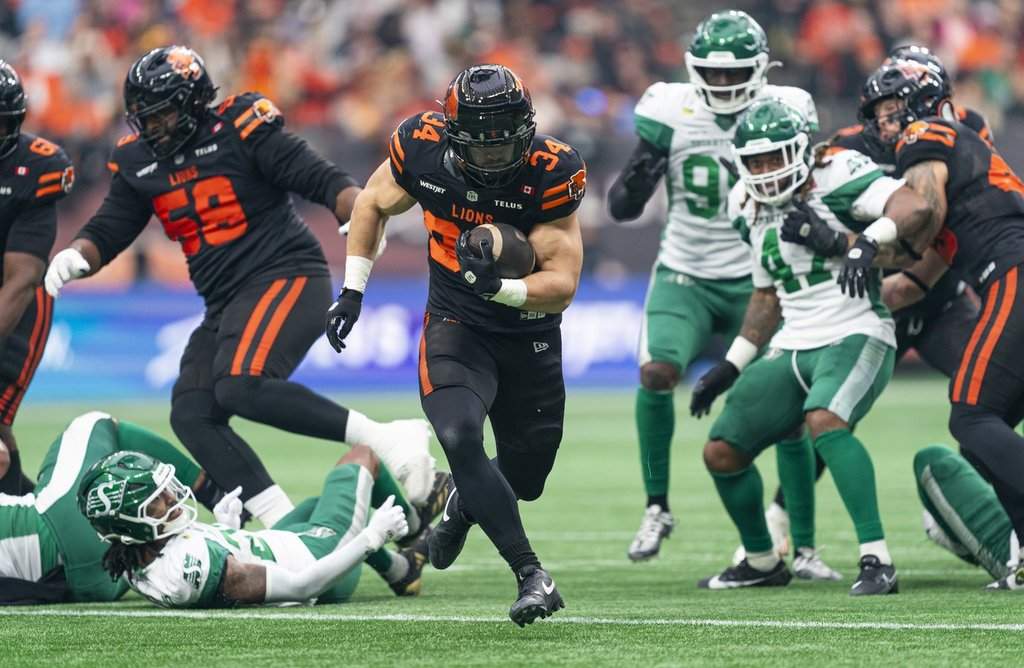
That is the exact emotional frequency of an elimination game gone sideways. And it is the precise grave the BC Lions were standing over before they decided to claw their way out of the dirt and send the Saskatchewan Roughriders packing for the winter. Similar analysis regarding this has been shared by Bleacher Report.
The Architecture of a Collapse
To understand why a playoff comeback hits the human nervous system like a defibrillator, you first have to understand how completely a team can vanish in plain sight.
Canadian football is a game of inches disguised as a game of chaos. With three downs instead of four, a wider field, and receivers sprinting toward the line of scrimmage before the ball is even snapped, momentum isn't just a sports cliché. It is a physical current. When it turns against you, it drowns you fast.
For long stretches of this postseason clash, Saskatchewan looked like the inevitable force of nature. The Roughriders played the kind of suffocating, disciplined football that wins championships in late autumn. Every gap in their defensive front seemed sealed. Every tackle carried a dull, punishing thud that echoed up to the press box. When Saskatchewan controls the clock and forces a passing offense into predictable, desperate third-and-long situations, they don't just beat you on the scoreboard. They break your will to call the next play.
I have stood on sidelines in November when the wind cuts through three layers of thermal gear and turns the football into a slick, heavy stone. In those moments, the hardest thing for a quarterback to do isn't throwing a forty-yard out route into double coverage. The hardest thing is standing in the huddle, looking ten exhausted, bruised men in the eye, and convincing them that the math still works.
Because the math rarely works.
When a team falls behind in the playoffs, panic creeps in through the micro-decisions. A wide receiver rounds off a route by six inches to avoid a safety hovering over the middle. A guard lunges at a defensive tackle instead of moving his feet, opening a seam straight to the quarterback’s blind side. The Roughriders feasted on that creeping hesitation, stacking stops, flipping field position, and dictating the entire emotional tempo of the afternoon.
If you were watching from the stands, or pacing your living room floor with your hands behind your head, the story felt written. Saskatchewan was advancing. BC was cleaning out its lockers.
The Turning of the Screw
Except football games aren't won by projections, and human beings are notoriously bad at behaving like statistics.
Think of a comeback not as an explosion, but as a slow, agonizing unlocking of a rusted door. You push against the iron, and nothing moves. You push again, and a flake of rust falls to the floor. You keep pushing until the hinges scream and the whole heavy frame finally gives way.
That is how the Lions began to tilt the field.
It didn't start with a miracle Hail Mary or a lucky bounce off a helmet. It started in the trenches, where the television cameras rarely linger long enough to show the real violence of the sport. BC’s offensive line, battered and out-leveraged early on, stopped retreating. They began to fire off the snap with a violent, synchronized low pad level, turning two-yard losses into four-yard gains.
Four yards doesn't make the evening highlight reel. Four yards doesn't make the crowd spill their drinks.
But in the Canadian Football League, four yards on first down changes the entire geometry of the field. Suddenly, second-and-ten becomes second-and-six. The playbook opens back up. The defensive coordinator across the sideline can no longer pin his ears back and send six rushers at the quarterback without risking a slant route behind them going for sixty yards.
You could see the subtle shift in body language long before the scoreboard reflected the danger. Saskatchewan’s defensive backs, who had been jumping routes with reckless confidence in the first half, started taking one extra step backward at the snap. That single step—barely twenty-four inches of turf—was the crack in the dam.
Once BC’s passing game found its rhythm, the Lions didn't just attack the Roughriders; they forced Saskatchewan to defend every blade of grass from sideline to sideline. The ball began coming out of the quarterback’s hand with sharp, rhythmic certainty. A quick hitch to the boundary. A seam route threaded between two linebackers a split second before the collision arrived. A deep shot down the sideline that forced the safety to sprint forty yards just to knock the ball away.
What Pressure Actually Looks Like
People love to talk about "clutch" performances as if certain athletes possess a mystical gene that activates when the clock ticks under three minutes. Having watched and covered championship-level competition for years, I don't believe in the clutch gene. I believe in preparation meeting exhaustion.
By the fourth quarter of a playoff game, nobody feels good. Fingers are jammed and swollen inside taped gloves. Ribs ache every time you inhale cold air. Your legs feel like they are wading through waist-deep mud. At that stage of a game, brilliance disappears. All you have left are your habits.
Saskatchewan spent three quarters building a lead, and then they spent the fourth quarter trying not to lose it. There is a massive psychological chasm between playing to win and playing to protect.
When a defense plays to protect a lead, they soften their coverage. They surrender the underneath throws to keep everything in front of them, betting that the offense will eventually make a mistake, drop a pass, or take a holding penalty before reaching the end zone. It is logical. It is conservative. And against a desperate, talented offense with nothing left to lose, it is slow poison.
The Lions took every inch Saskatchewan gave them, and then they stole ten more.
Drive after drive, BC marched down the field with a cold, methodical urgency that sucked the life out of the Roughriders' sideline. Watch the faces of players on the bench during a late-game collapse. Nobody yells. Nobody throws a helmet. They just stare at the turf between their cleats, watching the clock bleed away while the opponent’s offense converts third down after third down.
When BC finally punched in the go-ahead score, the roar that erupted wasn't the polite applause of a regular-season win. It was a primal, ragged release of tension—the sound of thousands of people suddenly realizing they didn't have to go home yet.
The Thin Line Between Glory and Winter
The final minutes of an elimination game are brutal because there is no grace period. In the regular season, a crushing loss gives you a Tuesday film session, a Wednesday practice, and a Sunday afternoon to wash the taste out of your mouth. In the playoffs, the final whistle is a guillotine. One second you are fighting for a championship; the next second your season is a memory, and you are packing cardboard boxes in a quiet locker room.
Saskatchewan had one last chance to rewrite the ending, one final possession to answer the Lions' surge and reclaim their season.
This is where the human element strips away all the X's and O's. The Roughriders' offense jogged onto the field carrying the weight of an entire province on their shoulders, facing a BC defense that suddenly smelled blood. When a defense senses the end is near, fatigue vanishes. Adrenaline floods the bloodstream, dulling the bruises and sharpening every instinct.
The Lions' front four pinned their ears back and collapsed the pocket. Receivers ran routes into a forest of outstretched arms and colliding pads. Every pass was contested. Every yard had to be earned through contact. When the final desperate throw fell harmlessly to the turf—or landed securely in the hands of a BC defender—the contrast between the two sidelines told the entire story of professional sports in a single frame.
On one side, grown men leaped onto each other's backs, screaming into the night sky, drunk on survival.
On the other side, Roughriders players stood frozen with their hands on their hips, helmets still buckled, staring at a scoreboard that refused to give them one more second.
Why We Keep Watching
If you strip away the logos, the statistics, and the playoff brackets, a game like this endures because it mirrors the exact thing we are all terrified of in our own lives: falling behind, running out of time, and having to find out what we are actually made of when the easy options are gone.
Most people quit when the math turns against them. Most teams do, too. They go through the motions, run the safe plays, keep the score respectable, and accept the inevitable with polite handshakes at midfield.
The BC Lions refused to accept the script. They absorbed Saskatchewan’s best punches, swallowed the doubt of a hostile momentum swing, and dragged the Roughriders into deep water in the fourth quarter until Saskatchewan couldn't tread water anymore.
Somewhere in the stands, our hypothetical fan Arthur never made it to his car early. He stayed until the final whistle, his voice shredded, his hands stinging from clapping in the cold, reminded once again why you never leave a stadium while there is still time on the clock.
The Lions move on to fight another week, bruised, exhausted, and dangerous. And the Roughriders are left with a long, quiet winter to replay every missed tackle, every surrendered inch, and the exact moment the roar started building on the other side of the field.