The reduction in physical destruction during the October 24, 2026 demonstrations in France was not the result of waning public anger, nor did it signal a resolution to the underlying macroeconomic grievances. Instead, the lower property damage reflects a deliberate shift in state security posture from reactive crowd dispersal to preemptive spatial containment and rapid asset-freeze deterrence. While approximately 320,000 people still mobilized across 150 marches on October 24—down from the 550,000 to 800,000 recorded during the October 17 escalation—the physical destruction profile changed drastically. To understand why commercial losses contracted sharply compared to the initial €207 million insured damage bill from the prior weekend, analysts must examine the operational mechanics of French public-order doctrine, the economics of riot liability, and the structural fragility of the state's fiscal position.
The Anatomy of Tactical Containment
Standard reporting attributes the drop in vandalism during the second weekend of the October 2026 unrest to generic increases in police presence and high arrest counts. This explanation misses the specific operational mechanisms that neutralise urban rioting. Crowd violence in dense European cities relies on mobility, anonymity, and chokepoint saturation. When security forces alter the physical topology of a city prior to mobilization, they strip radicalized factions—often referred to in French security parlance as casseurs or black bloc elements—of the kinetic momentum required to breach commercial targets.
Between October 17 and October 24, the French Ministry of the Interior executed a three-tiered containment protocol designed to break the operational loop of urban looting:
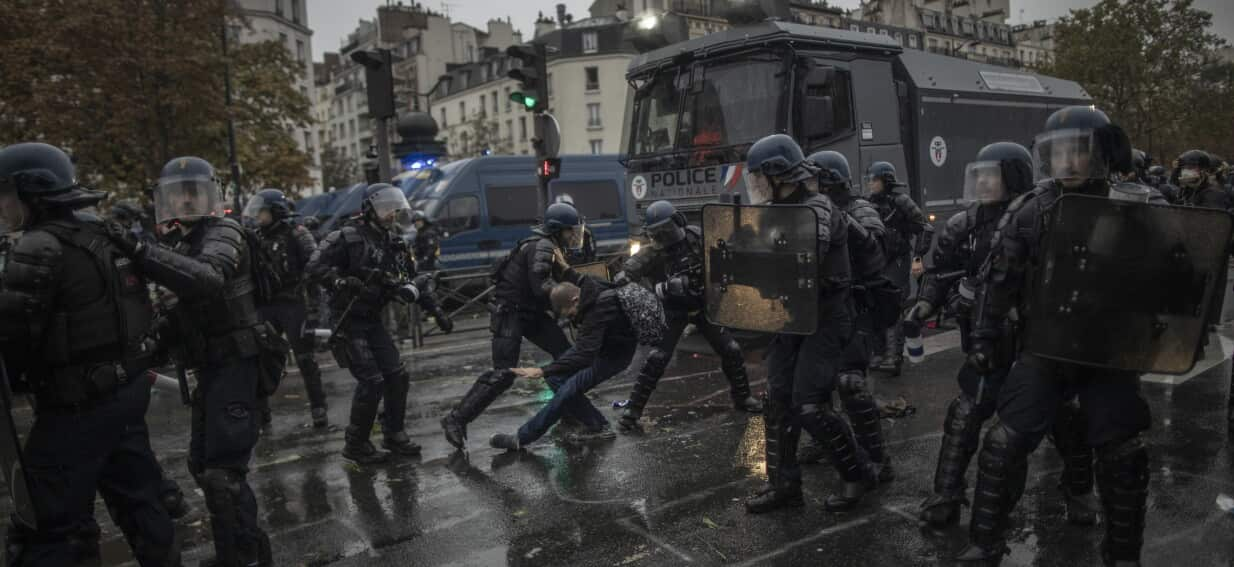
- Transit Interdiction and Perimeter Screening: Rather than allowing decentralized groups to coalesce at symbolic plazas like Place de la République, police shut down more than 40 metro stations in Paris and executed over 1,200 targeted identity and bag checks at major railway hubs. By confiscating protective gear, incendiary materials, and blunt instruments at transit bottlenecks, authorities degraded the tactical readiness of violent subgroups before they could merge with peaceful union or student blocs.
- Spatial Rerouting and Banning Orders: Municipal authorities in Lyon, Marseille, Nice, and Toulon issued blanket bans on demonstrations in high-value commercial corridors, while Paris authorities forcefully rerouted marches away from dense retail zones. In urban riot dynamics, property damage scales exponentially when marches pass unfortified luxury retail or banking branches. Diverting foot traffic onto wide boulevards with limited commercial frontage increases the exposure of vandals to flanking maneuvers by mobile gendarmerie units.
- High-Velocity Preemptive Arrests: During the October 17 unrest, police made roughly 400 arrests during daytime hours before nighttime looting overwhelmed local precincts, eventually reaching 1,200 to 2,400 detentions across the weekend. By October 24, authorities inverted this ratio, executing roughly 1,000 arrests rapidly upon the formation of unauthorized clusters. In queuing theory and crowd control, removing the core instigators within the first 15 minutes of a barricade formation prevents the bystander effect from converting passive demonstrators into active participants.
This tactical shift carries a severe operational limitation: high-friction containment is exceptionally resource-intensive and unsustainable over multi-month campaigns. Deploying tens of thousands of riot police and gendarmes while shuttering urban transit networks imposes a hidden tax on the municipal economy. When 40 metro stations close, retail footfall collapses just as surely as it does when storefronts are boarded up. The state successfully traded visible, insured property destruction for invisible, uninsured commercial stagnation.
The Economics of Destruction Direct Losses Versus Flow Disruption
Media coverage fixates on broken glass, burned vehicles, and looted storefronts because visual destruction generates immediate political pressure. However, from a macroeconomic perspective, conflating property damage with national economic contraction is a category error. Gross Domestic Product measures the flow of goods and services over time, whereas the destruction of physical buildings, municipal offices, and retail inventory represents a loss of capital stock.
Data from France Assureurs following the October 17–18 riots illustrates how concentrated this capital destruction actually is. Out of €207 million in insured losses across 5,280 claims filed within the first 24 hours of the initial unrest, commercial enterprises absorbed €198 million—more than 95 percent of the total financial blow. Damaged vehicles accounted for €6 million across 860 claims, while private residential damage totaled just €3.5 million. Preliminary upper-bound estimates from credit rating agencies projected total insured costs for the broader October wave at up to €1.2 billion, roughly 0.04 percent of French nominal GDP.
The true economic cost lies in the secondary shockwaves that never appear on an insurance ledger:
- Non-Recoverable Service Losses: When a consumer delays buying a coat because a Paris department store is closed during a Saturday protest, that purchase is usually deferred to the following week. When a tourist cancels a hotel reservation, or a local resident skips a restaurant meal due to curfews and metro closures, that economic output is permanently destroyed. During the 2018 Yellow Vest movement, insured property damage totaled roughly €217 million to €256 million, yet parliamentary inquiries estimated lost turnover at €2 billion for shopping centers and €850 million for the hospitality sector.
- The Broken Window Fallacy in Reconstruction: Insurance payouts and municipal reconstruction budgets eventually flow into construction and glazing firms, registering as positive economic activity in subsequent quarters. Yet this capital allocation represents pure opportunity cost. Funds directed toward rebuilding the burned 19th-century Hôtel de Ville in Limoges or replacing shattered storefronts in Lyon cannot be deployed toward productivity-enhancing investments.
- Sovereign Risk Premia and Bond Market Contagion: Unlike the 2018 unrest or the 2023 pension reform strikes, the October 2026 protests erupted while France was operating under an European Commission excessive deficit procedure, carrying a debt-to-GDP ratio approaching 116 to 119 percent and a budget deficit exceeding 5 percent. Images of burning public buildings triggered an immediate sell-off in French sovereign debt, pushing 10-year government bond yields up 16 basis points to 4.94 percent and widening the spread against German bunds. When civil disorder convinces fixed-income markets that a minority government cannot execute fiscal consolidation, the resulting increase in debt-servicing costs dwarfs the physical cost of the riots themselves.
Grievance Convergence and the Mobilization Engine
To treat the October 2026 unrest purely as a law-and-order problem is to misdiagnose the structural drivers fueling crowd turnout. The demonstrations did not originate as a unified anti-government insurrection; they emerged through a process of grievance convergence, where distinct socioeconomic groups with separate grievances synchronized their mobilization calendars.
The initial catalyst in late September 2026 was localized to secondary schools and universities. Students protested severe teacher shortages, deteriorating facility conditions, and opaque algorithmic selection criteria within Parcoursup, the national university admissions platform. By early October, blockades had forced the partial or total closure of 400 to 500 schools, with two dozen facilities damaged. Under normal political conditions, student strikes remain isolated from broader labor actions due to differing tactical goals.
Two macroeconomic variables bridged that divide by mid-October:
- Regressive Inflation Dynamics: Data published by the National Institute of Statistics and Economic Studies (INSEE) on October 15 revealed that while headline consumer inflation stood at 3.1 percent year-on-year in September 2026, essential non-discretionary categories were inflating at punishing rates. Energy costs had surged 21.3 percent, and fresh food prices had risen 9.5 percent. Because low- and middle-income households allocate a higher proportion of disposable income to fuel and groceries, headline inflation metrics understated the acute purchasing-power compression experienced outside major urban centers.
- Institutional Deadlock: Following the parliamentary fragmentation triggered by the 2024 snap legislative elections, the French executive branch lacked a stable majority in the National Assembly. For trade unions, agricultural workers, and veterans of the Yellow Vest movement, traditional legislative lobbying appeared futile. Street mobilization became the primary mechanism for exerting political leverage over a weakened cabinet.
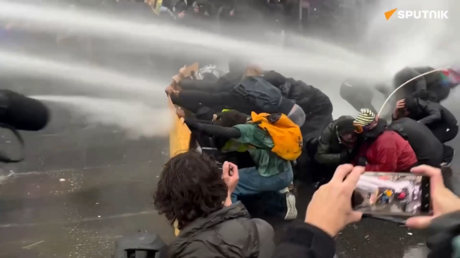
When student organizations merged their marches with trade unions, farmers, and cost-of-living protesters on October 17, they created massive crowd densities across 110 cities. Violent black bloc networks exploit high-density, multi-issue marches because legitimate demonstrators act as an involuntary human shield. Riot police cannot deploy tear gas or water cannons aggressively against a crowd containing high schoolers, retirees, and union families without risking severe injuries—such as the demonstrator who lost a hand in Saint-Étienne—that immediately delegitimize the state and swell turnout for the subsequent weekend.
The Legislative Deterrence Shift From Collective Insurance to Individual Liability
Recognizing that physical policing alone cannot secure every commercial street in France, the political establishment moved in late October 2026 to alter the financial incentive structure of street protest. Historically, the French state operated under a doctrine of socialized risk regarding civil unrest. Under the Code de la sécurité intérieure, the state bore primary civil liability for crimes and offenses committed by armed or unarmed gatherings, while private insurers absorbed commercial losses before passing costs onto business owners through higher premiums.
With a new riot insurance regime slated for 2027 threatening to price small shopkeepers out of coverage, the French Senate passed a protest liability bill designed to shift financial restitution directly onto individual participants. This legislative pivot introduces three distinct deterrence mechanisms:
- Joint Financial Liability: Courts are authorized to order individuals convicted of participating in groups formed with the intent to vandalize to pay up to €10,000 in restitution. Crucially, liability extends to demonstrators who voluntarily remain in an unauthorized zone after two official police dispersal warnings, lowering the evidentiary threshold required to penalize crowd members.
- Direct Garnishment of State Transfers: To solve the enforcement problem posed by judgment-proof defendants—such as unemployed youths or students lacking liquid savings—the legislation empowers authorities to seize social welfare benefits, housing assistance, family supplements, and back-to-school allowances to satisfy damage judgments.
- Algorithmic Velocity Controls: Alongside financial liability, lawmakers advanced measures compelling social media platforms to remove content deemed to incite insurrection within 24 hours or face domestic blocking. This targets the real-time coordination networks that allow decentralized looters to swarm undefended retail districts faster than police vans can redeploy.
While individual financial liability creates a powerful deterrent for middle-class demonstrators and welfare-dependent households, it introduces severe operational and political risks. Conflating peaceful protesters who fail to hear a dispersal order with organized arsonists invites protracted constitutional challenges and accusations of collective punishment. Furthermore, garnishing family allowances from low-income households risks deepening the exact economic desperation driving the cost-of-living protests in the first place.
Strategic Forecast and Risk Mitigation
The containment achieved on October 24 proves that French security forces can suppress headline property destruction when willing to impose heavy transit restrictions and preemptive detentions. However, tactical containment is a depreciating asset. Each weekend of metro closures, curfews, and municipal protest bans normalizes emergency governance while eroding commercial turnover in urban centers.
For institutional investors, corporate risk managers, and commercial operators exposed to the French market, relying on declining weekend arrest or vandalism counts as a signal of returning stability is a mistake. The underlying drivers—21.3 percent energy inflation, a paralyzed National Assembly, and a sovereign debt load near 119 percent of GDP—remain completely unaddressed.
Stakeholders must adjust their operational models to account for three realities over the next two quarters:
- Price in Chronic Margin Compression Over Catastrophic Loss: Commercial enterprises should shift risk management budgets away from pure physical fortification toward business-interruption hedging. Future unrest will likely feature lower acute property damage due to aggressive police perimeters, but prolonged, recurring Saturday closures and transit shutdowns will steadily erode Q4 and Q1 retail and hospitality margins.
- Monitor Sovereign Spreads as the True Political Barometer: Ignore street-level crowd estimates from unions or the Interior Ministry. Track the yield spread between French 10-year OATs and German Bunds. If street pressure forces the minority government to abandon spending cuts or subsidize energy costs to placate unions, bond vigilantes will punish French debt immediately, tightening credit conditions across the domestic corporate sector.
- Prepare for Asymmetric Escalation Ahead of the 2027 Election: With presidential campaigning accelerating and populist candidates capitalizing on both the disorder and the state's authoritarian countermeasures, protest movements will fragment. As heavy policing blocks mass urban marches, radicalized cells inevitably pivot toward decentralized infrastructure disruption—targeting rail switches, fuel depots, and logistics hubs where police manpower cannot maintain dense perimeters. Supply chain operators must build 48-to-72-hour inventory buffers around French transit corridors rather than assuming the quiet streets of central Paris signify national pacification.