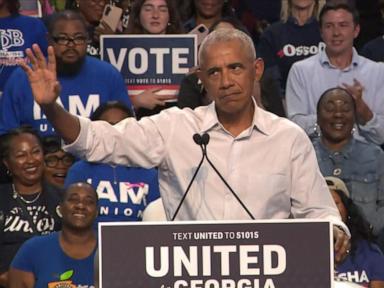
Political communication operates on an attention economy where emotional reactivity functions as a transfer of strategic capital. When former President Barack Obama referenced the Cheesecake Factory to critique Donald Trump’s public focus, and Trump subsequently reacted to that specific remark, the exchange demonstrated a classic tactical maneuver in political messaging: the use of low-stakes cultural signifiers to expose perceived vulnerability and redirect news cycles. Understanding this dynamic requires stripping away partisan commentary and examining the underlying mechanics of rhetorical framing, cognitive load, and earned media displacement.
The Architecture of the Rhetorical Trap
In high-level political communication, the objective of a critique is rarely to persuade an opponent's committed base. The objective is to elicit an unscripted, defensive response from the opponent that validates the original premise of the attack.
According to political communication frameworks and campaign accounts of the exchange, the sequence unfolded through a predictable three-stage mechanism:
- The Anchoring Premise: Obama’s initial commentary framed Trump’s public behavior as overly fixated on personal grievances, crowd sizes, and media coverage rather than policy execution or public service. To make this abstract critique concrete for a general audience, Obama used an everyday cultural reference—specifically noting how unusual it would be for a former president to spend time obsessing over trivialities or specific restaurant chains like the Cheesecake Factory.
- The Baiting Mechanism: By attaching a specific, slightly absurd cultural proper noun to a broader character critique, the speaker creates a rhetorical hook. In public relations theory, concrete nouns are significantly easier for both media outlets and political opponents to latch onto than abstract policy critiques.
- The Validation Loop: When Trump addressed the Cheesecake Factory remark directly at subsequent events and on social media, he inadvertently shifted his own platform toward defending against the specific phrasing rather than advancing his core economic or border messaging. In communications strategy, repeating an opponent's frame—even to refute it—reinforces the neural pathways associated with that frame in the minds of undecided voters.
Earned Media Displacement and Opportunity Cost
Every minute a political principal spends addressing a cultural aside on a rally stage or social media feed carries a measurable opportunity cost. Campaign cycles are finite, and public attention is a zero-sum resource.
Media analysts and campaign strategists track this phenomenon through earned media displacement. When a candidate responds to a minor taunt, the resulting headlines focus on the interpersonal feud rather than the candidate's preferred policy contrasts. For example, coverage titled around a dispute over a restaurant comment crowds out coverage of inflation metrics, legislative proposals, or judicial appointments.
This creates a structural asymmetry between the two actors:
- The Surrogate Advantage: A former president campaigning as a surrogate does not bear the burden of daily governing or primary message discipline. Their role is to generate headlines, energize base turnout, and disrupt the opponent's rhythm.
- The Principal’s Burden: A candidate actively seeking office must maintain message discipline to reach low-information, swing-district voters who tune in infrequently. When the principal abandons their core message to litigate a surrogate's joke, the surrogate has successfully dictated the terms of the news cycle.
Behavioral Drivers Behind the Response
Why do experienced political figures repeatedly take the bait when the strategic cost is well documented? Behavioral economics and political psychology point to two primary mechanisms: loss aversion in status and audience reinforcement.
First, political figures who build their brand on strength and counter-punching face a perceived reputational cost if they let an insult go unanswered. Within their immediate ecosystem, silence can be interpreted as weakness. This creates a structural trap: the very trait that endears a leader to their core base—an unwillingness to back down from any slight—becomes a vulnerability that skilled opponents can exploit on demand.
Second, live rally environments create an immediate feedback loop. When a speaker mentions a recognizable brand or addresses a viral taunt, the crowd reacts with immediate laughter or applause. This real-time validation rewards the speaker for deviating from prepared remarks, even if the broader national media reaction is detrimental to swing-voter persuasion.
Media Incentives and Headline Compression
The news ecosystem acts as an accelerant for this dynamic. Digital journalism relies on high-click-through-rate headlines that compress complex political narratives into easily digestible conflicts.
A nuanced speech on healthcare subsidies or tax policy requires significant cognitive effort from a reader and yields lower engagement metrics. Conversely, a headline highlighting a dispute between two presidents over a casual dining chain requires zero prior context to understand. Algorithmic distribution rewards this simplicity, ensuring that the trivial exchange receives disproportionate amplification compared to substantive policy debates.
Furthermore, once a specific phrase enters the algorithmic bloodstream, it becomes self-sustaining. Reporters ask follow-up questions about the remark, social media accounts clip the video segments, and commentators debate the optics, locking both campaigns into a narrative loop that neither fully controls.
Limitations of Rhetorical Baiting
While asymmetric baiting is effective at disrupting an opponent's schedule and dominating short-term news cycles, it carries distinct strategic limitations. Over-reliance on cultural jabs and personality critiques can yield diminishing returns over a multi-month campaign.
- Voter Fatigue: Swing voters frequently express frustration with political discourse that focuses on interpersonal squabbles rather than material living conditions, such as housing costs, healthcare access, and wage growth. If a campaign spends too much bandwidth on clever rhetorical traps, it risks appearing dismissive of voters' immediate economic anxieties.
- Base Mobilization vs. Persuasion: Mocking an opponent's sensitivity generates high engagement among partisan supporters who already share that view of the opponent. However, it rarely provides undecided voters with a concrete reason to support the speaker's own platform.
- Counter-Framing Risk: If the targeted opponent successfully pivots the cultural reference into an argument that the critic is elitist or out of touch with everyday consumers, the baiting strategy can backfire. Cultural signifiers are inherently ambiguous and open to reinterpretation by opposing media ecosystems.
Operationalizing Message Discipline
To neutralize asymmetric rhetorical attacks, communications teams must implement strict filtering protocols before allowing a principal to respond publicly.
- Classify the Source: Distinguish between attacks originating from an opposing principal (which may require a direct policy contrast) and attacks originating from surrogates (which should generally be delegated to lower-tier surrogates or ignored entirely).
- Audit the Frame: Evaluate whether addressing the comment requires repeating the opponent's specific vocabulary. If a response cannot be delivered using the campaign's own core messaging terms, the response should be withheld.
- Measure Cycle Cost: Assess whether the attack is penetrating beyond partisan media into local broadcast news in battleground states. If an issue remains confined to social media and cable news panels, responding to it only elevates its reach to audiences that would otherwise never see it.
When evaluating political exchanges like the Cheesecake Factory dispute, the decisive metric is not who delivered the sharper line, but who controlled the allocation of public attention over the subsequent 48 hours. In modern political warfare, the strategist who forces an opponent to spend prime campaign hours defending against a triviality has already secured a measurable advantage in message discipline.