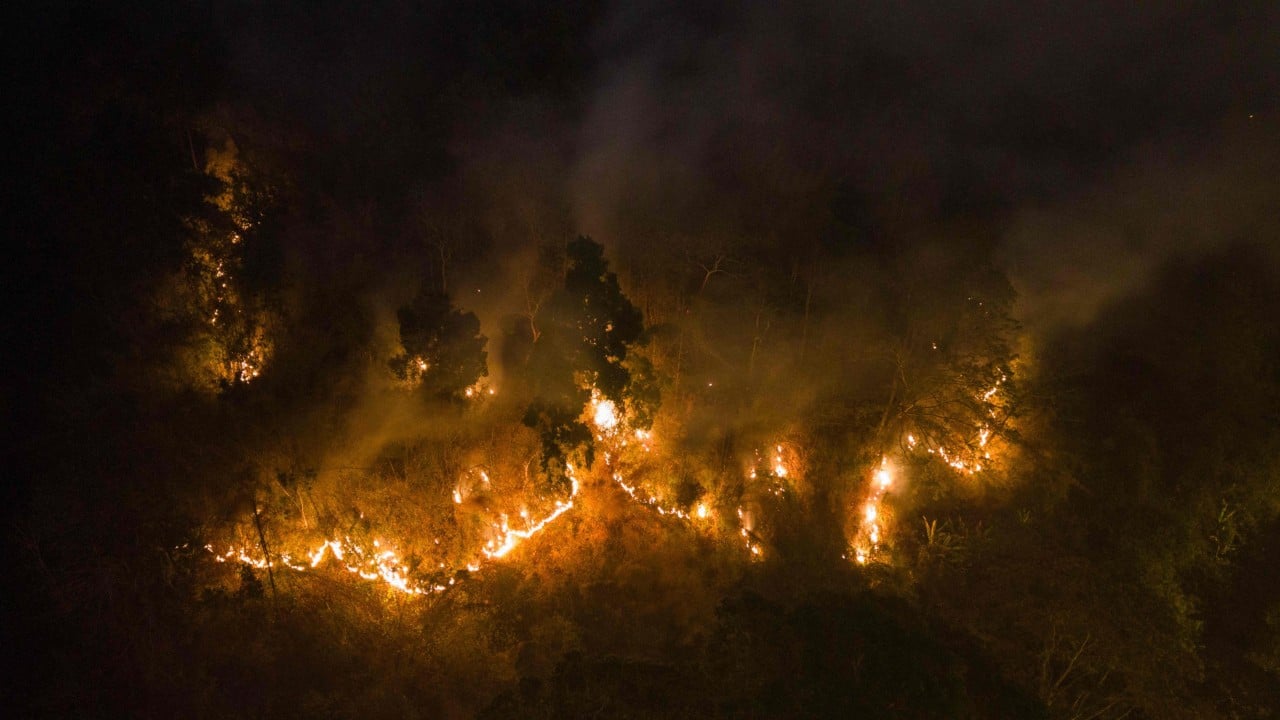
The cyclical incineration of the Mekong subregion is not a series of isolated "natural disasters" but a predictable outcome of a rigid agricultural economic model meeting specific atmospheric constraints. While media reports focus on the visual severity of the smoke, the underlying crisis is a failure of land-management logistics and the absence of a cross-border carbon-enforcement mechanism. The current air quality crisis in Thailand, Laos, and Myanmar represents a total breakdown of the regional "Zero Burn" policy, revealing that the cost of compliance for small-scale farmers remains exponentially higher than the cost of environmental degradation.
The Topographic Trap and Thermal Inversion Physics
The severity of the haze in Northern Thailand and the surrounding Mekong region is dictated by the Transboundary Haze Mechanism, a three-part intersection of topography, meteorology, and land-use patterns. Unlike coastal regions where maritime breezes disperse particulate matter, the valleys of the North act as a physical containment vessel.
- Thermal Inversion Layers: During the dry season, a layer of warm air settles over the cooler air trapped in the mountain basins. This acts as a physical lid, preventing the vertical dispersion of $PM_{2.5}$ (particulate matter with a diameter less than 2.5 micrometers).
- The Orographic Barrier: The Daen Lao and Thanon Thong Chai mountain ranges create a stagnant air mass. Even when active burning stops, the concentration of pollutants remains high because the air exchange rate is near zero.
- Diurnal Wind Stagnation: Nighttime cooling causes air to sink into the valleys, concentrating the smoke precisely at the altitudes where human settlements are most dense.
The result is a concentration of $PM_{2.5}$ that frequently exceeds 200 $\mu g/m^3$, far surpassing the World Health Organization’s recommended 24-hour mean of 15 $\mu g/m^3$. This is not merely "bad air"; it is an atmospheric failure where the environment's carrying capacity for pollutants has been breached.
The Economic Cost Function of Agricultural Residue
The primary driver of the fires is the management of agricultural waste, specifically in the maize and sugarcane supply chains. To understand why fires persist despite heavy fines, one must analyze the Negative Externality Equation of a typical upland farmer.
The cost of manual land clearing or mechanized tilling far exceeds the annual profit margins for smallholders. In this economic environment, fire is a rational, albeit destructive, tool for residue management.
- Mechanical Removal Cost: Requires investment in tractors, fuel, and labor. In steep upland terrains, mechanization is often physically impossible.
- Time Constraints: The window between the harvest and the next planting cycle is narrow. Burning clears the land in hours; composting takes months.
- Soil Nutrient Mythos: While burning provides a temporary flush of potassium-rich ash, it destroys the long-term soil microbiome and organic carbon content, forcing a dependency on chemical fertilizers.
The supply chain for maize, largely driven by the demand for animal feed, operates on a "contract farming" basis. While large conglomerates distance themselves from the fires via "sustainability codes," the lack of upstream traceability ensures that the burden of waste management remains on the individual farmer. Until the cost of mechanical residue collection is subsidized or internalized by the corporate buyers, the economic incentive to burn will remain undefeated.
Quantifying the Healthcare Bottleneck
The public health impact of the Mekong haze is often discussed in terms of "respiratory issues," but the true crisis is the Long-term Systemic Inflammation Load. $PM_{2.5}$ is small enough to enter the bloodstream, causing systemic damage far beyond the lungs.
- Cardiovascular Strain: High concentrations of particulates lead to acute myocardial infarction and stroke, particularly in populations with existing hypertension.
- Neurodegenerative Risk: Emerging data links prolonged exposure to neuroinflammation, potentially accelerating the onset of dementia and cognitive decline in the aging rural population.
- The Productivity Gap: The economic loss is not limited to healthcare spending. It includes the "hidden cost" of reduced cognitive performance in schools and decreased physical output in the labor force.
Current regional monitoring networks are insufficient. Many sensors are placed in urban centers, neglecting the "hot zones" where the concentrations are highest. This creates a data gap that masks the true scale of the mortality rate associated with seasonal haze.
The Geopolitical Friction of Transboundary Flux
The Mekong haze is a classic "Tragedy of the Commons" on a geopolitical scale. Satellite data consistently shows that a significant percentage of fire hotspots originate in Myanmar and Laos, with the smoke crossing borders into Thailand.
The ASEAN Agreement on Transboundary Haze Pollution has proven ineffective because it lacks a punitive framework. There are three primary frictions preventing a regional solution:
- Sovereignty Hurdles: Thailand cannot enforce land-use laws in Laos or Myanmar.
- Economic Disparity: Demanding that neighboring countries stop burning without providing the capital for alternative machinery creates a diplomatic stalemate.
- The "Laundering" of Commodities: Crops grown on burned land in one country are often sold across borders, effectively laundering the environmental damage into the legal global supply chain.
[Image showing satellite detected hotspots across Thailand, Myanmar, and Laos borders]
Technical Limitations of the Current Response
Current government interventions focus on two primary tactics: "Cloud Seeding" and "Water Spraying." From an engineering perspective, these are largely performative.
- Cloud Seeding (Artificial Rain): Requires specific humidity and cloud density conditions that are rarely present during the peak dry season. Even when successful, it provides only temporary, localized relief.
- Urban Water Cannons: The scale of the atmosphere is too vast for ground-level water spraying to have any measurable effect on $PM_{2.5}$ concentrations. It is a visual placebo rather than a technical solution.
The failure of these reactive measures highlights the need for a shift toward Predictive Analytics and Precision Forestry.
The Logistics of a Post-Burn Economy
A transition away from the burning model requires a fundamental restructuring of rural logistics. If the residue cannot be burned, it must be valued.
- Biomass Valorization: Converting maize husks and stalks into fuel pellets or bio-char. The bottleneck here is not technology, but the Collection Logistics. The cost of transporting low-density agricultural waste from remote hillsides to a central processing plant is currently prohibitive.
- Remote Sensing and Enforcement: Utilizing high-resolution satellite imagery (Sentinel-2 or Landsat) combined with AI-driven fire detection allows for real-time monitoring. However, enforcement requires "boots on the ground" which are often missing in remote border regions.
- Carbon Credit Integration: Farmers could be paid to sequester carbon through no-till farming and residue retention. For this to work, the carbon market must be accessible to smallholders, requiring a digital verification system that does not currently exist at scale in the Mekong region.
The Strategic Shift Toward Supply Chain Accountability
The only viable path forward involves shifting the liability from the farmer to the aggregator.
- Satellite-Linked Traceability: Mandating that every ton of maize or sugar purchased by a conglomerate be linked to a specific GPS-tagged plot. If that plot shows a fire hotspot on satellite data during the harvest window, the crop is disqualified from the premium market.
- Incentivized Mechanization: Large-scale agricultural buyers must provide the tilling and baling equipment as part of the contract service, treating waste management as a core operational cost rather than an external farmer responsibility.
- Cross-Border Carbon Levies: Thailand, as the regional economic leader, could implement a "Smoke Tax" on imported agricultural goods from regions with high fire counts, using the revenue to fund transboundary fire-fighting initiatives.
The current strategy of "begging for cooperation" is a proven failure. The atmospheric conditions of the Mekong region are a fixed variable; the only adjustable variables are the economic incentives and the logistical infrastructure of the agricultural sector. Without a structural shift in how agricultural waste is valued and moved, the seasonal collapse of air quality in the Mekong basin will remain an inevitable certainty.