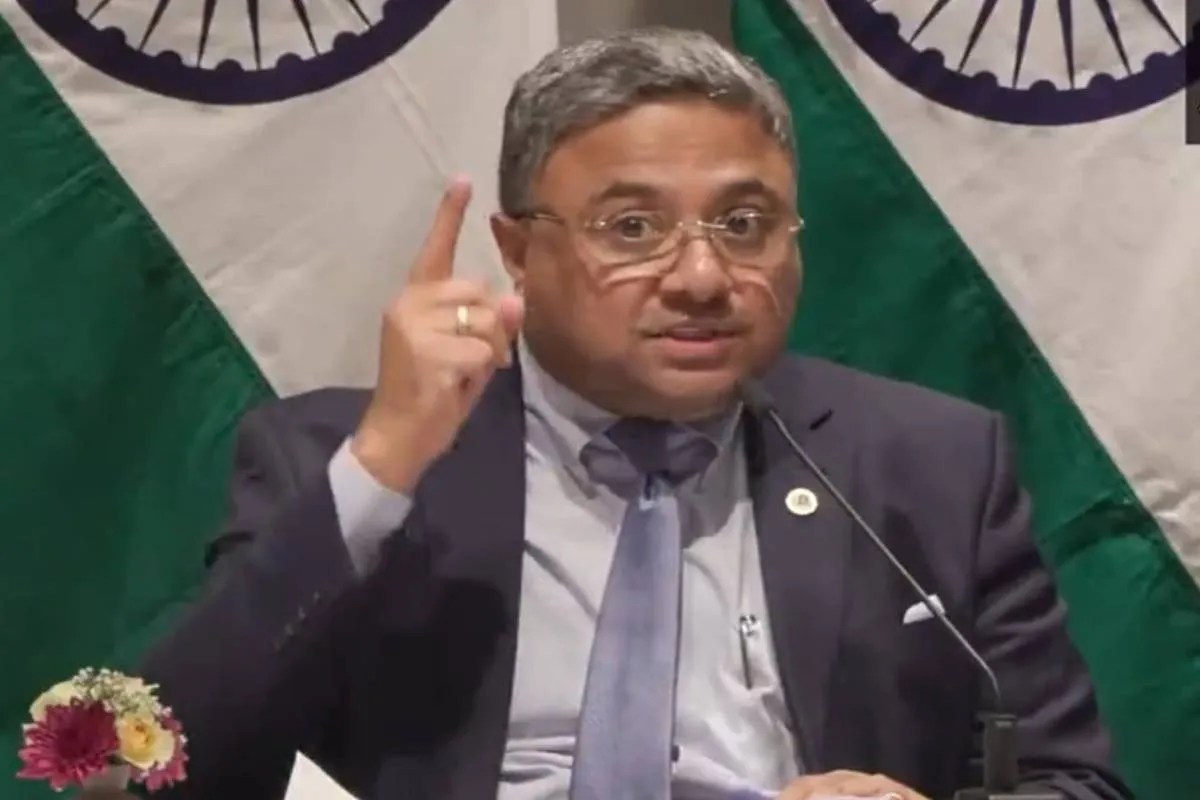
The room in Raisina Hills always smells faintly of old wood, brass polish, and the quiet, heavy air of history. It is a space where words are weighed in metric tons. On a Tuesday that felt like any other, a microphone clicked open. A Western journalist, his voice carrying the distinct, rhythmic cadence of a Nordland upbringing, cleared his throat. He looked across the table at India's External Affairs Minister, S. Jaishankar.
The question he asked was not just a query. It was an inheritance.
"Why should the world trust you?"
The subtext hung in the air, thick and suffocating. It was the familiar tone of a schoolmaster demanding to see a student's homework. For decades, global geopolitics has operated on this exact frequency. A small, wealthy pocket of the globe decides the moral parameters of the planet, while the rest of the world is expected to nod, comply, and queue up for a passing grade.
Jaishankar did not blink. He leaned forward. What followed was not a standard diplomatic boilerplate. It was a masterclass in shifting the tectonic plates of global perception.
The Geography of Perception
To understand the friction in that room, you have to look at a map, but not the one hanging on schoolroom walls. Look at the map of psychological entitlement.
For centuries, a specific cluster of nations has enjoyed the luxury of defining "the world." When a European diplomat says "the international community," they rarely mean Namibia, Peru, or Indonesia. They mean their immediate neighbors and their transatlantic allies. It is a linguistic sleight of hand that shrinks the globe to fit a preferred narrative.
Consider the sheer mathematics of human existence. India is home to 1.4 billion people. That is not just a statistic; it is a living, breathing reality of every fifth human being on Earth. Yet, the question posed by the journalist treated this massive civilizational state as an applicant auditioning for a club whose rules were written when the subcontinent was still a colony.
The Minister's response cut straight to the bone of this absurdity. He did not offer a defensive list of virtues. Instead, he challenged the very premise of the jury.
Trust is not a one-way street where the global South must constantly present its credentials to the global North. If we are talking about credibility, we must look at the track record of those who claim to distribute it. Who ran the global economy into the ground in 2008? Who hoarded vaccines while the developing world watched its citizens die in the streets during the pandemic? The answers to these questions do not lie in New Delhi.
The Sovereign Scale
Step away from the diplomatic corridors for a moment. Look at a small manufacturing unit in Pune or a tech startup in Bengaluru.
A young engineer named Rahul works twelve-hour days developing affordable diagnostic tools. He does not wake up thinking about how to please a think tank in Oslo or Washington. He thinks about how to keep his lights on, how to ensure his parents have access to healthcare, and how to scale his business in a market that moves at breakneck speed.
When Western commentators demand that India align its foreign policy with their immediate moral imperatives—such as cutting off energy ties with traditional partners during European conflicts—they are asking Rahul to pay the price for a theater he did not create.
Europe's problems are the world's problems, but the world's problems are not Europe's problems.
This double standard is the friction point. When India purchases discounted oil, it isn't an act of defiance; it is an act of survival and calculated self-interest. It keeps inflation from crushing hundreds of millions of families who live on the economic margins. To ask a government to sacrifice the well-being of its own citizens to satisfy the ethical aesthetic of a distant capital is not diplomacy. It is a demand for self-harm.
The New Lexicon of Power
The shift we are witnessing is linguistic as much as it is geopolitical. For too long, developing nations spoke the language of supplication. They explained, they justified, they pleaded.
That era has ended.
The response in that press room signaled a new vocabulary. It is the language of parity. It says: We see you, we respect your interests, but we expect you to see ours. It is an acknowledgment that the unipolar world is a ghost. We are living in a multipolar reality where alliances are fluid, issue-based, and fiercely pragmatic.
This confuses the old guard. They look at India's participation in the Quad alongside the United States, while simultaneously engaging with Russia and China in the BRICS format, and they see a contradiction. They call it fence-sitting.
But it isn't fence-sitting. It is owning the fence.
It is the realization that a nation of India's scale does not need to choose a side; it is a side. The country's foreign policy is anchored in its own geography, its own historical memory, and its own future trajectory.
The Weight of the Mirror
When the journalist asked why the world should trust India, the real answer was a mirror held up to the questioner.
Trust is built on consistency. When the West champions state sovereignty in Europe but ignores it when convenient in the Middle East or Asia, the concept of a "rules-based order" begins to erode. It becomes clear that the rules apply only when they protect the interests of the creators.
India's position is grounded in a deep, historical skepticism of these shifting goalposts. The nation has learned, through decades of trial and fire, that its true security lies in strategic autonomy. This autonomy is not isolationism. It is the exact opposite. It is the freedom to engage with everyone on terms of mutual respect rather than subservience.
The world does not need a single moral policeman. It needs a web of reliable partners who understand that stability is not achieved through coercion, but through balance.
The microphone in the Raisina Hills room was eventually switched off. The papers were packed away. The Western journalist sat back, perhaps realizing that the old script no longer worked. The world had grown up, the balance had shifted, and the answers were no longer being dictated from across the ocean. They were being forged right here, in the messy, loud, and uncompromising reality of a subcontinent that refuses to ask for permission to exist.