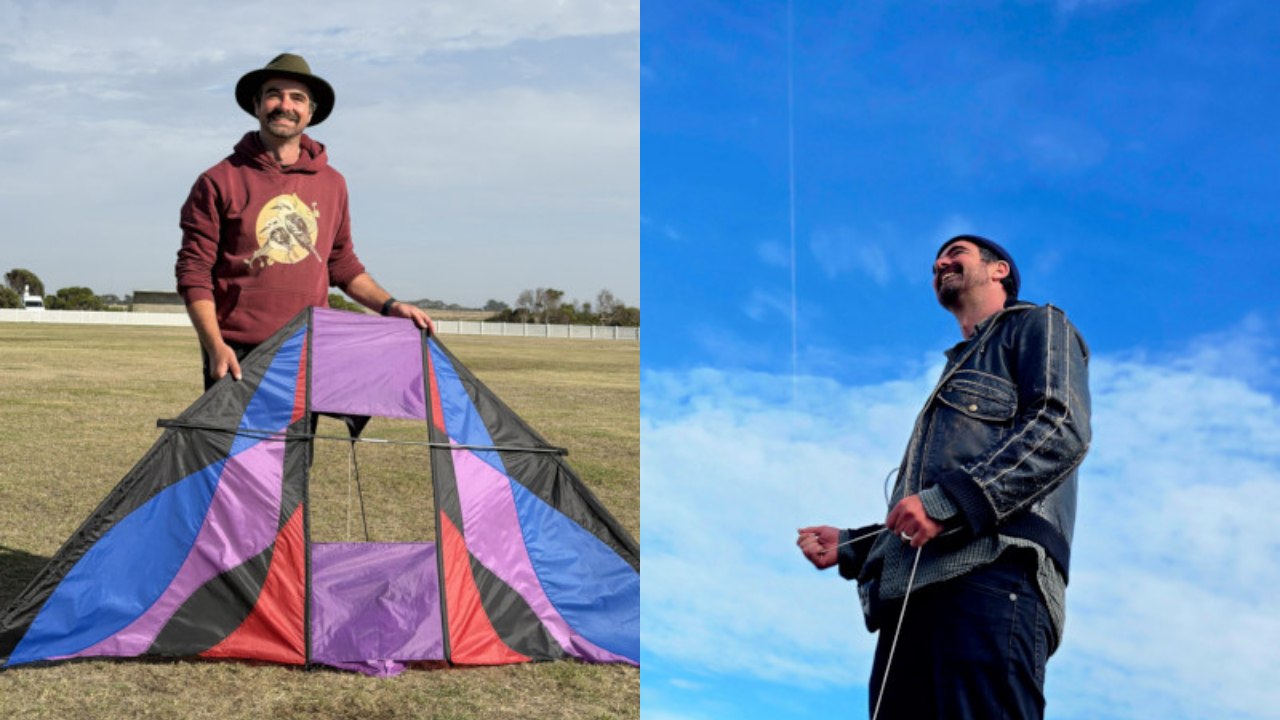
Angus Johnstone stood on a desolate stretch of Australian coastline for twenty-six consecutive hours, his hands gripping a line connected to a kite that refused to descend. This was not a leisurely afternoon pastime or a whimsical hobbyist pursuit. It was a grueling endurance test designed to push human physical and psychological limits for the purpose of charitable fundraising. While most charitable efforts rely on gala dinners or digital donation drives, Johnstone opted for a primitive, exhausting mechanism to capture public attention.
Kite flying, when stripped of its nostalgic connotations, is an exercise in tension management. Holding a kite aloft for a full day and night requires a constant, micro-adjustment of muscle fibers. The wind rarely stays constant. It shifts, gusts, and occasionally drops entirely, forcing the operator to compensate with erratic, exhausting movements. Johnstone bypassed automated retrieval systems or anchors. He held the line himself.
The Physiology of Prolonged Tension
Medical professionals often study repetitive strain injuries in factory workers or office employees, yet the specific toll of holding a taut line for over a day offers a unique case study in isometric fatigue. When a muscle maintains a static contraction for extended periods, blood flow is restricted. The buildup of metabolic waste products in the forearms and shoulders creates a dull, burning sensation that eventually transitions into sharp, localized pain.
Johnstone faced more than just muscle fatigue. Sleep deprivation altered his perception of time. Around the eighteen-hour mark, the human brain begins to prioritize survival functions, shedding non-essential cognitive processing. The rhythmic tugging of the kite, which felt like a conversation at hour two, likely became an oppressive sensory input by hour twenty. The act of standing in one place creates its own form of trauma on the lower back and knees. This is the hidden tax of endurance challenges. The public sees the achievement; the body processes the systemic inflammation.
Why Extreme Charity Events Succeed
Modern philanthropy suffers from donor fatigue. Traditional appeals for funding have lost their ability to shock or inspire. When someone organizes a marathon or a bake sale, it barely registers on the collective consciousness. By contrast, an act of singular, absurd endurance—like flying a kite for twenty-six hours—cuts through the noise. It forces a question. Why would a sane individual subject themselves to such misery?
That question acts as the primary hook. The charity involved effectively gained a spokesperson who sacrificed his comfort to build a narrative. People do not donate to a charity because of a flyer. They donate because they feel an emotional connection to a human who displayed a level of grit they would never attempt themselves. It is a cynical calculation, perhaps, but it is undeniably effective. The spectacle provides the legitimacy that a standard press release lacks.
The Mechanics of the Kite Line
The kite itself was not a toy. It was a specialized tool built for stability and lift. In high-wind environments, the line tension can reach hundreds of pounds of pressure. To keep such a device in the air for twenty-six hours, Johnstone had to calculate the trade-off between drag and lift with surgical precision. If the wind died, he had to be ready to run to generate artificial lift. If the wind spiked, he had to know how to dampen the vibration before the line snapped or his grip failed.
This is where the amateur perspective fails. People assume kites drift peacefully. In reality, they are fighting the wind. The kite is a captured vessel of kinetic energy. Holding that energy requires a deep, intuitive understanding of fluid dynamics. Johnstone, as a teacher, likely understood the underlying mathematics, but the application was entirely visceral. He became a human anchor, his body serving as the final connection between the earth and the atmospheric currents.
Public Perception and the Teacher Archetype
There is a cultural gravity to the figure of the teacher engaged in a challenge. We expect teachers to be measured, patient, and restrained. When a teacher steps outside that box to perform an act of physical extremity, the reaction is magnified. It validates the idea that ordinary people—those who spend their days in classrooms or offices—possess a latent reservoir of capability that only reveals itself under duress.
The news cycle latches onto this because it is easy to frame. It avoids the complexities of institutional failures or systemic problems. A man flying a kite is a neat, contained story. It requires no deep political analysis. It requires only an appreciation for the spectacle. Yet, beneath that surface, there is the reality of the hours he spent shivering in the dark. The cold at 3:00 AM is a different beast than the heat of the afternoon. The isolation becomes absolute. When the sun finally rose on the second day, the kite was likely the only thing tethering his focus to the physical world.
The Limits of Performative Endurance
Critics might argue that such feats are mere performative art, doing little to address the root causes of the issues they support. There is truth in that. A single kite flyer does not overhaul the healthcare system or eliminate poverty. However, expecting individual charitable acts to solve structural inequality is a fundamental misunderstanding of how society functions. These events serve a different function: they act as a momentary rallying point.
For the donor, the act of giving money to support someone who spent twenty-six hours fighting the wind is a way to participate in that grit. They aren't just paying for a service; they are subsidizing a moral triumph. The fact that the kite eventually came down is irrelevant. The point was the duration. It was a demonstration of a refusal to quit, a trait that is in short supply.
Sustaining the Effort
The logistics of such an attempt are rarely discussed. Hydration, calorie intake, and bathroom breaks all require assistance. No one does this entirely alone. There is a support crew hidden in the periphery—people holding flashlights, checking pulse rates, and ensuring the line remains clear of obstacles. This is the reality of all extreme endurance. It is always a team effort masquerading as an individual feat.
True endurance is not about the peak moment of completion. It is about the ability to ignore the signals from the nervous system that demand rest. Johnstone demonstrated that the threshold for pain is largely a matter of psychological framing. Once you decide that the kite will not touch the ground, the body is forced to fall into line. Whether that lesson carries over into the classroom is a matter for his students to decide. For the rest of us, it is a reminder that the human capacity for sustained, focused discomfort is deeper than we care to admit.
He didn't just fly a kite. He occupied a space between the earth and the void, proving that even a simple string and a frame of nylon can become a stage for human willpower. The wind eventually shifts, the line eventually wears thin, and the muscles eventually seize, but the moment of standing firm against the elements remains. The charity received their funds, the observers received their spectacle, and the teacher returned to his life, likely looking at the sky with a changed perspective on what it means to hold on.