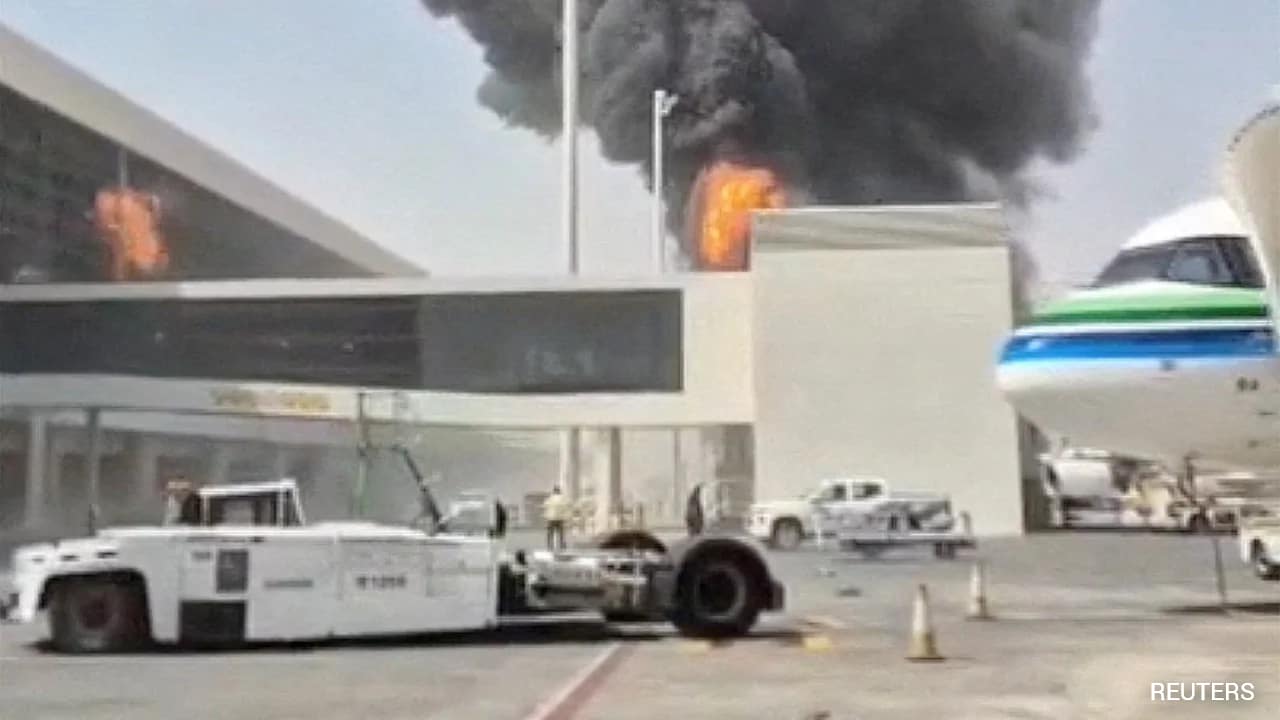
Mainstream aviation coverage treats King Khalid International Airport resuming operations after a Houthi warning like a reckless game of geopolitical chicken.
It isn't.
Every lazy wire report frames this binary choice as either "reckless hubris by Saudi authorities" or "business as usual." Both takes miss the brutal operational math behind modern airspace management, war-risk underwriting, and asymmetric deterrence. When an airport serving tens of millions of passengers keeps its runways open despite militant threats, nobody in the control tower is flipping a coin. They are executing a cold, calculated risk-mitigation protocol that mainstream journalists rarely bother to understand.
I have spent over a decade analyzing route network resilience and aviation security across contested corridors in the Middle East. I have watched airlines burn millions rerouting widebodies around phantom threats while missing actual kinetic vulnerabilities sitting right beneath their flight paths. If you are looking at Riyadh's decision through the lens of a press release from Sanaa, you are asking the wrong question entirely.
The Myth of the "Binary" Airspace Closure
Most travelers—and plenty of armchair defense pundits—assume airspace works like a light switch. Either a sky is safe, or it is a no-fly zone.
That is pure fiction.
In reality, civil aviation operates on granular, layered risk matrices governed by standards from the International Civil Aviation Organization (ICAO) and national civil aviation authorities like Saudi Arabia's General Authority of Civil Aviation (GACA). Under ICAO Doc 10084 (the Risk Assessment Manual for Civil Aircraft Operations Over or Near Conflict Zones), threat assessments are broken down by altitude, weapon capability, trajectory probability, and active air defense coverage.
When the Houthi movement issues a blanket "unsafe" warning for Riyadh, they are engaging in psychological area denial. Firing a long-range ballistic missile or launching a one-way attack drone over 1,000 kilometers from northern Yemen to central Saudi Arabia is fundamentally different from targeting low-altitude traffic near a frontline border.
Here is what the surface-level headlines ignore:
- Terminal Defense Saturation: Riyadh sits inside one of the densest, most battle-tested multi-layered air defense umbrellas on the planet, combining Patriot PAC-3 batteries, THAAD systems, and airborne early warning assets. Intercepting high-altitude ballistic trajectories hours before they reach terminal descent is a routine operational reality for Saudi air defense, not an experimental gamble.
- The Economic Cost of Capitulation: Shutting down a primary global hub like Riyadh (RUH) on the basis of a verbal threat hands an adversary a strategic victory at zero cost. If a militant group can ground a G20 capital's flagship airport with a Telegram statement, every commercial hub within 1,500 kilometers becomes permanently uninsurable.
- NOTAM Precision vs. Media Sensationalism: Notice to Air Missions (NOTAM) bulletins do not deal in vague adjectives like "unsafe." They specify exact coordinates, flight levels (FL), and time windows. Resuming operations does not mean ignoring the threat; it means routing arrivals and departures along shielded vectors while holding patterns are shifted away from southern approach corridors.
What the Insurance Underwriters Actually Know
Follow the money, not the press conferences.
Commercial airlines do not fly into Riyadh because a government ministry tells them to. They fly because London’s Lloyd’s market and global aviation war-risk underwriters agree to back the hull and liability policies. An Airbus A350 or Boeing 787 carries a hull value north of $150 million, before factoring in passenger liability limits under the Montreal Convention.
If the actuarial data showed an unmitigated probability of a surface-to-air or ballistic strike on a commercial airliner during takeoff or landing at RUH, war-risk premiums would spike overnight to levels that make ticket prices mathematically impossible. Airlines like Saudia, Flynas, and international carriers connecting through the Gulf would pull metal immediately—just as they did over Ukraine in 2014 and again in 2022, or during acute escalations over Iranian and Iraqi airspace.
The fact that flights resumed proves that actuarial risk models separated rhetoric from kinetic probability.
Underwriters look at three hard variables that journalists ignore:
- Weapon Guidance Limitations: Long-range drones and unguided or inertial-guided ballistic missiles used by Houthi forces are area-effect weapons aimed at fixed infrastructure. They lack the terminal radar homing seekers required to track and engage a commercial jet moving at 250 knots on a dynamic glide slope.
- Electronic Warfare Environments: Modern GPS jamming and spoofing around high-security zones pose a far more frequent operational headache for flight crews than physical shrapnel. Flight decks operating into Riyadh use inertial reference systems (IRS) and ground-based Instrument Landing Systems (ILS) specifically to bypass satellite interference.
- Fuel Reserves and Diversion Infrastructure: Every flight dispatched into a heightened-alert zone carries contingency fuel calculated to reach alternate hubs—such as Dammam, Jeddah, Bahrain, or Dubai—without touching emergency minimums.
Answering the Questions Travelers Are Actually Asking
When headlines scream about missile warnings and airport reopenings, passengers immediately flood search engines with panicked, poorly framed questions. Let's dismantle the worst of them.
"Is it safe to fly through Riyadh right now?"
Asking if an airport is "safe" in absolute terms is the wrong framing. Commercial aviation never operates at zero risk; it operates at managed, acceptable risk. Right now, the statistical probability of an aviation incident at Riyadh due to regional conflict remains orders of magnitude lower than routine weather delays or mechanical diversions. However, "safe" does not mean "predictable." You are far more likely to experience a three-hour tarmac delay, an abrupt airspace hold, or a sudden diversion to Jeddah than you are to see anything out your window.
"Why don't airlines just avoid the Middle East altogether?"
Because geography is non-negotiable. The Arabian Peninsula sits directly astride the primary Europe-to-Asia and Africa-to-Asia trunk routes. Rerouting global widebody traffic north over the Caucasus and Central Asia—while Russian and Ukrainian airspace remain closed to Western carriers—creates an impossible bottleneck over a narrow corridor between the Black Sea and the Caspian Sea. The global aviation system literally lacks the air traffic control capacity and fuel efficiency margins to bypass Gulf hubs without triggering a worldwide supply chain and fare collapse.
"Aren't airlines putting profits ahead of passenger lives?"
This is the laziest trope in aviation journalism. One hull loss destroys an airline's brand equity for a decade, triggers catastrophic regulatory scrutiny, and wipes out billions in market capitalization. Ask Malaysia Airlines how profitable ignoring conflict-zone risk was after MH17. Airlines are ruthlessly self-interested, and their primary self-interest is never losing an aircraft. When they fly, it is because their flight safety departments—staffed by former military aviators and risk analysts—have signed off on the threat matrix.
The Uncomfortable Downside Nobody Mentions
Taking a contrarian stance does not mean pretending the current setup is flawless. There is a massive, underreported flaw in how Gulf aviation handles persistent asymmetric threats, and it has nothing to do with missiles hitting planes.
It is operational normalization.
When air defense interceptions and sudden NOTAM closures become routine background noise, human complacency creeps into the cockpit and the dispatch center. In 2020, the tragic shootdown of Ukraine International Airlines Flight 752 over Tehran demonstrated what happens when an air defense network operates on a hair-trigger while civil airspace remains open during a period of acute military tension. The danger in contested skies is rarely the adversary's weapon hitting a commercial jet by design; it is the fog of war creating misidentification among friendly air defenses or forcing civilian aircraft into congested, unfamiliar holding patterns during an active interception.
Riyadh's air defense network integrates civil radar feeds with military command-and-control far better than most regional neighbors, drastically reducing fratricide risk. Yet every time an airport stays open during an active threat window, the margin for human error narrows.
How Smart Flyers Navigate Contested Hubs
If you are booking travel through Riyadh—or any major hub sitting near a geopolitical fault line—stop reading sensationalist news alerts and start managing your itinerary like a logistics professional.
- Book Direct Hub-to-Hub on Flag Carriers: If airspace closes for four hours due to a security alert, carriers with massive local footprints (like Saudia or Flynas in Riyadh) own the gate slots, crew reserves, and hotel vouchers. Foreign carriers flying one daily rotation will leave you stranded in a terminal for 48 hours while they wait for a relief crew.
- Eliminate Tight Connections: Never book a 55-minute layover in a region prone to sudden airspace holds. A single 30-minute reroute around a restricted sector will break your itinerary. Build a minimum three-hour buffer into any transit through the Gulf.
- Monitor FlightAware and ADS-B Data, Not Social Media: When rumors of an airport shutdown circulate online, open a live flight-tracking map. Look at the arrival stream. If heavy widebodies are actively lining up on final approach at RUH, the airspace is open and underwriters are satisfied. If planes are circling in tight racetrack patterns 150 miles north, pack your patience.
- Understand Your Travel Insurance Exclusions: Standard credit card trip-delay policies almost always contain a "war, civil unrest, or act of terrorism" exclusion clause. If an airport closes due to a military threat, your card issuer will deny your hotel claim. Buy a policy with a specific Cancel For Any Reason (CFAR) or Non-Medical Evacuation rider if your business depends on strict arrival times.
Riyadh reopening its runways isn't a sign that the danger vanished, nor is it proof of reckless hubris. It is a calculated demonstration that modern air defense, actuarial discipline, and network economics refuse to be held hostage by a press release.
Stop watching the headlines from Sanaa, and start watching the departure boards at RUH—because the only vote that counts in aviation is cast by the pilots pushing back from the gate.