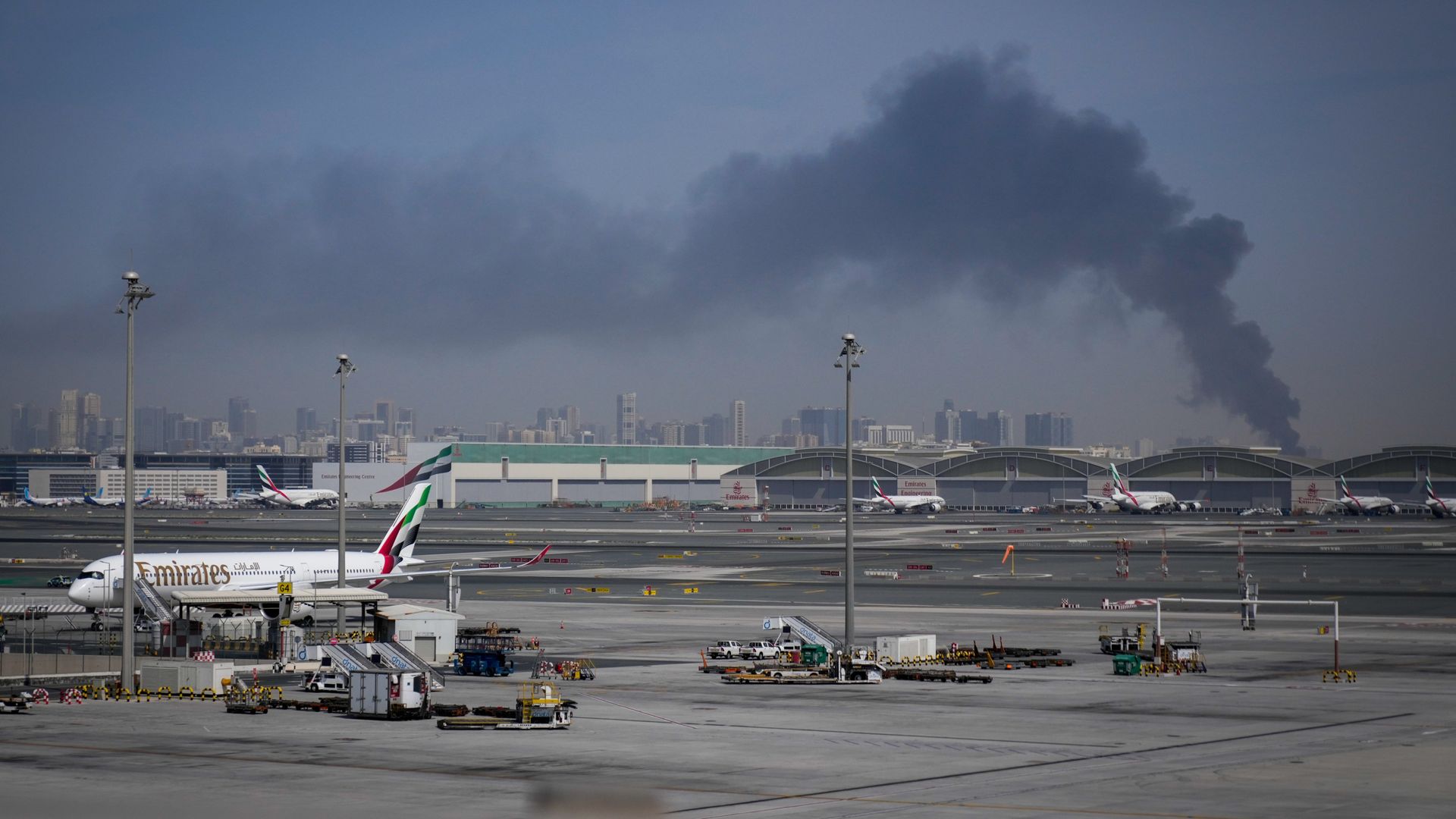
The cancellation of 34,000 flights within the Middle Eastern corridor represents more than a logistical failure; it is a systemic shock to the global aviation network that reveals the fragility of "hub-and-spoke" efficiency in high-volatility environments. When rocket attacks force the closure of sovereign airspace, the resulting disruption propagates through three distinct layers: the immediate kinetic shutdown, the subsequent rerouting penalty, and the long-term erosion of passenger confidence. Understanding this crisis requires moving beyond the raw number of cancellations and examining the underlying cost functions and operational bottlenecks that dictate how an airline—and a region—survives such a rupture.
The Triple Constraint of Airspace Closure
Aviation operations in contested zones are governed by a rigid hierarchy of safety, fuel economics, and crew duty limits. When airports in hubs like Tel Aviv, Amman, or Beirut close, the impact is not localized. It triggers a cascade of failures across the international flight grid.
1. The Kinetic Barrier
The primary cause of the 34,000-flight deficit is the physical inability to utilize runways under active threat. Unlike weather-related delays, which are probabilistic, kinetic threats are binary. If a missile defense system is active, civilian traffic is grounded. This creates a Static Grounding Loop, where aircraft are stuck at the point of origin, unable to reposition for their next scheduled leg. This leads to a 1:4 disruption ratio: for every hour a major hub is closed, it takes approximately four hours to return the localized system to equilibrium, provided no further threats emerge.
2. The Rerouting Penalty
Airspace is a finite resource. When Israeli or Lebanese airspace is declared a No-Fly Zone (NFZ), traffic must be diverted into adjacent corridors, primarily over Cyprus, Turkey, or Saudi Arabia. This creates a Congestion Bottleneck.
- Fuel Burn Volatility: Rerouting a long-haul flight from Europe to Asia to avoid the Levant can add 60 to 90 minutes of flight time. For a Boeing 777-300ER, this translates to an additional 10 to 15 tons of fuel.
- Payload Restrictions: To carry the extra fuel required for longer routes, airlines must often reduce "payload"—the weight of passengers and cargo. In many cases, this makes the flight economically unviable before it even leaves the gate, leading to preemptive cancellations.
3. Crew Legal Limits
Aviation safety regulations strictly govern "Flight Duty Periods" (FDP). When a flight is rerouted or delayed due to airspace closures, crews often "time out." Because airlines cannot easily stage backup crews in conflict zones, a single diverted flight can result in the cancellation of the next three days of that aircraft's schedule as the airline struggles to get a fresh crew to the new location.
Mapping the Financial Erosion
The loss of 34,000 flights creates a direct revenue vacuum, but the secondary costs are often more damaging to an airline’s balance sheet. We can categorize these losses into Sunk Costs, Operational Spikes, and Liability Bloat.
Fixed Cost Absorption
Airlines are high-fixed-cost businesses. Even when 34,000 flights are cancelled, lease payments on aircraft, hangar fees, and salaried staff costs continue. When a fleet is grounded, the "Unit Cost per Available Seat Kilometer" (CASK) skyrockets because there are no "Available Seat Kilometers" to spread the costs across.
Insurance and Risk Premiums
Operating in or near a conflict zone triggers "War Risk" insurance premiums. These are not static. They are calculated on a per-flight basis and can increase by 500% within hours of a rocket attack. For many low-cost carriers (LCCs), these premiums alone exceed the profit margin of the flight, forcing a strategic withdrawal from the market until the risk profile stabilizes.
Passenger Rights and Re-accommodation
Under regulations such as EU261 (for flights originating in the EU), airlines are often responsible for passenger care, including hotels and meals, even if the cause is "extraordinary circumstances." While they may not have to pay cash compensation for rocket attacks, the logistical cost of housing thousands of stranded passengers in expensive hub cities like Dubai or Istanbul creates a massive cash-outflow event.
The Hub-and-Spoke Vulnerability
The Middle East has built its aviation dominance on the "Mega-Hub" model. Emirates (Dubai), Qatar Airways (Doha), and Etihad (Abu Dhabi) rely on the geographic advantage of being within an 8-hour flight of 80% of the world’s population.
This model relies on Precision Connectivity. A passenger flying from London to Sydney via a Middle Eastern hub has a narrow window—often 90 minutes—to catch their connecting flight. When rocket attacks disrupt the central corridor, the "Spoke" (London) can no longer reach the "Hub," and the entire transit chain collapses. The 34,000 cancellations are a testament to how quickly a centralized network can be dismantled when its core nodes are threatened.
Strategic Shift: From Efficiency to Resiliency
Airlines are now forced to choose between two competing operational philosophies:
- Optimization-First: Maximizing aircraft utilization and minimizing fuel buffers to drive down costs. This model is currently failing.
- Resiliency-First: Maintaining "Hot Spares" (extra aircraft and crews) and carrying "Contingency Fuel" to allow for sudden rerouting. This increases the cost of every ticket but prevents the total system collapse seen in the recent 34,000-flight drawdown.
The current crisis highlights a lack of Modular Airspace Management. Currently, if one sector of airspace is threatened, the entire Flight Information Region (FIR) is often avoided by Western carriers. A more nuanced approach involves "Risk-Based Corridors," where flights are tracked via satellite with real-time telemetry to adjust altitudes and headings based on active threat detection. However, this requires a level of international cooperation that currently does not exist.
The Intelligence Gap in Passenger Confidence
The data shows that cancellations are not the only metric of failure; "Book-to-Fly" ratios have plummeted. Even when flights are technically available, demand has softened due to the Predictability Deficit.
Travelers prioritize the certainty of arrival over the speed of transit. The shift of traffic away from the Middle Eastern corridor toward trans-Atlantic or trans-Pacific routes—even when those routes are longer—indicates that the market is pricing in the risk of being stranded. This "re-corridoring" of global travel could take years to reverse, as corporate travel departments rewrite their safety protocols to exclude certain hubs.
Structural Decoupling of Regional Aviation
The long-term result of this disruption is the "decoupling" of Middle Eastern aviation into two tiers.
- State-Backed Giants: Carriers with sovereign wealth backing can absorb the losses of 34,000 cancellations and wait for the market to return. They use this period to modernize fleets and grab market share from weakened competitors.
- Private and Low-Cost Carriers: LCCs operate on razor-thin margins. For them, a 10% cancellation rate is an existential threat. We are likely to see a consolidation phase where smaller regional players are absorbed or go bankrupt, leaving a less competitive and more expensive travel environment.
Aviation authorities must move away from reactive groundings and toward a Proactive Vectoring Model. This involves the integration of military-grade situational awareness into civilian Air Traffic Control (ATC) systems. Until airlines can prove to insurers and passengers that they can navigate around kinetic events with 99.9% reliability, the 34,000-flight cancellation figure will not be an anomaly, but a recurring benchmark of regional instability.
Airlines should immediately diversify their hub dependencies. Relying on a single geographic chokepoint is no longer a viable 20-year strategy. Carriers must invest in "Ghost Hubs"—secondary airports in stable regions equipped with the fuel and maintenance infrastructure to act as immediate relief valves when primary corridors fail. The cost of maintaining this redundancy is high, but the cost of total network paralysis is higher.