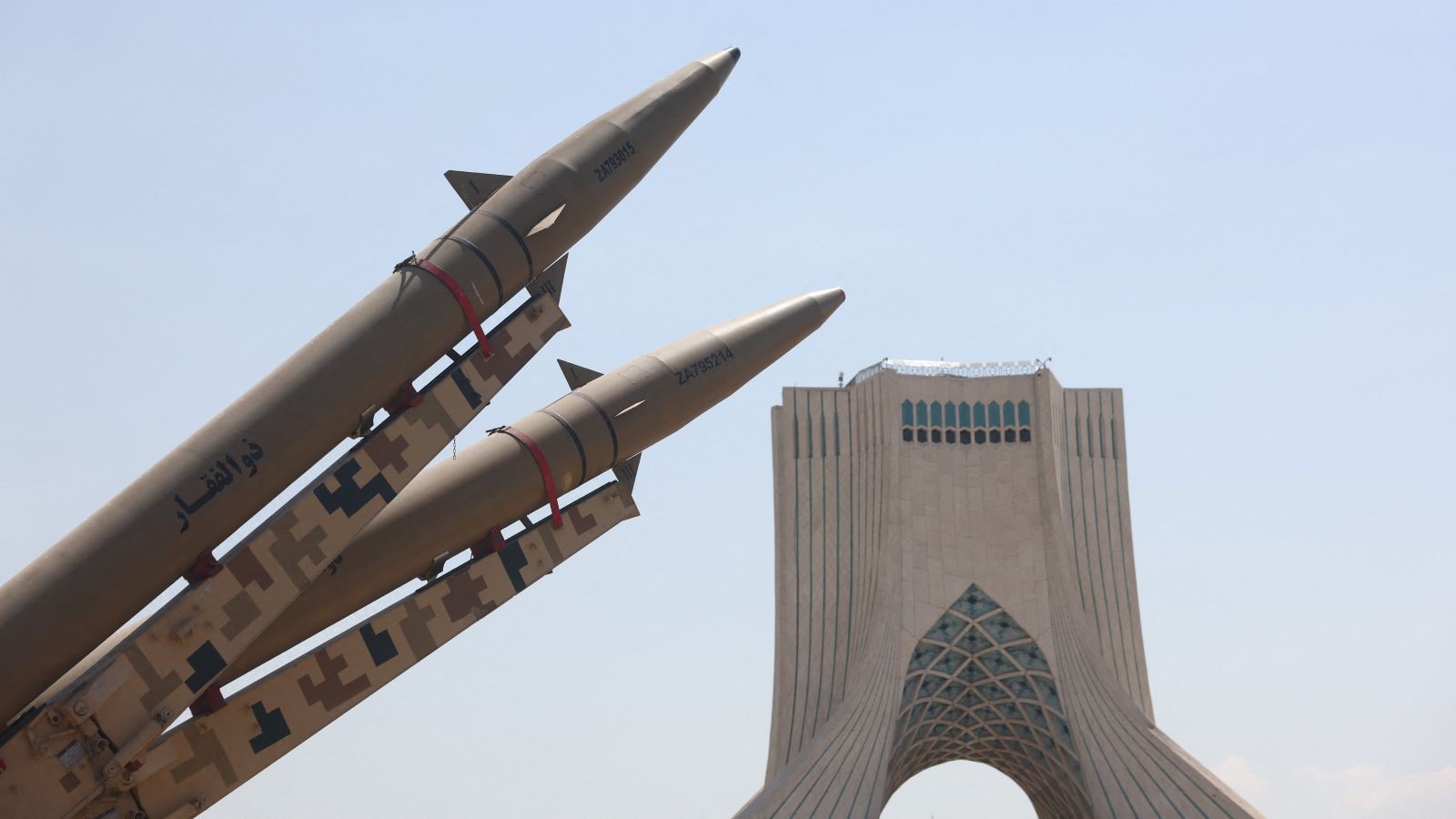
Military attrition campaigns rarely fail because an attacker runs out of targets; they fail when the cost of neutralizing surviving, hardened assets exceeds the strategic return of the strike. Intelligence assessments indicating that Iran retains an estimated 2,500 ballistic missiles following coordinated U.S. and Israeli air operations reveal a fundamental asymmetry in modern missile warfare. Kinetic strikes can degrade fixed infrastructure, radar arrays, and exposed launch pads, yet a dispersed, subterranean, and mobile missile force operates under an entirely different survival curve than conventional air or armored formations.
Understanding how an arsenal of roughly 2,500 missiles persists requires moving past simplistic body-count metrics. Journalists often treat a missile stockpile as a static pile of inventory that shrinks linearly with every airstrike. In operational reality, a ballistic missile force is a distributed network composed of hardened storage, mobile transporter-erector-launchers (TELs), decentralized command nodes, and domestic reconstitution pipelines. When an external force strikes that network, it encounters diminishing marginal returns almost immediately. Also making headlines in this space: The Mosquitoes Over Manama And The Quiet Fracture Of American Deterrence.
The Architecture of Arsenal Survivability
To evaluate why up to 2,500 missiles remain viable, analysts separate the physical munitions from the kill chain required to fire them. A missile sitting inside a reinforced tunnel is inert until mated with a launcher, fueled, fed targeting telemetry, and exposed to open sky. U.S. and Israeli strike packages primarily target the exposed nodes of this system, yet Iran spent decades engineering its missile enterprise specifically to survive an overwhelming first strike by superior air forces.
Subterranean Hardening and the Overburden Problem
Iranian military doctrine relies heavily on deep underground facilities—often referred to in defense literature as "missile cities"—excavated beneath mountainous terrain across western and central provinces. Additional details on this are explored by Al Jazeera.
- Geological Shielding: Unlike surface bunkers constructed from reinforced concrete, tunnels bored hundreds of meters into solid granite or limestone neutralize standard precision-guided munitions. Destroying these facilities requires specialized earth-penetrating weapons (EPWs) delivered repeatedly against identical coordinates to collapse tunnel portals or fracture structural ceilings.
- Portal Redundancy: Deep storage complexes feature multiple dispersed entry and exit shafts separated by kilometers of rugged topography. Collapsing two entrances does not destroy the inventory inside; it merely imposes an engineering delay while heavy equipment clears rubble or shifts munitions to secondary exits.
- Internal Decoupling: Blast doors and compartmentalized galleries prevent a single sympathetic detonation from cascading through an entire storage complex. Even if an airstrike breaches one section, adjacent bays remain intact.
The Launcher Bottleneck
Counting warheads without counting launchers produces a distorted picture of operational threat. A state can possess 2,500 missiles, but its actual salvo capacity—the number of weapons it can fire simultaneously to saturate enemy air defenses—is strictly capped by the number of surviving Transporter-Erector-Launchers (TELs).
Modern ballistic missile doctrine hinges on salvo size. Air defense architectures like Arrow, David's Sling, Patriot, and THAAD calculate interception probabilities per incoming threat. If an attacker fires ten missiles, modern interceptors can achieve high kill rates. If an attacker fires 150 missiles simultaneously, interceptor magazines deplete and radar tracking channels saturate.
Strikes against Iran's missile force prioritize TELs because destroying one mobile launcher effectively neutralizes multiple reloads. However, TELs are engineered for concealment. Commercial truck chassis disguised as civilian freight haulers blend into highway traffic, move at night, and hide inside industrial warehouses or agricultural structures. Finding a mobile launcher before it fires requires persistent overhead intelligence, surveillance, and reconnaissance (ISR) paired with sub-minute sensor-to-shooter timelines—a difficult standard to maintain across a territory exceeding 1.6 million square kilometers.
Solid vs. Liquid Propellant Dynamics
The composition of the remaining 2,500-missile inventory dictates how fast those weapons can be deployed under active aerial surveillance. Ballistic missiles fall into two distinct operational categories based on their propulsion chemistry, and each carries radically different vulnerability profiles.
Liquid-Fueled Systems
Older Iranian platforms—such as variants of the Shahab and Ghadr series—rely on liquid propellants. These systems present severe operational liabilities during an active air campaign:
- Extended Pre-Launch Exposure: Liquid fuels are often corrosive and toxic, meaning missiles are stored empty and fueled immediately prior to launch. Fueling requires specialized tanker trucks, transfer hoses, and ground crews operating in the open for 30 to 90 minutes.
- Thermal and Visual Signatures: A fueling convoy creates a large, unmistakable footprint for satellite imagery and unmanned aerial vehicles. Strikes frequently catch liquid-fueled units during this preparation window.
- Logistical Tail: Every launch requires not just a TEL, but a convoy of support vehicles carrying oxidizer, fuel, and power generators, multiplying the number of targets an adversary can detect.
Solid-Fueled Systems
Over the past decade, Tehran shifted production toward solid-propellant designs, including the Fateh-110 family, Zolfaghar, Kheibar Shekan, and Haj Qasem. Solid-fuel rockets cast the propellant directly into the motor casing during manufacturing.
- Shoot-and-Scoot Compression: Because the fuel is already onboard, a solid-fuel TEL can emerge from a tunnel, elevate the missile, receive digital coordinates, fire, and return to cover in under ten minutes.
- Reduced Footprint: Eliminating fuel tankers shrinks the convoy to a single vehicle. By the time overhead sensors detect the launch plume and cue a strike aircraft, the launcher is often already back underground.
- Extended Shelf Life: Solid motors remain stable for years with minimal maintenance, allowing deep underground vaults to hold ready-to-fire rounds indefinitely without degradation.
The persistence of 2,500 missiles suggests that strikes successfully degraded fixed production plants and exposed liquid-fuel infrastructure, while a substantial fraction of the solid-fuel inventory—and its associated mobile launchers—remained insulated from kinetic targeting.
The Economics of Asymmetric Attrition
Evaluating the U.S. intelligence estimate requires examining the cost-exchange ratio between offensive ballistic missiles and defensive interceptors. In warfare, numbers do not exist in a vacuum; they interact with industrial manufacturing capacity and unit economics.
Interceptor Depletion Rates
Every ballistic missile launched toward defended territory forces the defender to expend high-end air defense munitions. Standard doctrine often dictates firing two interceptors per incoming ballistic target ("shoot-look-shoot" or dual-salvo doctrine) to ensure high probability of kill against warheads carrying heavy payloads or decoys.
- Cost Asymmetry: A single Iranian medium-range ballistic missile (MRBM) costs an estimated $1 million to $3 million to manufacture domestically, utilizing sanctioned-workaround supply chains and indigenous tooling. Conversely, a single advanced exo-atmospheric or upper-tier interceptor—such as an Arrow-3, SM-3, or THAAD round—costs between $3 million and $15 million.
- Production Bottlenecks: High-end interceptors rely on complex seeker heads, rare earth elements, and precision microelectronics. Global production lines for these interceptors yield hundreds of units per year, not thousands. If an adversary retains 2,500 missiles, even a 50 percent attrition rate of launchers leaves enough warheads to exhaust regional interceptor stockpiles during prolonged, multi-wave exchanges.
The Intelligence Uncertainty Interval
When intelligence agencies report "up to 2,500 missiles," that phrasing reflects deliberate analytical hedging rather than precise inventory accounting. Battle Damage Assessment (BDA) against subterranean and mobile targets suffers from structural blind spots:
- Concealment vs. Destruction: Satellite imagery can confirm that a warehouse roof collapsed or a tunnel entrance caved in. It cannot confirm how many missiles were inside that warehouse prior to the strike, nor whether the munitions inside a collapsed tunnel were crushed or merely trapped.
- Decoy Saturation: Modern military forces deploy high-fidelity inflatable, wooden, and metallic decoys equipped with radar reflectors and thermal emitters. Strikes frequently destroy decoys that register as confirmed TEL kills in initial post-strike assessments, inflating estimates of enemy attrition until signals intelligence or human sources reveal the true surviving count.
- Pre-Strike Dispersal: Major air operations rarely achieve complete strategic surprise. Diplomatic friction, naval deployments, and tanker movements telegraph impending strikes days or weeks in advance. During that warning window, missile commands disperse warheads out of known depots into undocumented civilian infrastructure, skewing baseline intelligence models.
Reconstitution and Supply Chain Resilience
An intelligence estimate of 2,500 missiles is a snapshot in time, not a permanent ceiling. Kinetic strikes target active inventory and visible factories, yet ballistic missile manufacturing is modular.
The Planetary Mixer Bottleneck
The true chokepoint in solid-fuel missile production is not the airframe—which relies on standard metallurgical techniques—but the planetary mixer, the specialized industrial machine used to blend solid rocket propellant without triggering catastrophic friction explosions.
Airstrikes targeting known propellant mixing facilities impose severe delays on new solid-motor production. However, planetary mixers can be relocated underground, and smaller batch mixers can be distributed across dozens of dual-use chemical or industrial workshops. While precision strikes can halt mass-production assembly lines, halting artisanal or decentralized manufacturing entirely requires continuous, multi-month bombing campaigns combined with airtight interdiction of precursor chemicals like ammonium perchlorate.
Guidance and Microelectronics
Modern Iranian missiles achieve terminal accuracy through inertial navigation systems (INS) paired with commercial-grade satellite navigation receivers and, in newer variants, maneuverable reentry vehicles (MaRVs) equipped with aerodynamic fins.
- Component Miniaturization: Guidance packages are small enough to fit inside a briefcase. Stockpiling thousands of gyroscopes, accelerometers, and microprocessors requires minimal physical space and cannot be targeted effectively from the air.
- Supply Chain Adaptation: Decades of sanctions forced procurement networks to rely on shell companies, dual-use commercial electronics, and modular designs that accept substitute chips when primary suppliers are cut off. Destroying a missile assembly plant does not destroy the hidden warehouses holding the microelectronics needed to outfit future airframes.
Strategic Implications for Deterrence and Campaign Design
A surviving arsenal of up to 2,500 ballistic missiles fundamentally alters the strategic calculus for Washington, Jerusalem, and regional Gulf states. Even if half of those missiles are older, less accurate models, and even if launcher attrition limits simultaneous salvo sizes to dozens rather than hundreds, the sheer volume creates persistent coercive leverage.
The Shift from Counterforce to Counter-Logistics
Attempting to eliminate every remaining missile through aerial bombardment faces a steepening cost curve. Once the obvious above-ground depots, radar sites, and fixed launch complexes are destroyed, finding the remaining mobile units consumes vast amounts of ISR flight hours and precision munitions for marginal gains.
- Targeting the Enablers: Effective degradation shifts away from hunting individual warheads and focuses instead on destroying the specialized support ecosystem: propellant chemical plants, precision CNC machining centers, TEL maintenance depots, and encrypted command-and-control fiber hubs.
- Sustained ISR Persistence: Suppressing mobile launchers requires continuous, unblinking surveillance over launch boxes—geographic zones within range of target nations—paired with loitering munitions or armed drones capable of striking within the five-to-ten-minute window a solid-fuel TEL exposes itself.
- Industrial Scaling of Defenses: Because offensive missiles remain cheaper and easier to hide than interceptors are to build, defensive strategy must pivot toward directed-energy weapons (high-energy lasers) and lower-cost kinetic interceptors to invert the unfavorable cost-exchange ratio.
Operational Reality Going Forward
The persistence of 2,500 missiles proves that air power alone rarely achieves total disarmament against an adversary that has spent thirty years burying its strategic assets. Attrition campaigns degrade peak capacity—forcing an opponent to fire smaller, less coordinated salvos with older, less accurate munitions—but they do not eliminate the threat entirely.
Strategic planners must operate under the assumption that a hardened missile force retains a survivable second-strike reserve. Rather than relying solely on offensive strikes to zero out an adversary's inventory, containment requires combining continuous disruption of solid-propellant production bottlenecks, aggressive interdiction of precursor supply chains, and rapid expansion of low-cost interceptor manufacturing to outlast the remaining stockpile.


