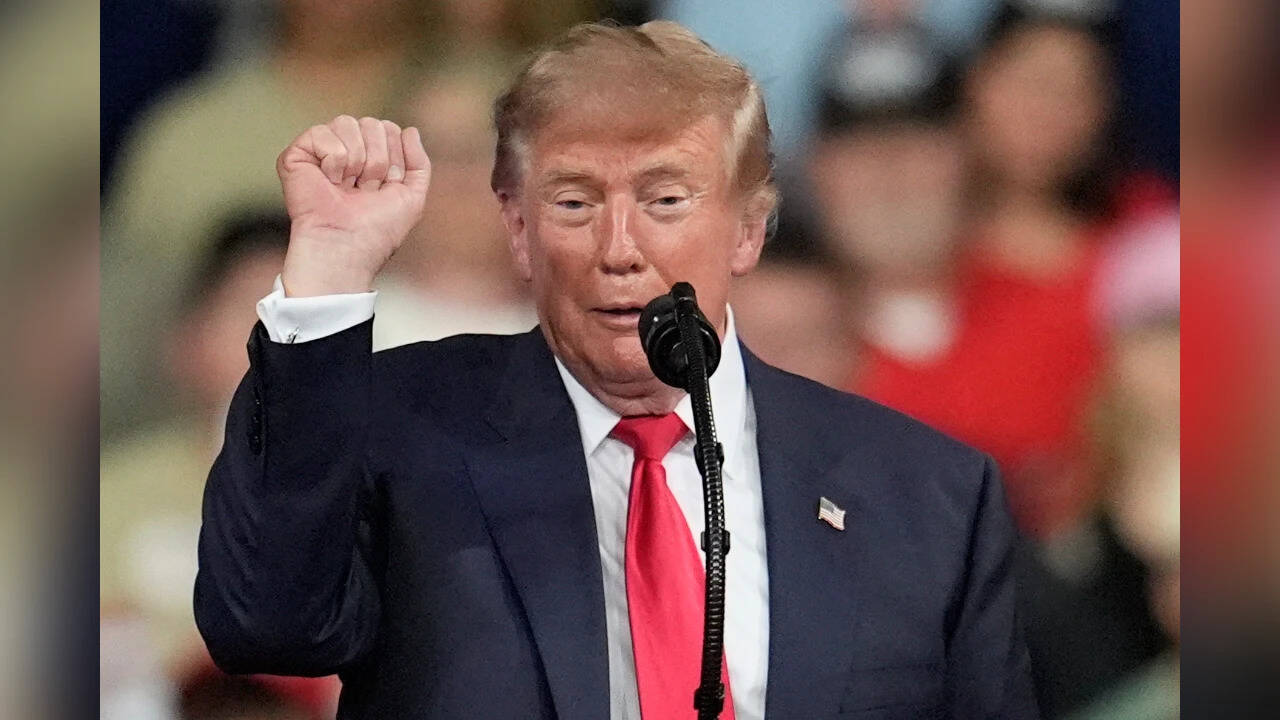
When former President Barack Obama steps onto a campaign stage and characterizes Donald Trump’s political brand as an exercise in "chaos and cruelty," he is executing a calculated rhetorical strategy designed to mobilize exhausted swing voters and disillusioned moderates. Rather than debating granular tax policy or legislative minutiae, Obama condenses years of political grievance into two visceral words. The tactic shifts the election from a referendum on current economic anxieties to a moral and temperament test, betting that voters fear institutional instability and personal vindictiveness more than they dislike the status quo.
Most political coverage treats these rally speeches as routine partisan theater. Reporters quote the sharpest lines, note the crowd's applause, and move on to the next news cycle. That surface-level reading misses the structural mechanics of how modern Democratic messaging operates when the party faces an enthusiasm deficit. Obama is not merely venting frustration; he is road-testing a specific psychological frame intended to neutralize Trump’s strongest appeal—his image as a decisive disruptor.
The Architecture of a Two-Word Framing Strategy
Political communication relies heavily on cognitive shortcuts. Voters rarely read white papers, and they quickly tune out statistics about job growth or inflation rates when those numbers contradict their grocery bills. To break through that noise, campaign strategists look for language that validates an emotional feeling voters already hold but struggle to articulate.
By pairing chaos with cruelty, Obama targets two distinct demographics within the electorate simultaneously.
The word "chaos" speaks directly to suburban moderates, corporate-minded independents, and traditional conservatives who harbor deep reservations about Trump’s governing style. Many of these voters might approve of deregulation or conservative judicial appointments, yet they remain fatigued by the constant stream of legal battles, abrupt personnel firings, and norm-breaking rhetoric that characterized the Trump administration. When Obama invokes chaos, he reminds those voters of the daily exhaustion they felt between 2017 and 2021. He frames Democratic governance not as a radical ideological project, but as a return to predictable, boring competence.
"Cruelty" serves an entirely different function. That word is engineered to awaken the Democratic base, particularly younger progressives, minority voters, and women who may feel alienated by the party’s incrementalism or foreign policy decisions. Disillusioned base voters often stay home when they view an election as a choice between two uninspiring options. Framing the opposition as actively cruel transforms voting from a policy preference into an act of self-defense and moral solidarity.
It is an old political rule. Fear of loss motivates turnout far more reliably than hope for gain.
The limits of the Elder Statesman Playbook
Deploying a popular former president is standard practice, yet Obama’s position within the Democratic coalition has grown noticeably more complicated over the past several election cycles. During his own presidential runs in 2008 and 2012, Obama built his brand on an aspirational message of unity and structural reform. His current role as the party’s primary attack dog requires a sharp pivot toward defensive warning.
This shift exposes a quiet vulnerability in the Democratic strategy. Relying on Obama to generate crowd sizes and media oxygen highlights the party's ongoing struggle to cultivate younger national figures who command similar cultural authority. While Obama can still fill an arena and dominate cable news chyrons for forty-eight hours, his appearances also underscore the passage of time. For a twenty-two-year-old first-time voter, the Obama administration is not a lived political memory; it is a chapter in a history textbook.
Furthermore, the "chaos and cruelty" critique carries diminishing returns among voters who view the existing political system as fundamentally broken. To a working-class voter in a deindustrialized manufacturing town, institutional stability does not sound like a promise of security. It sounds like a guarantee that nothing will ever change.
Trump’s political genius—and the core reason he remains impervious to traditional establishment attacks—lies in his ability to weaponize that exact resentment. When Obama warns of chaos, Trump’s supporters hear a promise that someone is finally willing to wreck a system they believe is rigged against them. What looks like cruelty from a stage in Philadelphia or Atlanta often reads as strength and authenticity to audiences who feel mocked by coastal elites.
How Campaign Surrogates Test and Refine Messaging
Modern presidential and midterm campaigns operate less like traditional political machines and more like high-frequency trading desks. Every phrase delivered by a top-tier surrogate undergoes rigorous message testing through focus groups, dial-testing, and digital sentiment tracking before it ever reaches a teleprompter.
When Obama uses specific phrasing on the trail, those words almost immediately filter down into the talking points of congressional candidates, state party chairs, and allied super PACs. You can watch the synchronization happen in real time across Sunday morning talk shows and digital ad buys.
- Phase One: A high-profile surrogate introduces the core framing at a major rally to generate earned media coverage.
- Phase Two: Digital operations clip the sharpest thirty-second soundbites and distribute them across targeted social media feeds in battleground states.
- Phase Three: Local candidates adopt the exact vocabulary in debates and town halls to create an echo chamber of reinforcement.
- Phase Four: Pollsters measure whether the language moves undecided voters in key swing counties, adjusting the emphasis based on the data.
This disciplined echo chamber explains why political rhetoric often feels repetitive. Campaigns do not care if political reporters grow bored hearing the same lines in five different cities. They care about reaching the low-information voter who only pays attention to politics for fifteen minutes a week while scrolling on their phone.
The Historical Precedent for Temperament Attacks
Attacking an opponent's fitness and temperament rather than their policy platform is hardly a modern invention. American political history is littered with elections decided on questions of character, stability, and perceived extremism.
In 1964, Lyndon B. Johnson’s campaign famously portrayed Republican nominee Barry Goldwater as an impulsive extremist whose election would lead to nuclear catastrophe. The infamous "Daisy" advertisement never mentioned tax rates or healthcare policy; it relied entirely on the visceral fear of instability. Johnson won in a historic landslide because voters decided Goldwater posed an unacceptable risk to national security and domestic calm.
Twelve years later, Jimmy Carter capitalized on public exhaustion following the Watergate scandal and Richard Nixon’s resignation. Carter’s appeal rested heavily on a promise of honesty, decency, and a restoration of moral order to the White House. Voters were less focused on his specific legislative agenda than on putting an end to the institutional turmoil of the preceding decade.
Obama is drawing directly from this historical lineage. By emphasizing chaos and cruelty, he is attempting to place Trump outside the boundaries of normal political disagreement. The argument is simple: you do not have to agree with every Democratic policy proposal to recognize that the alternative poses a threat to basic democratic norms and civil decency.
Why Economic Reality Complicates the Moral Argument
The greatest obstacle facing Obama’s rhetorical push is the stubborn persistence of pocketbook anxiety. Moral arguments about democratic norms and presidential temperament tend to perform best when the economy feels secure and predictable. When voters are worried about housing costs, interest rates, and the price of basic goods, abstract warnings about institutional chaos lose some of their urgency.
Consider a hypothetical family in a battleground suburb of Milwaukee or Phoenix. Suppose their household income has risen over the past four years, yet their purchasing power feels tighter due to cumulative inflation and higher borrowing costs. When they watch Obama deliver a warning about Trump’s cruelty, they might nod in agreement with the critique of Trump’s rhetoric. Yet when they step into the voting booth, they must weigh that discomfort against their dissatisfaction with their current financial footing.
This tension creates a profound strategic dilemma for Democratic strategists. If they focus exclusively on economic statistics, they risk sounding out of touch with voters who feel financially squeezed. If they focus exclusively on Trump’s character and rhetoric, they risk appearing indifferent to the material struggles of working families.
Obama attempts to bridge this gap by arguing that Trump’s policy agenda—specifically broad tariffs, corporate tax cuts, and efforts to repeal healthcare protections—is the ultimate manifestation of both chaos and cruelty. He connects the behavioral critique directly to economic self-interest, warning that erratic leadership inevitably leads to economic disruption for ordinary people.
The Double-Edged Sword of Personalizing the Race
There is an undeniable irony in Obama’s prominence on the campaign trail. Every time he steps up to the microphone to dismantle Trump, he inadvertently reinforces the exact political dynamic that fueled Trump’s rise in the first place.
Trump’s political identity was forged in direct opposition to the Obama presidency. From his early promotion of the birther conspiracy theory to his systematic efforts to undo Obama’s signature legislative achievements, Trump has always used Obama as his primary foil. For a significant portion of the electorate, seeing Obama attack Trump does not provoke shame or reconsideration; it triggers a reflexive tribal defense.
Veteran campaign operatives recognize this risk. They know that turning an election into a personal grudge match between two former presidents locks voters into rigid partisan camps. In a deeply polarized electorate where elections are decided by tens of thousands of votes across a handful of states, hardening the lines can cut both ways. It drives up Democratic turnout in urban centers, while simultaneously energizing rural and exurban conservatives who view Obama as the ultimate symbol of the establishment they despise.
Ultimately, the effectiveness of the "chaos and cruelty" message depends on which group of voters feels a stronger sense of urgency on Election Day. If swing voters decide that stability and institutional predictability outweigh their economic frustrations, Obama’s framing will have done its job. If voters decide they are willing to tolerate turmoil in exchange for disruption, no amount of rhetorical precision from the podium will alter the outcome.
Campaign speeches rarely change minds outright; they simply give hesitant voters permission to act on instincts they already hold.