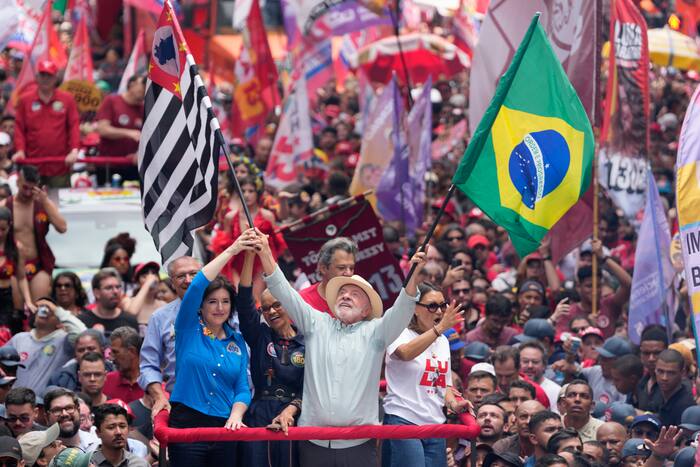
The asphalt of São Paulo does not care about political ideology, but it absorbs the sweat of every politician desperate enough to claim it. When Luiz Inácio Lula da Silva and Flávio Bolsonaro converged on Brazil's most ferocious electoral engine in the final stretch of the presidential campaign, they were not merely chasing votes. They were fighting for the administrative and economic center of gravity of Latin America's largest democracy.
To understand why this specific state dictates the terms of survival for both the Brazilian left and the resurgent right, one must look past the superficial gloss of television ads. São Paulo is an urban behemoth of over 44 million citizens, holding an electorate that outweighs entire nations in the region. Winning here requires a delicate alchemy of working-class outreach and middle-class tax anxiety mitigation.
For Lula, the stakes were existential. The veteran trade unionist entered the race carrying the heavy luggage of an incumbent administration battered by persistent inflation, global trade friction, and voter fatigue. His campaign strategy in São Paulo relied heavily on mobilizing historic trade union strongholds while neutralizing the persistent narrative that his economic policies favored state over-reach. Yet, walking the factory floors of the industrial belt, Lula faced a populace far more cynical than the one that first elected him two decades ago. The promise of social ascension through consumption had collided with the harsh reality of household debt and high interest rates.
Across the ideological divide, Flávio Bolsonaro stood as the proxy standard-bearer for a fractured yet deeply loyal right wing. With his father legally barred from holding elective office, Flávio inherited an apparatus fueled by religious conservatism, anti-establishment fury, and an acute grievance against judicial overreach. His rallies in the interior of São Paulo drew crowds waving yellow-and-green jerseys, hungry for a return to the uncompromising posture of the previous administration. But Flávio carried his own liabilities, including mounting scrutiny over family scandals and the persistent friction of aligning too closely with external populist figures like Donald Trump, which alienated pragmatic centrists who view foreign interference with deep suspicion.
The mechanics of this dual campaign exposed a deeper fracture in modern political combat. While traditional analysts obsess over daily tracking polls, the ground war in São Paulo was won or lost in the digital trenches and localized neighborhood networks. Social media algorithms created isolated echo chambers where compromise was treated as treason. On one side, pro-Lula networks amplified historical memories of poverty reduction and social stability. On the other, the Bolsonaro camp weaponized public insecurity, corruption fatigue, and economic anxiety into an unrelenting stream of digital outrage.
What the mainstream coverage routinely misses is the exhaustion of the Brazilian electorate. Neither candidate offered a visionary blueprint for structural reform. Instead, the discourse degraded into a binary choice between competing ghosts: the specter of a return to hyper-inflationary state control versus the fear of democratic erosion under populist pressure. Voters in São Paulo were forced to pick a vehicle not because they trusted the driver, but because they feared the destination under the alternative.
When the dust settled and the ballots were tallied, the narrow margins revealed a country cleaved directly down the middle. The machinery of the state continued to function, constrained by a hostile congress and an increasingly skeptical public. Polarization is no longer an anomaly in Brazilian politics; it is the permanent climate.
The real crisis in Brasília and São Paulo is not who occupies the presidential palace, but the systematic decay of institutional trust. Until leadership addresses the structural rot beneath the electoral theater, every subsequent election will remain a high-stakes gamble on the edge of a knife.
Lula Wins Fourth Term: Emotional Scenes As Supporters Cry, Hug And Celebrate
This video captures the emotional reactions and immediate aftermath of the election results that defined this intense political season.