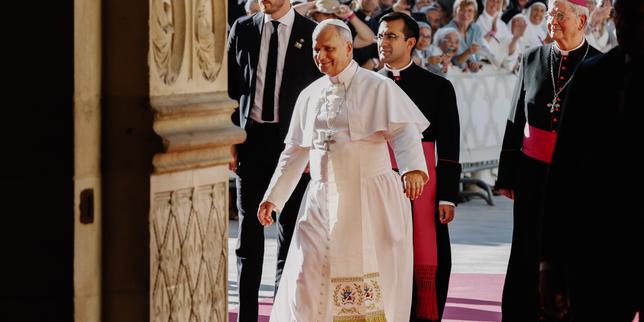
The stone has been scrubbed clean of soot and lead dust. Paris watches its most famous cathedral reopen, yet the physical restoration masks a much deeper ideological fracture. When ecclesiastical leadership steps into the pulpit and declares that sacred institutions cannot function as insulated fortresses against contemporary culture, the statement exposes a nervous institution trying to justify its relevance. This is not merely about gothic architecture or tourist foot traffic. It is about survival in a society that has largely moved past traditional dogma.
For centuries, cathedrals served as total environments. They dictated time through bells, morality through iconography, and community through proximity. Today, Notre-Dame sits at the heart of a secular republic that guards its laws on public neutrality with fierce jealousy. The French state owns the building. The Catholic Church occupies it. This uneasy partnership creates a unique pressure cooker where every official pronouncement carries political weight.
When high-ranking authorities insist that the cathedral must remain porous to the outside world, they are responding to an existential threat. Empty pews do not sustain centuries-old masonry. State subsidies help, but cultural relevance dictates survival. A museum piece draws tourists with cameras. A living church requires believers who care about doctrine. Bridging that gap demands an uncomfortable compromise with modern values.
The fire of 2019 forced a rushed introspection. Millions of euros poured in from billionaires and working-class citizens alike. Why? Because the monument represented identity far beyond theological adherence. People wept for the spire not because they prayed daily, but because it anchored their historical continuity. Ecclesiastical strategists noticed. They realized that the emotional attachment of secular citizens represents the only remaining bridge back to institutional engagement.
Maintaining a medieval masterpiece costs millions annually. Stone weathers. Pollution stains flying buttresses. Timber roofs require specialized carpentry that few craftsmen alive can execute. The financial equation is brutal. Hundreds of artisans spent five years hewing oak beams with medieval adzes and hand axes. Every joint had to match historical specifications while complying with modern fire safety regulations. That synthesis of ancient technique and contemporary engineering required extraordinary capital and coordination.
Reliance on state funding brings strings attached. French law strictly prohibits direct public subsidization of religious worship under the 1905 law separating church and state. Historic monuments receive public funds for preservation, but operational costs fall squarely on the diocese. This financial reality shapes rhetoric. An open church is an accessible church. An accessible church attracts donations, corporate sponsorships, and cultural events that generate revenue.
Critics argue that this commercialization cheapens the sacred. They point to ticketed exhibitions, restricted zones for tourists, and the commercial infrastructure surrounding the parvis. Yet, without these mechanisms, the doors simply close. The administrative machinery behind modern cathedrals operates more like a multinational heritage corporation than a humble parish.
Consider the logistics of daily crowd management. Millions pass through the portals every year. Security protocols rival those of major airports. Metal detectors, bag checks, and police cordons alter the pilgrim experience entirely. When leaders preach openness, they do so behind concrete barriers and armed patrols. The contrast between theological philosophy and operational reality is striking.
France defines secularity as a public space stripped of religious markers. Yet, Notre-Dame is both a religious site and a national icon. This duality creates constant friction.
When religious authorities make political or social pronouncements from the pulpit, secular politicians listen with suspicion. The boundary between pastoral guidance and political interference is razor-thin. If the Church adopts an aggressively open stance toward contemporary social debates, it risks alienating its conservative base. If it retreats into traditionalism, it becomes a relic ignored by the broader populace.
Leadership walks a tightrope. Every sermon is parsed by journalists, sociologists, and government officials. A call for openness can easily be misread as capitulation to secularism. Conversely, a defensive posture invites charges of irrelevance. The modern ecclesiastical diplomat must speak two languages simultaneously. One language addresses eternal dogma for the faithful. The other language addresses universal human rights and social solidarity for the secular public.
This dual-track communication often leads to ambiguity. Ambiguity satisfies no one completely. Traditionalists feel abandoned. Progressivists feel patronized. The result is a fractured internal audience watching every move from the nave.
Pews across Western Europe tell a grim story. Aging congregations dominate Sunday services. Ordinations dwindle year after year. Seminaries struggle to fill classrooms.
In this climate, declaring openness is not an act of charity. It is an act of desperation. Institutions that fail to engage demographic shifts wither away. The urban centers of France are culturally diverse, highly secularized, and largely indifferent to Catholic sacramental life. Reaching this population requires dropping defensive postures.
Yet, engagement carries risks. Opening doors to a pluralistic society means confronting deep ideological disagreements. Issues surrounding bioethics, family structures, and gender roles put the Church at odds with modern legal frameworks. Can an institution remain open to a culture while fundamentally rejecting its core legislative norms? That contradiction remains unresolved.
Observers often compare this moment to historical inflection points. The Second Vatican Council attempted a similar modernization decades ago, with mixed long-term results. Some parishes revitalized. Others emptied out faster. Modern leadership faces the same ghosts. They experiment with digital outreach, cultural programming, and architectural accessibility, hoping something sticks.
Architecture is theology made visible. Gothic cathedrals were engineered to draw the human eye upward, away from mundane earth toward divine heights. High vaults and stained-glass windows created an alternate reality.
Reopening Notre-Dame with a philosophy of radical openness challenges this vertical orientation. If the church is merely a meeting place for horizontal human solidarity, what happens to the vertical dimension of faith? Critics warn of horizontalism, where theology collapses into sociology. They argue that a church focused entirely on worldly problems ceases to offer spiritual transcendence.
Proponents counter that true transcendence must engage human suffering. They point to feeding programs, refugee advocacy, and cultural dialogue as extensions of the Gospel. The debate is fierce and uncompromising. Every stained-glass window repair, every liturgical rearrangement, and every public statement becomes a battleground for this ideological war.
The interior layout has sparked intense debate among art historians and liturgists. Minimalist altars replace ornate historical fixtures in certain chapels. Lighting is adjusted to highlight modern artworks alongside medieval relics. These choices are deliberate. They signal to visitors that the building is not a fossilized museum, but an active participant in contemporary artistic and cultural discourse.
Modern institutions cannot escape the lens. Global television networks broadcasted the fire in real time. They broadcasted the reconstruction phase with equal fervor. Now, the reopening dominates international news cycles.
This media saturation changes how the institution operates. Every public address by church leaders is optimized for soundbites. Press offices function with the sophistication of corporate public relations firms. The message of an open church plays well in international headlines, projecting an image of adaptability and grace.
Behind the cameras, however, the daily grind of parish administration continues unchanged. Volunteers manage tour groups. Priests counsel the troubled. Accountants balance ledgers against inflating construction costs. The gap between media spectacle and grassroots reality is vast.
When analysts evaluate these high-profile pronouncements, they must separate public relations strategy from actual institutional transformation. A grand speech under soaring vaults makes for compelling television. Changing the entrenched habits of a global bureaucratic hierarchy takes generations.
Can an ancient institution successfully pivot toward a contemporary, open model without losing its distinct identity? History offers cautionary tales.
Too much accommodation leads to irrelevance through assimilation. When a church mirrors secular culture too closely, believers wonder why they need the church at all. They can find secular humanism, social work, and ethical philosophy elsewhere, often with less administrative baggage.
Conversely, total withdrawal leads to irrelevance through ghettoization. A closed community preaching only to the converted shrinks into a historical curiosity, disconnected from the lived realities of ordinary citizens.
The strategy currently on display at Notre-Dame attempts a narrow middle path. It uses the magnetic pull of monumental heritage to draw in the curious, offering moments of aesthetic and spiritual encounter without demanding immediate doctrinal compliance. It is a calculated gamble.
Whether this gamble revitalizes European Catholicism or merely manages its graceful decline remains entirely unproven. The crowds will continue to line up along the Seine. Tour buses will idle outside the massive oak doors. Millions of smartphones will capture the soaring arches and restored rose windows.
Beneath that glittering surface, the hard work of institutional survival grinds on, hidden from the tourists, unresolved by the speeches, and indifferent to the headlines.