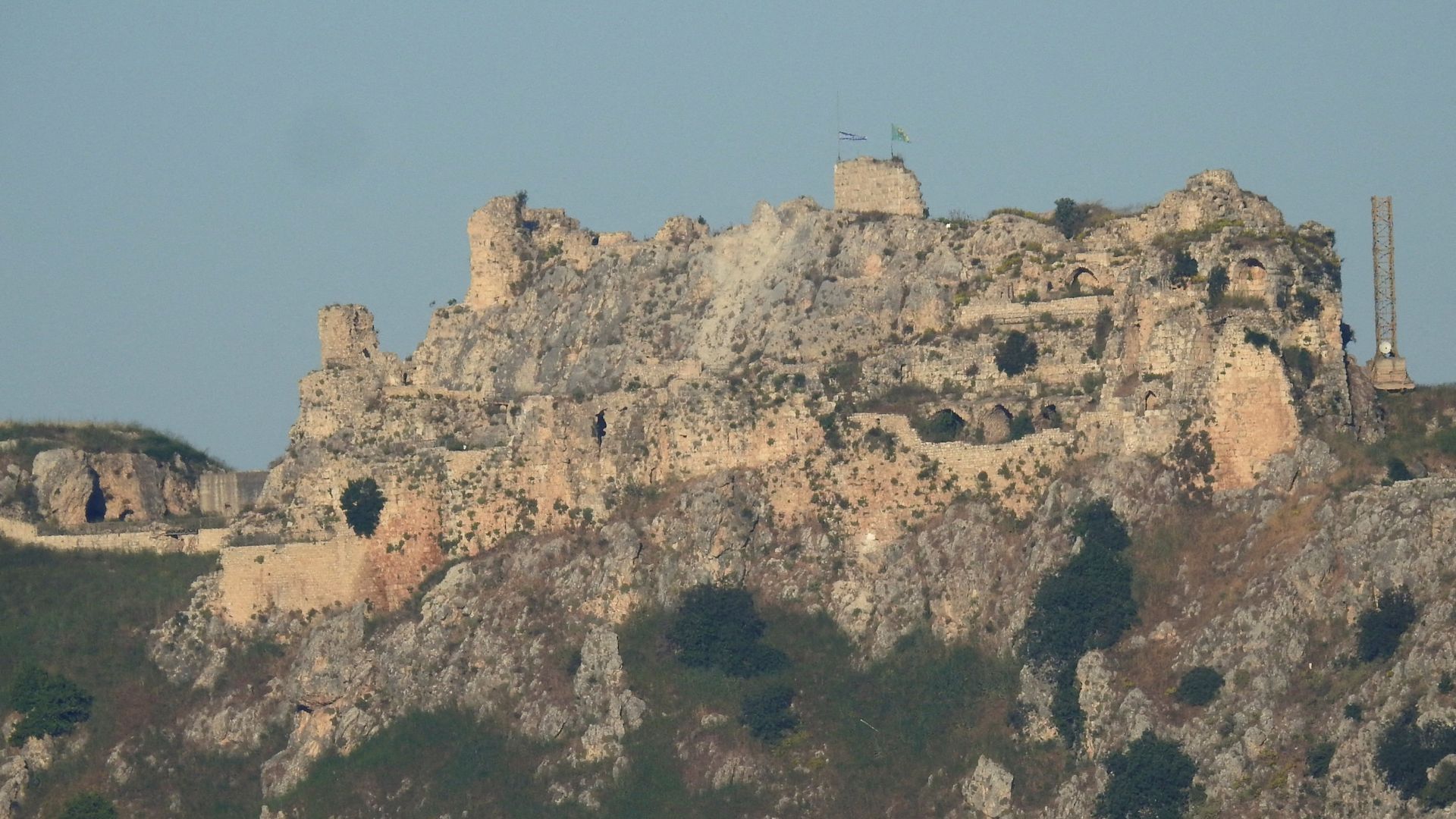
The media is losing its mind over a pile of 900-year-old rocks.
With the Israeli military raising its flag over Beaufort Castle after pushing past the Litani River, the consensus machine has kicked into overdrive. We are being told this is a massive territorial gain, a strategic masterpiece, and a watershed moment in the campaign against Hezbollah. Defense Minister Israel Katz is leaning heavily into the nostalgia, celebrating the return to a summit last occupied 26 years ago.
It is a masterful public relations stunt. But as a military and geopolitical reality, it is a catastrophic misreading of modern asymmetric warfare.
The media is looking at a map of southern Lebanon through a 12th-century lens, treating a medieval fortress as the ultimate prize. In reality, planting a flag on the Beaufort Ridge is a tactical trap that misallocates blood, capital, and strategic focus.
The Fallacy of High Ground in the Drone Era
The lazy consensus relies on a classic military maxim: he who holds the high ground wins the war. The Crusaders built Beaufort because its high cliff offered visual dominance over the Litani River valley. In the 1982 war, occupying that peak made sense for traditional armies looking to spot artillery and monitor troop movements with binoculars.
But this is 2026. The high ground is an illusion.
When an adversary relies on decentralized cell networks, underground tunnels, and low-altitude loitering munitions, holding a fixed, highly visible mountain top does not give you an advantage. It turns your forces into static targets. I have watched military operations blow millions of dollars defending high-profile outposts just to satisfy a political narrative, only to watch those same outposts get harassed daily by $500 commercial drones equipped with mortar shells.
Hezbollah does not need to hold Beaufort to threaten northern Israel. They operate from subterranean shafts, masked fruit orchards, and dense urban thickets in places like Nabatiyeh and Tyre. By forcing ground troops to push deep into the rugged terrain of the Suluki Valley and the Beaufort Ridge to capture a monument, the military command has extended its supply lines and concentrated its personnel in a fixed geographic location.
Digging a Familiar Financial and Human Sinkhole
Let's look at the actual data from history rather than the romanticized war films. Israel held this exact castle for 18 years, from 1982 until the withdrawal in May 2000. That occupation became a meat grinder. The fortress did not stop the evolution of Hezbollah; it catalyzed it. The group spent nearly two decades refining its ambush tactics and anti-tank missile operations against the static targets garrisoned at Beaufort.
The financial cost of maintaining an advanced base on a exposed ridge is astronomical. Logistics convoys must travel up winding, predictable mountain roads—the exact environment where improvised explosive devices (IEDs) and anti-tank guided missiles are most lethal.
Imagine a scenario where a military spends tens of millions of dollars to reinforce a medieval structure with modern concrete bunkers, air defense batteries, and electronic warfare jamming suites. While those assets are tied down protecting a symbolic peak, the adversary simply bypasses the hill, moving through the valleys and continuing to launch rocket salvos from deeper inside the country. This is not speculation; it is exactly what is happening. Despite the push past the Litani River, rocket and drone alerts continue to disrupt life across the Galilee.
The capture of Beaufort is being framed as an asset that strengthens Israel’s hand in the Washington peace talks. The truth is the opposite: it gives the opposition a high-value, high-visibility target to bleed until a final agreement is signed.
The Flawed Premise of Border Buffers
The "People Also Ask" circuit is filled with a fundamental question: Will creating a security zone in southern Lebanon protect border communities?
The answer is a brutal no, because the premise assumes a flat, two-dimensional battlefield.
Even if you push the forward defense line to the Zahrani River, 40 kilometers north of the border, you are trying to solve a three-dimensional problem with a one-dimensional line on a map. A security zone stops a cross-border raid by infantry. It does absolutely nothing to stop an arsenal consisting of precision-guided long-range missiles, heavy rockets, and autonomous drones that fly well above any medieval fortress.
By expanding the invasion despite a nominal ceasefire, the political leadership has chosen a scorched-earth path of village demolitions and mass displacements that guarantees long-term instability. Erasing physical structures does not erase the institutional knowledge of a guerrilla force. It merely shifts their operational footprint deeper into the Lebanese interior while destroying any chance of building a cooperative relationship with the local population or the Lebanese state.
The Operational Cost of Nostalgia
The real danger of the Beaufort operation is the triumph of sentimentality over cold, hard military science. Far-right elements within the political cabinet are treating this conquest as a emotional vindication for the retreat of 2000.
But nostalgia is a terrible defense strategy.
By celebrating the return of the flag to the "peaks that overlook the Galilee," the current leadership is chaining its military strategy to a historical ghost. It forces commander to allocate elite units, like the Golani Brigade, to garrison and patrol a symbolic rock formation instead of utilizing them as a highly mobile, flexible counter-terrorism force.
Every soldier stationed on the Beaufort Ridge is a soldier who is not actively intercepting launch teams, protecting vulnerable gaps on the actual international border, or resting for future contingencies. It is a classic example of mission creep driven by the desire for a triumphant photo-op.
The fortress has changed hands for 900 years—from Crusaders to Saladin, Mamluks, Ottomans, the PLO, and Israel. Each power believed that holding the rock meant holding the region. And each power was eventually forced to march back down the mountain. Expecting a different outcome this time around isn't strategy. It is historical blindness.