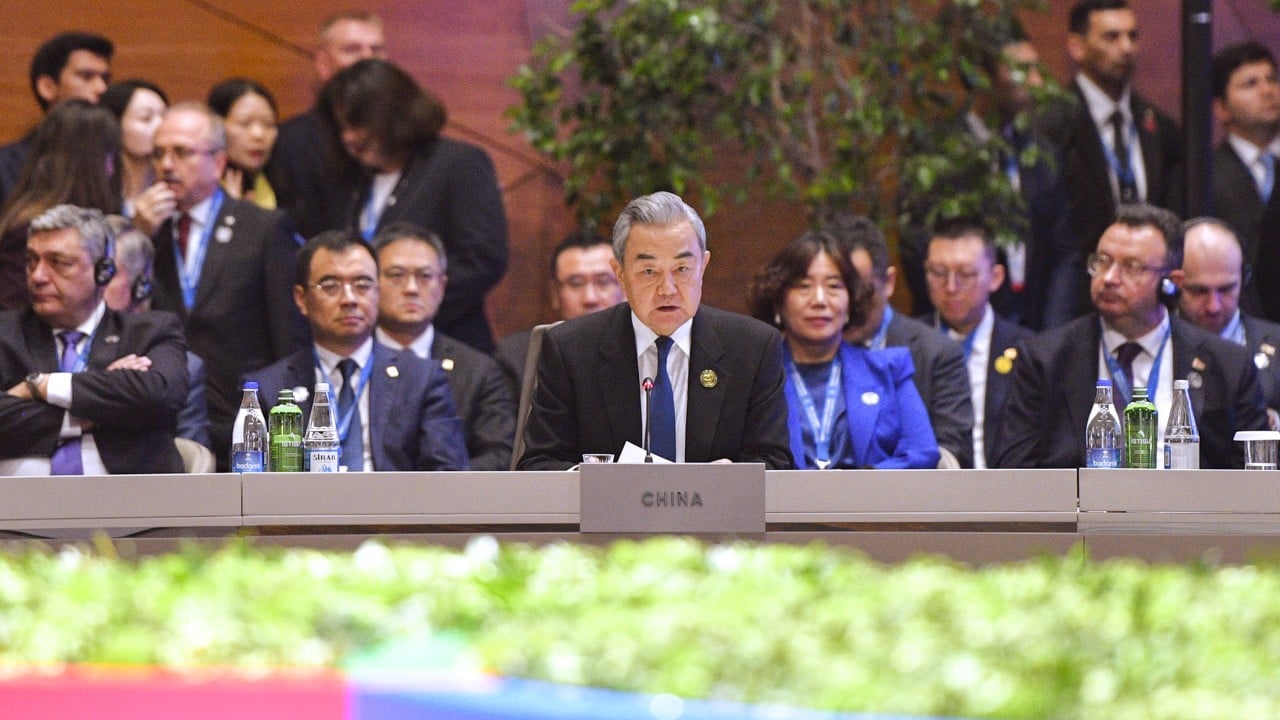
When Chinese Foreign Minister Wang Yi presses Israeli officials to halt and reverse West Bank settlement expansion while calling for full access to Gaza, the central strategic question is not whether Beijing opposes those policies. Beijing's diplomatic posture on Palestinian statehood and territorial integrity is established. The real analytical question is whether rhetoric alone alters territorial facts on the ground or humanitarian bottlenecks when China's material and political leverage remains constrained.
Standard wire coverage of such diplomatic meetings typically treats a foreign minister's remarks as a self-contained policy event: Beijing spoke, urged restraint, and reaffirmed a long-standing position. That framing misses the structural gap between declaratory diplomacy and enforcement capacity. To evaluate what Chinese interventions actually achieve, analysts need to separate Beijing's signaling incentives from its operational instruments, map how West Bank land policy and Gaza access interact, and account for the hard limits on third-party influence in an active multi-front conflict.
Deconstructing Standard Diplomatic Reporting
Conventional coverage of Chinese statements on the Israeli-Palestinian conflict follows a predictable arc. It summarizes the bilateral or multilateral setting, quotes the strongest phrase from the readout, and notes that China supports a two-state solution and humanitarian relief. While accurate as a record of official messaging, this approach obscures three critical mechanisms:
- Signaling versus coercion: Publicly urging a government to reverse settlement expansion or open border crossings is a diplomatic signal, not an enforcement mechanism. Without binding sanctions, security guarantees, or administrative control over territory or crossings, exhortation relies on reputational pressure rather than direct cost imposition.
- Audience segmentation: A single diplomatic message in the Middle East addresses multiple audiences simultaneously. Remarks directed at an Israeli counterpart sit alongside parallel outreach to Palestinian representatives, Arab states, regional partners such as Iran, and domestic or Global South observers watching how major powers position themselves.
- Asymmetry of stakes: For Israel and Palestinian factions, territorial control, security, and survival are existential or core domestic imperatives. For Beijing, Middle East diplomacy is an instrument of broader multipolar positioning, energy and trade risk management, and regional credibility rather than a sole vital security theater.
Treating a diplomatic readout as a turning point mistakes rhetoric for leverage. A clearer framework evaluates what Beijing can realistically move and where its influence stops.
The Three Pillars of Beijing's Diplomatic Calculus
China's posture on West Bank settlements and Gaza access rests on three interlocking pillars—diplomatic positioning, regional relationship management, and low-cost humanitarian engagement—that pull in different directions when translated into concrete action.
Diplomatic Positioning and Normative Framing
Beijing consistently frames the Palestinian issue around international consensus, territorial integrity, and a two-state framework, contrasting its rhetoric with Western policies that regional critics view as overly aligned with Israel. Calling for an end to settlement expansion and full humanitarian access positions China as a champion of multilateral norms and Global South concerns without requiring Beijing to deploy military assets or bear direct frontline risks.
The limitation of this pillar is structural. Normative statements carry diplomatic weight in multilateral forums and among sympathetic capitals, but they do not alter administrative approvals for land, infrastructure, or security zones in the West Bank, nor do they dictate inspection or border protocols governing Gaza.
Multi-Vector Regional Hedging
Unlike powers anchored by formal mutual defense treaties with a single side, China maintains concurrent relationships across competing regional fault lines. It trades heavily with Israel, courts Gulf economies for investment and energy ties, and maintains strategic partnership agreements and diplomatic channels with Iran.
This multi-vector posture gives Beijing broad conversational access across the region, yet it also creates friction. Criticizing Israeli settlement policies aligns Beijing with broad Arab and Palestinian positions—and avoids friction with Tehran—while preserving commercial pragmatism with Jerusalem. The trade-off is predictable: a hedging power rarely pays steep bilateral economic or strategic costs to force an adversary into concessions when its own core interests are not directly attacked.
Humanitarian Signaling Versus Reconstruction Scale
Calling for unrestricted humanitarian access into Gaza pairs moral urgency with low fiscal exposure. China has periodically announced aid pledges and participated in multilateral relief discussions, reinforcing its image as a constructive actor.
Here, the scale mismatch is stark. Humanitarian relief addresses immediate survival needs, whereas full physical and economic recovery in Gaza after large-scale destruction requires tens of billions of dollars over years, alongside durable political and security arrangements. Aid pledges and diplomatic appeals cannot substitute for sustained reconstruction financing or negotiated access regimes on the ground.
Causal Linkages Between West Bank Settlements and Gaza Access
In analytical terms, West Bank settlement expansion and Gaza humanitarian access are distinct operational problems that interact through political and security feedback loops rather than operating in isolation.
On the West Bank, settlement growth and related administrative or security measures reshape geographic contiguity and political expectations. In strategic terms, physical fragmentation makes a contiguous Palestinian state harder to envision and deepens Palestinian distrust of negotiated pathways. When diplomatic horizons narrow in the West Bank, frustration and volatility spill across political factions and public sentiment, complicating broader regional de-escalation.
In Gaza, access to food, water, medical supplies, shelter materials, and fuel governs daily humanitarian conditions and any prospect of stabilization. Tight restrictions worsen living conditions and civilian vulnerability, while broader regional escalation—including tensions involving neighboring fronts and wider Middle Eastern rivalries—further constrains diplomatic bandwidth and logistics.
The causal chain runs in both directions, though not symmetrically. Halting settlement expansion does not automatically open a Gaza border crossing, because physical access into Gaza is controlled by immediate military, security, and border-management decisions. Conversely, easing Gaza access does not reverse established settlements or land designations in the West Bank. Treating both demands together in a diplomatic statement reflects a political linkage—both bear on Palestinian viability and regional stability—rather than a single operational lever.
Why External Appeals Face Hard Constraints
Understanding why external calls to stop settlements or open Gaza often stall requires looking at the incentives of the parties directly involved.
For the Israeli government, settlement policy and security controls are tied to domestic coalition politics, security doctrines, and contested historical and legal claims. External criticism from a major trading partner like China registers diplomatically, but domestic political survival and perceived security imperatives routinely outweigh non-coercive foreign appeals.
For Palestinian leadership and factions, divisions between West Bank authorities and Hamas—alongside deep skepticism toward external mediators—limit unified negotiating leverage. Even when external powers endorse Palestinian positions rhetorically, diplomatic backing does not resolve internal governance splits or restore territorial control.
For outside powers, including China and the United States, influence is bounded by credibility and instruments. Washington has historically wielded far greater military and diplomatic weight with Israel, yet even intense external pressure has repeatedly run into domestic Israeli political resistance. Beijing has less direct leverage over Israeli security decisions than Washington, and its preference against military entanglement limits how far it is willing to push.
Separating Known Facts from Educated Hypotheses
Rigorous analysis requires drawing a sharp line between verified facts and analytical interpretation.
Known facts include the content of official diplomatic readouts in which Chinese officials urge an end to West Bank settlement expansion and full access for Gaza relief, alongside China's stated support for a two-state solution and its simultaneous diplomatic and economic ties across the Middle East. It is also a matter of public record that physical land realities in the West Bank and access restrictions in Gaza are governed by Israeli authorities, local actors, and border arrangements rather than Chinese administration.
Educated hypotheses include the assessment that Beijing uses high-profile Middle East statements primarily to bolster its diplomatic standing among Arab and Global South states and position itself as an active counterweight to Western influence. Another educated hypothesis is that without pairing diplomatic language with concrete economic incentives, coordinated multilateral pressure, or binding verification mechanisms, verbal calls for reversal will produce marginal or no immediate policy shifts on settlement expansion.
Tactical Framework for Evaluating Future Developments
Analysts, policymakers, and risk managers tracking this file can test whether future diplomatic rhetoric is turning into real movement by watching four concrete indicators:
- Follow-through mechanisms: Look past communiqués to see whether statements are accompanied by specific diplomatic initiatives, UN Security Council text negotiations, or coordinated regional monitoring rather than standalone bilateral talking points.
- Economic and commercial signals: Track whether bilateral trade, investment, or banking interactions show measurable friction or remain insulated from political disagreements.
- Operational access metrics: Monitor actual changes in truck volumes, cargo inspection rules, and humanitarian agency entry into Gaza rather than general calls for "full access."
- Administrative actions in the West Bank: Watch official land designations, planning approvals, and infrastructure policies on the ground, which provide far more reliable evidence of trajectory than diplomatic assurances.
This framework has clear limitations. Diplomatic intelligence is often opaque, and sudden regional shocks—such as escalations on adjacent fronts or shifts in domestic leadership—can override incremental diplomatic track record overnight. No analytical checklist can predict crisis sparks with precision, so indicators should be read as probability shifts rather than guarantees.
Strategic Recommendation
For decision-makers assessing China's role in the Israeli-Palestinian conflict, the optimal play is to treat Beijing's public calls on West Bank settlements and Gaza access as diplomatic positioning and relationship management, not a decisive lever for territorial or border change. Allocate analytical and strategic attention toward the actors and mechanisms that control physical access, security arrangements, and domestic political coalitions on the ground, while using engagement with Beijing primarily to gauge broader regional alignment, Global South diplomatic momentum, and potential avenues for multilateral humanitarian coordination.