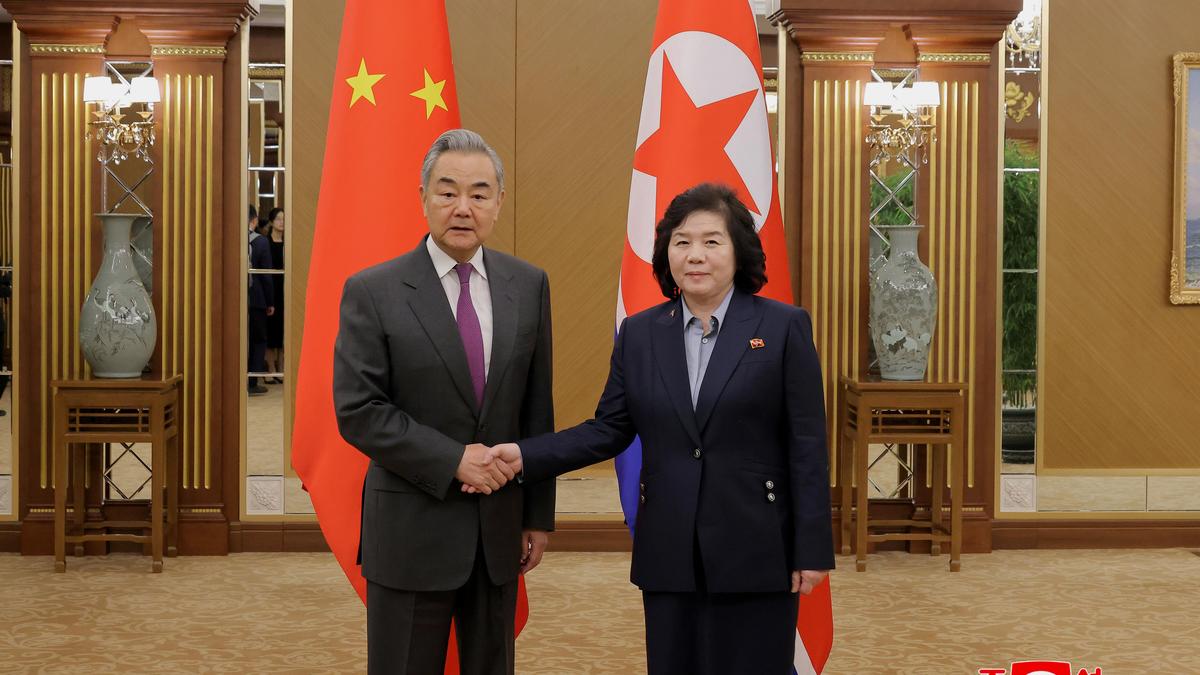
The recent high-level diplomatic exchange between the foreign ministers of China and North Korea signifies a shift from performative neighborliness to a cold, calculated strategic alignment. While public statements focused on the "traditional friendship" and "deepening cooperation," the reality on the ground points toward a synchronized defense against Western-led pressure. This is not a marriage of shared values, but a consolidation of a buffer zone that serves both Beijing’s regional dominance and Pyongyang’s survival.
By formalizing these ties now, both nations are signaling that the era of using North Korea as a bargaining chip in U.S.-China relations is over. Beijing has calculated that a nuclear-armed, stable North Korea is a more useful asset than a volatile neighbor that might collapse and bring a unified, pro-U.S. Korea to its doorstep.
The End of Strategic Ambiguity
For years, China played a delicate game. It voted for UN sanctions while ensuring enough trade flowed through the "cracks" of the Yalu River to keep the Kim Jong Un government from imploding. That balancing act has effectively ended. The recent talks indicate that Beijing is no longer interested in even the appearance of enforcing sanctions that it views as tools of American hegemony.
The shift is visible in the logistics. Satellite imagery and trade data suggest a steady increase in rail traffic and the modernization of border infrastructure. This isn't just about food or fuel. It is about integrating North Korea into a regional economic shadow-system that functions independently of the SWIFT banking network or Western oversight.
Weapons of Mass Distraction
While the world watches the missile tests in the Sea of Japan, the more significant development is the quiet transfer of dual-use technology. China provides the backbone—truck chassis, high-grade chemicals, and machine tools—that allow North Korea to refine its domestic arms industry.
Pyongyang provides something equally valuable to Beijing: a constant, low-cost distraction for the U.S. Indo-Pacific Command. Every time a North Korean ICBM rolls across Kim Il Sung Square, Washington is forced to divert resources, diplomatic energy, and military assets toward the Peninsula. This gives China more breathing room in the South China Sea and the Taiwan Strait. It is a symbiotic relationship where chaos in one theater buys time in another.
The Russian Factor
The elephant in the room during these bilateral talks is Moscow. The blossoming "bromance" between Kim Jong Un and Vladimir Putin has forced China’s hand. Beijing does not want to lose its primary influence over North Korea to a desperate Russia looking for artillery shells.
By deepening its own cooperation, China is reasserting its position as the senior partner in the autocratic trio. They are effectively telling Pyongyang that while Russian oil and military tech are welcome, the long-term economic and political survival of the regime still goes through Beijing.
A Failed Policy of Isolation
The West has operated under the assumption that if the "squeeze" is tight enough, North Korea will eventually trade its nukes for bread. This strategy has failed. The North Korean economy, though battered by the pandemic, has proven remarkably resilient because it has become a master of the black market.
Cybercrime, cryptocurrency theft, and ship-to-ship transfers of coal and oil provide the hard currency the regime needs. China’s role here is passive but essential. By simply looking the other way and providing the digital and physical ports of entry, Beijing ensures the "maximum pressure" campaign remains a hollow threat.
The Mineral Wealth Hidden in the North
One often overlooked factor in this deepening cooperation is North Korea’s vast, untapped mineral reserves. The country sits on some of the world’s largest deposits of magnesite, zinc, iron ore, and, crucially, rare earth elements.
China already dominates the global supply chain for rare earths, which are vital for everything from smartphones to electric vehicle batteries. Securing long-term, exclusive access to North Korean mines would cement China’s monopoly for decades. These talks aren't just about "friendship"; they are about securing the raw materials of the 21st-century economy.
The Buffer Zone Logic
To understand Beijing’s perspective, one must look at a map from the eyes of a People's Liberation Army (PLA) strategist. The Korean Peninsula is a dagger pointed at the heart of China’s industrial northeast.
The nightmare scenario for the CCP is not a nuclear North Korea. The nightmare is a "German-style" unification where the DMZ vanishes and U.S. troops, equipped with advanced sensor arrays and missile defense systems, are stationed on the Chinese border. To prevent this, China will tolerate almost any behavior from the Kim regime. Cooperation is the price of a permanent buffer.
Internal Stability and the Kim Dynasty
The talks also serve to legitimize Kim Jong Un’s "Byungjin" policy—the simultaneous development of the economy and the nuclear program. By appearing alongside Chinese officials, Kim demonstrates to his own internal elites that he is not a pariah. He is a statesman with the backing of the world’s second-largest economy.
This domestic signaling is vital. It prevents internal fractures within the Korean People’s Army and the Workers' Party of Korea. If the generals believe that China will always have their back, the chance of a coup or internal collapse drops to near zero.
The Digital Iron Curtain
A significant part of the new cooperation involves information technology and surveillance. North Korea has been eager to adopt the "Great Firewall" model used by Beijing to control its population.
We are seeing a move toward a shared authoritarian toolkit. Chinese companies are providing the hardware for North Korea’s domestic intranet, ensuring that while the population remains disconnected from the global web, the state has total visibility into their digital lives. This isn't just about trade; it's about the export of a specific model of high-tech totalitarianism.
The Illusion of Denuclearization
Any diplomatic statement coming out of these meetings that mentions "denuclearization" should be treated as fiction. Neither China nor North Korea believes it will happen. Beijing has accepted North Korea as a nuclear state in everything but name.
The goal has shifted from "elimination" to "management." China wants to manage the North’s nuclear program so it doesn't trigger a nuclear arms race in Japan or South Korea. This is a high-stakes gamble. If Seoul or Tokyo decides they can no longer rely on the U.S. nuclear umbrella and builds their own bombs, China’s strategic environment becomes exponentially more dangerous.
Economic Integration Without Reform
Western analysts often wonder why North Korea doesn't follow the "Chinese Model" of economic opening. The answer is simple: Kim Jong Un knows that economic liberalization leads to political instability.
Instead, the cooperation discussed in these talks focuses on "enclave" projects. These are special economic zones where Chinese investment can flow in, and manufactured goods can flow out, without the North Korean public ever interacting with the outside world. It is economic growth in a vacuum, designed to enrich the elite without empowering the masses.
The Geopolitical Checkmate
Washington’s response to this tightening bond has been largely rhetorical. Sanctions are already at their limit. Military options are off the table due to the risk of a regional conflagration.
This leaves the U.S. and its allies in a difficult position. The more the U.S. strengthens its trilateral alliance with Japan and South Korea, the more China and North Korea feel justified in their mutual defense pact. It is a classic security dilemma. Every move intended to increase security only serves to harden the opposition.
Infrastructure as Destiny
The construction of new bridges and the reopening of old shipping routes between the two nations are the most honest indicators of where this is going. Concrete and steel don't lie. They represent a long-term commitment to a shared future that bypasses the international order.
When a new bridge opens over the Tumen River, it isn't just for tourism. It is a pipeline for the resources and hardware that keep the "Hermit Kingdom" functioning as a vital extension of Chinese regional power.
The Cold Reality for the West
The deepening cooperation between North Korea and China is a sign of the emerging multipolar world. The "rules-based order" that dominated the post-Cold War era is being actively dismantled in East Asia.
Policy makers in the West must stop waiting for China to "help" with the North Korean problem. China is not interested in solving the problem; it is interested in owning it. Every diplomatic handshake in Beijing or Pyongyang is a brick in a wall that is being built to keep Western influence out of the region for good.
The focus must shift from the hope of a nuclear-free peninsula to the reality of a fortified, long-term alliance that is now immune to traditional diplomatic pressure.
Investors and strategists should prepare for a Peninsula that is permanently divided, increasingly militarized, and fully integrated into a Beijing-led economic sphere. The window for a "managed" solution is closing, replaced by a rigid architecture of mutual survival that benefits no one but the architects themselves.