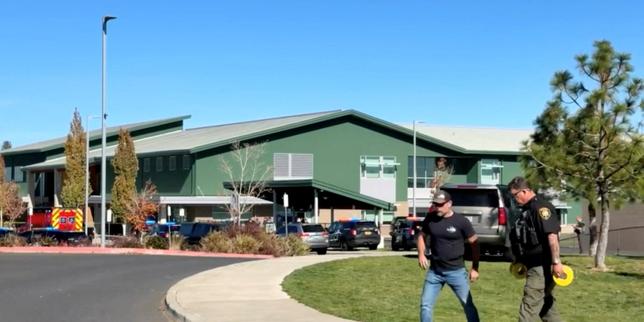
Picture day at a neighborhood elementary school shouldn't end with sirens, shattered glass, and grief-stricken families waiting behind police tape. Yet on October 15, 2026, Silver Rail Elementary School in Bend, Oregon, became the scene of a devastating attack that claimed four lives—three children, ages five, eight, and eleven, along with a teacher—and wounded others.
A 16-year-old gunman forced his way into the school around 1:00 p.m. local time before being fatally shot inside a classroom by Kaylub Giamanco, a parent whose daughters attended the school and who had followed the attacker inside. Police arrived within minutes, and federal investigators joined the probe, but for families in Bend, the shock didn't fade when the perimeter came down. If you found value in this post, you might want to look at: this related article.
Honestly, this tragedy hits a nerve that goes way beyond a single afternoon in central Oregon. Silver Rail Elementary wasn't an unguarded, forgotten building. It had modern infrastructure, electronic check-ins, and post-Uvalde upgrades. Still, the attacker got inside and killed four people. That collision between "supposedly secure" design and brutal reality forces a hard look at what actually protects young students—and what doesn't.
Why Silver Rail Elementary Still Faced a Breach
When people hear about a school shooting, the first assumption is usually that the doors were wide open or nobody was paying attention. That's not what happened in Bend. For another angle on this event, check out the latest update from TIME.
Silver Rail Elementary opened in 2015 as part of the Bend-La Pine School District, which uses secure vestibules, background-checked visitor sign-ins, interior and exterior security cameras, and armed school resource officers. After the 2022 Uvalde tragedy, local voters even approved new classroom door-locking hardware that lets staff secure doors quickly by flipping a switch.
On paper, those are textbook defenses. In practice, physical access controls have limits when an assailant uses gunfire to force entry through locked doors or moves faster than staff can seal a room. Teacher Becky Drury later described trying to close a classroom door only to find the shooter already there, leaving her no chance to shelter children before being shot at close range.
Hardware Helps, Yet Speed Decides Outcomes
I've seen plenty of districts treat security hardware like a magic shield. Buy better locks, install more cameras, buzz people in at the front desk, and check the box.
Locks buy time. They don't stop a determined attacker on their own. If a shooter breaches entry points in seconds or catches a classroom door mid-swing, even recently funded hardware can't rewind the clock. What separates a near-miss from a mass casualty event often comes down to seconds—how fast staff can barricade or lock out, how quickly police arrive, and whether someone intervenes before more shots are fired.
What Happened Inside the Classroom That Day
Details released through investigative reporting and interviews have made the timeline inside the school painfully clear. The attack struck a special needs classroom, killing three young children and a teacher while injuring another teacher and a child.
Teacher Cassidy Schutz confronted and struggled with the gunman inside the room. Outside, Kaylub Giamanco—a local carpenter and parent who had called 911 as he headed toward his daughters' school—entered the building, spotted the struggle through the classroom doorway, and shot the teenager before the attacker could regain control of his weapon.
That split-second intervention has sparked intense debate across the country. Some see Giamanco's actions as decisive and life-saving; others point out the chaotic risks of armed civilians entering active scenes, including how another teacher initially fled when she saw him, understandably fearing a second shooter. Even Giamanco himself later spoke candidly about the emotional weight of the moment, saying he felt haunted by the children he couldn't save and that the adrenaline only gave way once he called his family.
The Myth of Easy Answers on Armed Intervention
Whenever an armed civilian stops an attacker, partisan arguments flare up immediately. One side treats it as proof that more armed bystanders are the answer; the other warns against vigilante chaos and crossfire.
The honest truth is messier. Chaos inside an active shooting is extreme—for teachers, kids, arriving officers, and anyone holding a firearm. In Bend, Giamanco had a clear line of sight and stopped the threat, yet four people were already dead and trauma rippled through everyone who heard gunfire. Relying on luck or a parent happening to drive by isn't a public safety strategy. It's a symptom of systemic failure.
How School Safety Experts View Prevention Today
Education safety researchers, law enforcement agencies, and child psychologists generally agree on one uncomfortable point: no single measure prevents every attack. Still, evidence points toward layers that work together rather than silver bullets.
Threat assessment teams, behavioral intervention programs, and safe firearm storage laws aim to stop a crisis before a teenager ever reaches a school parking lot. Once an incident begins, rapid law enforcement response, clear lockdown communication, and trauma-informed crisis care become critical. According to reporting on the Bend aftermath, law enforcement reached the scene within two minutes of the emergency call, showing that fast police dispatch alone cannot always prevent early casualties when an attacker strikes suddenly.
There are real trade-offs and debates in every part of this picture. Some parents worry that heavy security measures make elementary schools feel like fortresses for five- and eight-year-olds, while others—as seen among Bend families navigating the return to class—feel unsafe sending kids back without stronger protections. Data on rare events like elementary school shootings is also complicated by how different databases define mass shootings or school gun incidents, making quick generalizations risky.
Practical Steps Parents and Communities Can Take Now
When tragedy strikes a community like Bend, helplessness is one of the heaviest burdens families carry. While national policy gridlock drags on, parents and local residents still have concrete ways to push for better protection and support families affected by violence.
- Ask specific questions at school board meetings: Skip vague demands for "better security" and ask concrete questions about exterior door hardening, classroom lock drills for young children, radio/alert systems between classrooms and offices, and whether the district has a trained behavioral threat assessment team.
- Push for safe storage norms in your own circle: Most youth gun violence involves firearms accessed from a home or acquaintance. Having straightforward, non-judgmental conversations with family and friends about locked storage and unloaded firearms is one of the most direct prevention steps available at home.
- Support local crisis and mental health resources: Recovery after a school shooting doesn't end when news cameras leave. Supporting local school counselors, community mental health funds, and victim support organizations helps children, teachers, and first responders process trauma over months and years rather than days.
- Check in on kids without forcing details: Young children often express fear through sleep trouble, clinginess, irritability, or school avoidance rather than clear words. Keep routines steady, limit graphic news exposure around kids, and let a school counselor or pediatrician guide you if anxiety lingers.
What happened at Silver Rail Elementary reminds us how fragile normal life can feel—and how urgent it is to pair clear-eyed prevention with real care for the people left picking up the pieces.
Silver Rail Elementary shooting coverage on PBS News
Bend families navigating life after the shooting on OPB


