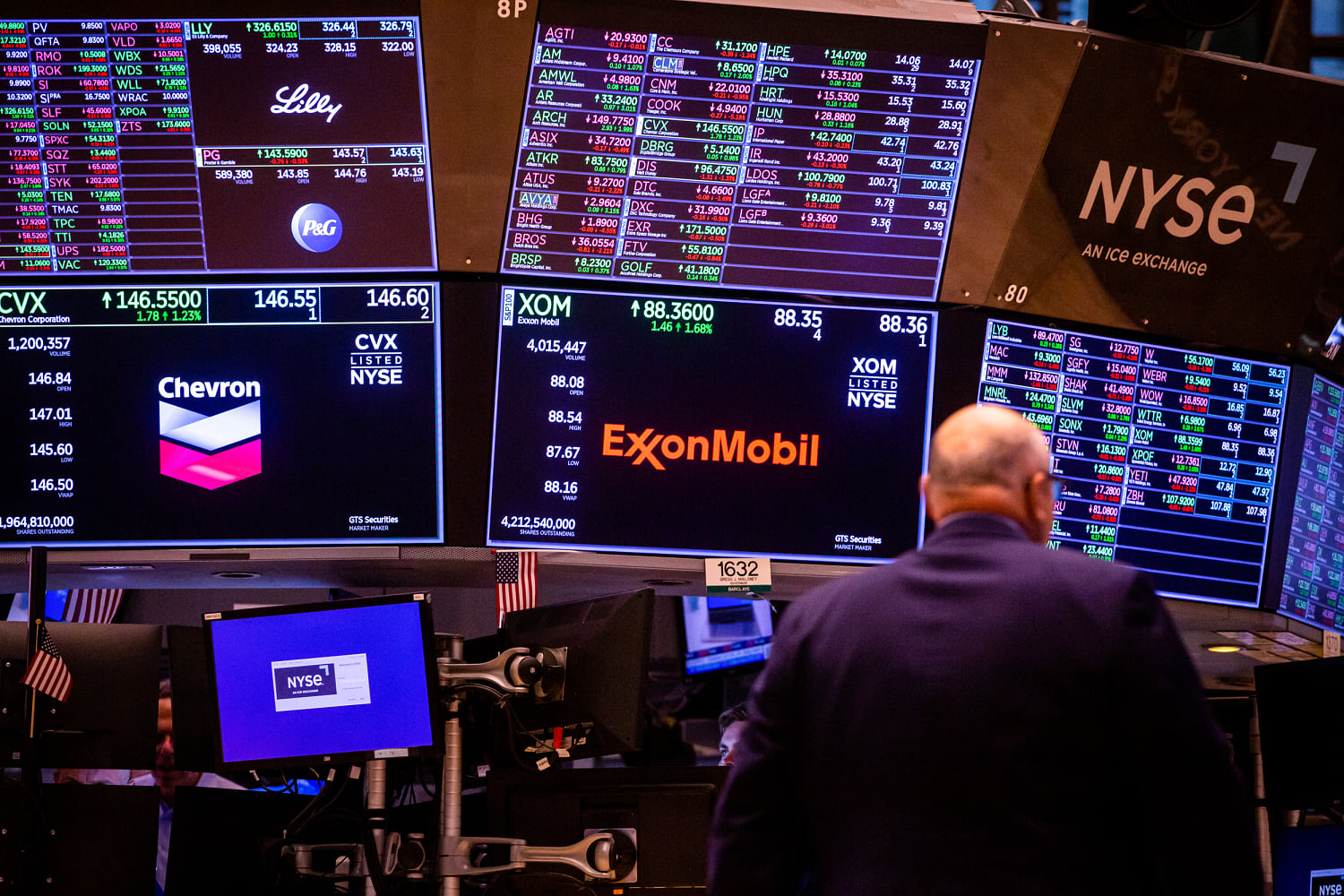
Mainstream financial media loves a simple villain. When ExxonMobil and Chevron print tens of billions in quarterly windfalls while Donald Trump cheers on high crude prices from a podium, the narrative writes itself. Greed. Price gouging. A golden age for fossil fuels.
Every single piece of that analysis is wrong.
If you actually read the balance sheets instead of the cable news chyrons, those "blowout" earnings look less like a victory lap and more like a liquidation sale. Wall Street is cheering cash flows that are only possible because the supermajors have stopped building for the future. Meanwhile, political cheerleading for triple-digit crude ignores the basic thermodynamics of global demand destruction.
I have spent twenty years watching energy executives destroy shareholder value every time oil crosses eighty dollars a barrel. They get drunk on free cash flow, overpay for marginal acreage, and set themselves up for the inevitable bust. Today, they are doing the exact opposite—starving their own capital expenditure budgets to feed buybacks—and commentators are mistaking starvation for health.
The Illusion of the Windfall
To understand why ExxonMobil and Chevron are drowning in cash, you have to look at what they are not doing. They are not drilling like they used to.
For decades, the integrated oil model relied on aggressive reinvestment. You took profits from existing wells and poured them into deepwater exploration, megaprojects, and frontier basins to replace every barrel you pumped out of the ground. That is how an oil company stays alive.
Between 2010 and 2014, when crude routinely traded above $100, Exxon and Chevron spent money like drunken sailors. Upstream capital expenditures hit historic highs. When the shale revolution flooded the market and prices crashed in 2014, those massive investments turned into stranded liabilities. Shareholders revolted. Institutional investors demanded capital discipline, forcing executives to prioritize dividends and stock buybacks over production growth.
Fast forward to today. High oil prices arrive, and the supermajors keep their wallets shut.
| Metric | Old Big Oil Playbook (2011–2014) | Current Big Oil Playbook |
|---|---|---|
| Primary Cash Use | Frontier exploration and megaprojects | Share buybacks and special dividends |
| Reserve Replacement | Aggressive organic drilling | Acquiring existing cash-flowing peers |
| Wall Street Mandate | Grow production volume at all costs | Maximize Free Cash Flow (FCF) yield |
| Long-Term Risk | Overbuilding into a price crash | Slowly liquidating the core asset base |
When a company refuses to reinvest in its core revenue-generating asset, its short-term profit margins explode. You can make any business look wildly profitable for a few years if you stop maintaining the factory and fire the R&D department. That is what is happening in Houston and San Ramon. The earnings reports are spectacular because the numerator (revenue from high commodity prices) is inflated while the denominator (capital reinvestment) is artificially suppressed.
Buying back your own stock at all-time highs using windfall commodity profits is not strategic genius. It is an admission that you cannot find a single project on planet Earth capable of beating your cost of capital.
Why High Oil Prices Are a Political Trap
Donald Trump’s rhetoric around high oil prices rests on a foundational misunderstanding of how modern energy markets operate. The pitch is straightforward: high prices mean booming domestic production, high-paying roughneck jobs, and American energy dominance.
That worked in 1980. It fails miserably in the 2020s.
First, domestic producers no longer respond to price signals the way politicians expect. When crude spikes, independent shale operators in the Permian Basin do not rush out to hire thousands of workers and double their rig counts. Under pressure from private equity and public shareholders, they use the extra cash to pay down debt. You can wave $95 oil in front of a Midland CEO all day long, and he will still keep his rig count flat because Wall Street will crucify his stock price if he chases volume.
Second, sustained high oil prices act as a massive, regressive tax on the exact working-class voters who decide elections. The United States is the world's largest oil producer, yes, but it is also the world's largest consumer of refined petroleum products. Every ten-dollar jump in a barrel of crude translates roughly to an extra twenty-five cents per gallon at the pump.
You cannot run an economy on expensive energy. High diesel costs bleed into every supply chain, driving up the price of groceries, construction materials, and manufactured goods. Inflation spikes. The Federal Reserve is forced to keep interest rates elevated to crush demand. Consumers pull back on discretionary spending, manufacturing contracts, and the economy tips into a recession.
What happens to oil prices in a recession? They crater.
Cheering for high oil prices as an economic stimulus is like cheering for a fever because it means your immune system is working. If the fever runs too hot for too long, it kills the patient.
The Megamerger Mirage
Look closely at how ExxonMobil and Chevron are actually deploying their historic profits. Instead of exploring for new oil, they are buying their neighbors. Exxon swallowed Pioneer Natural Resources in a $60 billion all-stock deal. Chevron moved on Hess for $53 billion.
Pundits frame these acquisitions as bold bets on the longevity of fossil fuels. They are the exact opposite.
Consolidation at the top of a commodity cycle is a defensive crouch. When organic reserve replacement becomes too expensive or politically risky, the biggest players buy existing, already-drilled inventory from mid-sized competitors. It allows them to strip out redundant corporate overhead, consolidate acreage in prime basins like the Permian, and maintain production plateaus without taking exploration risk.
- Zero new oil is discovered when Exxon buys Pioneer. The total global supply does not increase by a single drop.
- Market concentration increases, reducing competition among oilfield service providers and driving down operational costs for the surviving giants.
- Shareholders get diluted in all-stock transactions, trading future upside for immediate balance sheet stability.
I watched this exact movie play out in the late 1990s. When oil collapsed below $15 a barrel, Exxon bought Mobil, BP bought Amoco, and Chevron bought Texaco. Those mergers were survival mechanisms born out of distress. Today, the supermajors are executing the same consolidation playbook at the top of the market. They are preparing for an era of structural stagnation, bulking up on low-cost barrels so they can survive the next inevitable downturn when weaker competitors go bankrupt.
Dismantling the Wrong Questions
If you want to understand where energy markets are actually heading, you have to stop asking the questions dominating financial television.
Do high oil company profits mean consumers are being gouged?
No. ExxonMobil and Chevron are price takers, not price setters. Even combined, they control less than ten percent of global crude production. The marginal price of a barrel of oil is dictated by global supply-demand balances, OPEC+ production quotas, geopolitical chokepoints, and futures market liquidity. When global supply is tight, prices rise, and every producer captures the spread between their lifting costs and the market rate. Calling it price gouging ignores basic commodities economics. If you want lower prices at the pump, you have to either increase global supply or crush global demand—blaming corporate profit margins does nothing.
Will a pro-oil White House unleash a new American drilling boom?
This is the biggest myth in energy politics. The executive branch has very little control over short-term domestic oil production. During the Biden administration—widely perceived as hostile to fossil fuels—U.S. crude output hit an all-time record high of over 13 million barrels per day. Why? Because geology and technology dictate production, not campaign speeches. Permitting reforms and federal lease sales matter on a five-to-ten-year timeline, particularly in the Gulf of Mexico or on federal lands in New Mexico. In the immediate term, production is governed entirely by wellbore economics, takeaway pipeline capacity, and investor return thresholds. No president can order a public company to drill unprofitable wells.
Does Big Oil’s cash pile prove the green transition is dead?
Hardly. High fossil fuel prices are the single greatest accelerant for alternative energy adoption. When gasoline is cheap, nobody cares about fuel efficiency or battery range. When crude stays elevated, industrial buyers, logistics fleets, and retail consumers aggressively seek substitutes to hedge against volatility. High oil prices subsidize the exact technologies designed to make oil obsolete. Every month that crude trades at a premium gives electric vehicle manufacturers, grid-scale battery developers, and nuclear startups a wider economic moat to compete against internal combustion.
The Structural Trap Nobody Wants to Admit
Here is the uncomfortable reality that neither Wall Street bulls nor political cheerleaders want to confront: the integrated oil business model is trapped in a permanent tug-of-war between short-term cash generation and long-term relevance.
If Exxon and Chevron take their massive profits and reinvest them heavily into new oil and gas production, they risk flooding the market, crashing commodity prices, and destroying their own margins—all while facing fierce pushback from institutional investors who demand immediate payouts.
If they keep doing what they are doing right now—returning nearly 100 percent of free cash flow to shareholders via buybacks and dividends while underinvesting in long-cycle supply—they guarantee a massive supply crunch later this decade.
Imagine a scenario where global oil demand grows by just one million barrels per day annually over the next five years, driven by emerging markets in Southeast Asia and India. Meanwhile, existing oil fields naturally decline at an average rate of five to seven percent per year. Without massive, continuous capital expenditure just to offset natural decline rates, global supply falls off a cliff.
We are currently underinvesting in upstream supply relative to baseline global demand. That means the blowout profits we are seeing today are borrowing directly from future supply stability. When that supply deficit finally hits, prices won't just edge higher; they will spike violently enough to trigger severe economic contraction.
There is a massive downside to the contrarian view that Big Oil is in trouble, and I will state it plainly: cash is still king, and energy transition timelines are notoriously slow. Hydrocarbons still account for roughly eighty percent of global primary energy consumption. You cannot run container ships, cargo planes, steel mills, or petrochemical plants on wind turbines. Exxon and Chevron own some of the lowest-cost, highest-margin assets in the world, particularly in Guyana and the Permian Basin. Even if global oil demand peaks and enters a slow decline, the lowest-cost producers will be the last ones standing, minting cash for decades while higher-cost national oil companies bleed out.
How to Actually Read the Energy Market
Stop watching quarterly earnings headlines and political rallies. They are pure noise designed to generate clicks and votes. If you want to know what is actually happening beneath the hood of the global energy system, track three hard metrics instead:
- The Reserve Replacement Ratio (RRR). Look at the end-of-year filings for Exxon and Chevron. Divide the amount of proved reserves added during the year (excluding acquisitions) by the amount of oil and gas produced. If that number is consistently below 100 percent, the company is shrinking, regardless of how big its quarterly profit looks.
- Upstream Capital Expenditure vs. Depreciation. Compare how much money a supermajor spends on new exploration and development against the depreciation of its existing assets. When CapEx barely exceeds depreciation, management is merely maintaining the status quo, not growing the enterprise.
- Refining Crack Spreads. Upstream profits tell you what crude is worth; refining margins tell you what the real economy is actually consuming. When crack spreads—the difference between the price of crude oil and the petroleum products extracted from it—begin to compress, it means consumer and industrial demand is buckling under the weight of high prices.
Big Oil’s historic earnings are not a sign of an unstoppable juggernaut. They are the financial signature of a mature, capital-starved industry harvesting its existing assets while the sun still shines. Politicians can take credit for the boom, and pundits can rage against the profits, but the balance sheets tell the real story: the supermajors are cashing out, not doubling down.