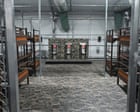
Governor Ron DeSantis stood in Ochopee and declared victory, flashing the number 21,000 like a trophy. The mainstream press scrambled to frame the shutdown of the Everglades Detention Facility—the infamous Alligator Alcatraz—as either a triumphant completion of a security mission or a historic victory for human rights activists.
Both narratives are completely wrong. They miss the actual mechanics of what just happened.
Alligator Alcatraz did not close because it fulfilled its mission, nor did it close because a few weekly protests made it politically toxic. It closed because the temporary political theater served its purpose, and the massive stream of taxpayer capital has successfully shifted into permanent, less visible corporate hands. The facility was never a sustainable border solution. It was a highly efficient wealth-transfer mechanism operating at a staggering burn rate of $1.2 million per day.
If you want to understand the true state of modern immigration enforcement, you have to stop looking at the tents and start looking at the balance sheets.
The Myth of Fiscal Efficiency
The official narrative claims this makeshift camp was an "assist" to a federal government lacking immediate bed space. The state spent over $1 billion of Florida taxpayer funds to erect and run a collection of soft-sided tents in a swamp, operating under the assumption that federal reimbursements would cover the tab.
Look at the actual recovery numbers. To date, the state has clawed back a meager $58 million from the Federal Emergency Management Agency. Waiting on a slow-moving federal bureaucracy to reimburse a billion-dollar expenditure while burning over a million dollars every single day is not a strategic policy triumph. It is a fiscal disaster disguised as a security operation.
Politicians love to boast about raw output—in this case, 21,000 processed deportations. But evaluate the unit economics. When you factor in the construction costs, the logistical nightmare of operating in an environmentally hostile wetland, and the ongoing legal battles, the cost per individual processed at Alligator Alcatraz skyrockets past standard federal detention averages.
Private defense contractors and logistics firms were the sole entities operating with high efficiency here. They secured massive state contracts with zero traditional environmental oversight, shielded by an ongoing immigration state of emergency that bypassed standard bidding and regulatory scrutiny.
The Logistical Mirage of Temporary Camps
Proponents of the facility argued that the remote location near the Dade-Collier Training and Transition Airport was perfect for quick staging and rapid deportation flights. They claimed it kept undocumented individuals out of local communities and streamlined federal processing.
But anyone who understands industrial logistics saw the fatal flaws from week one. Building a high-density detention infrastructure in the middle of a major flood zone during hurricane season is a catastrophic management failure. The recent emergency evacuation, which officials quietly executed under the guise of seasonal safety, proved that the entire setup was a logistical liability.
You cannot run a serious, secure processing pipeline when your infrastructure has to be completely dismantled or emptied every time a tropical depression forms in the Atlantic. Moving thousands of detainees overnight to facilities across California, Arizona, and Texas does not show structural readiness. It reveals a chaotic, reactive system that creates massive administrative backlogs and spikes transportation overhead.
The Baker County Shift
Activists are celebrating the removal of the tents as a permanent rollback of aggressive enforcement. This reveals a fundamental misunderstanding of how the carceral system scales.
The closure of Alligator Alcatraz is not a retreat; it is a consolidation. The operational infrastructure hasn't vanished; it has merely migrated to more permanent, less scrutinized brick-and-mortar facilities like the Baker County facility. While the public focused its attention on the dramatic imagery of cages in the Everglades, the state quietly hardened its long-term capabilities elsewhere.
Temporary camps attract cameras, lawsuits, and international headlines. They create a highly visible target for civil rights groups and environmental litigators. Hardened, rural state prisons retrofitted for federal immigration use do the exact same work without the public relations liability. The corporate operators running these systems prefer the quiet stability of a permanent facility over the chaotic public relations battleground of a swamp tent city.
The Real Cost of Emergency Governance
Operating an enforcement strategy via continuous executive emergencies sets a dangerous precedent for state commerce. The state executive branch bypassed county authorities, ignored municipal land use values, and disrupted the long-term economic plans for the Dade-Collier airfield, which is now being offloaded to the National Park Service just to clear the structural baggage.
When a government overrides standard fiscal checks and balances to build temporary infrastructure, the taxpayer always loses. The physical tents in Ochopee are coming down over the next two weeks, but the financial obligations and the institutionalized network of private carceral vendors are now deeply embedded in the state's budget.
Stop analyzing the immigration debate through the lens of political speeches or activist press releases. Alligator Alcatraz was a high-priced proof of concept for emergency privatization, and the vendors just cashed their checks.