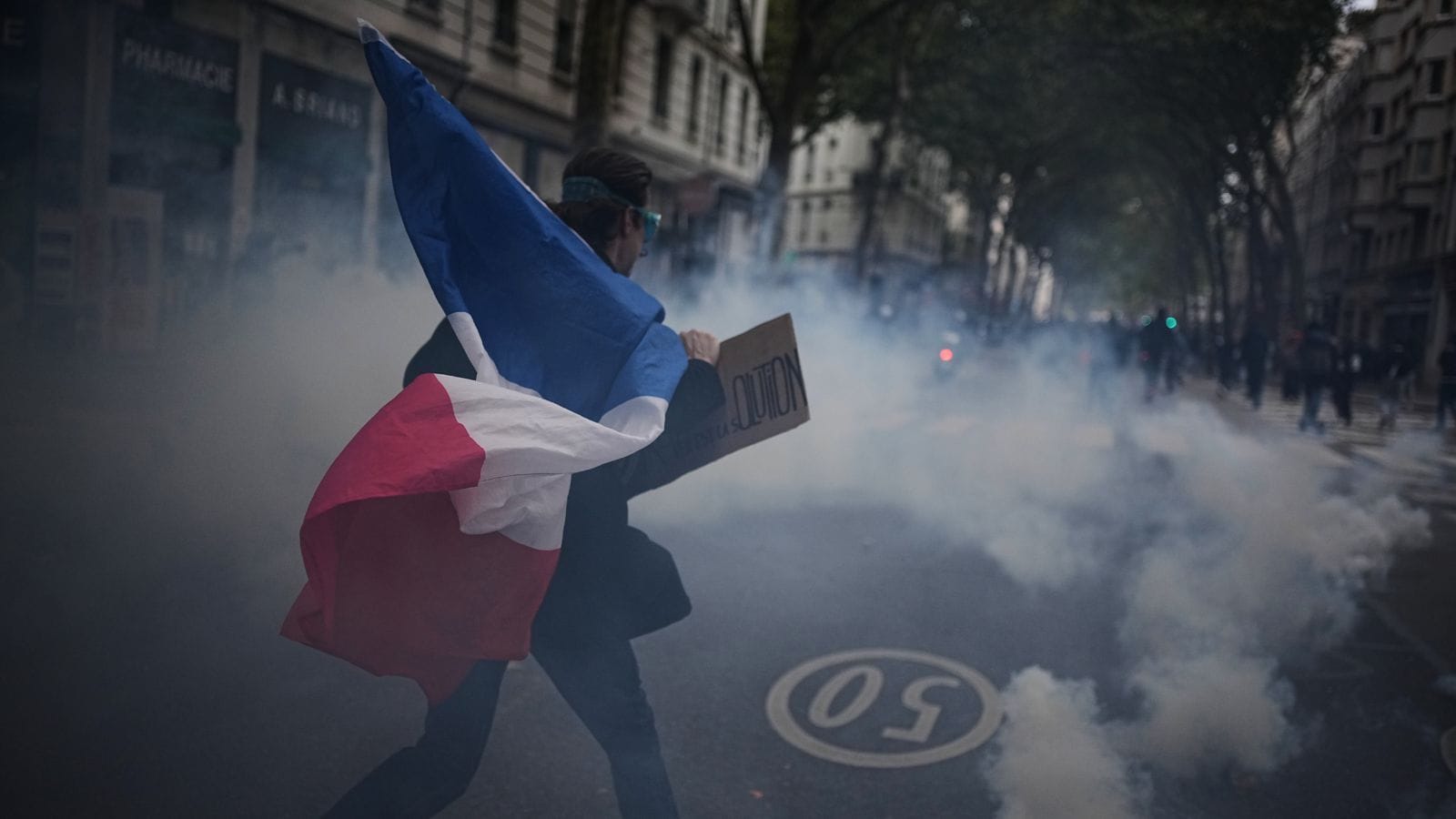
The smell of burnt rubber does not wash out of brick easily.
If you walk down a side street in Nanterre or a quiet avenue in Dublin months after the sirens have faded, you can still see the ghosts of a summer night etched into the pavement. A melted patch of asphalt where a municipal bus died. A boarded-up pharmacy window where an elderly woman used to pick up her heart medication every Tuesday morning. The glass gets swept up within forty-eight hours, and the politicians hold their press conferences in front of the scorched concrete, promising swift justice and unwavering resolve. You might also find this related article interesting: What Most People Get Wrong About Punitive Home Demolitions in the West Bank.
Then the cameras pack up. And someone has to pay the invoice.
In the summer of 2023, riots tore through France for nearly a week, leaving a trail of charred town halls, looted storefronts, and torched vehicles. When the French business federation MEDEF tallied the wreckage, the number stopped the room cold: one billion euros. Roughly $1.1 billion in property damage, lost business, and shattered infrastructure. Later that same year, a single night of chaos in central Dublin left tens of millions of euros in destruction, turning one of Europe’s busiest shopping corridors into a smoking ruin. In the UK, the summer of 2024 brought its own wave of street violence, stretching police forces to their absolute breaking point and leaving local councils staring at terrifying budget deficits. As discussed in detailed reports by Associated Press, the results are widespread.
When a billion-euro bill lands on a nation's desk, the traditional legal machinery grinds to a halt. You cannot squeeze a million euros out of a sixteen-year-old wearing a thrifted tracksuit. You cannot garnish wages that do not exist.
So, across Europe, governments are quietly rewriting the rules of accountability. They are looking past the masked figures throwing cobblestones in the dark. Instead, they are turning their gaze toward two very different targets: the exhausted parents sitting at kitchen tables miles away, and the trillion-dollar technology companies living inside every teenager's pocket.
The Kitchen Table Reckoning
To understand how this legal shift feels on the ground, consider a hypothetical scenario drawn directly from the realities of French civil courts. Imagine a mother named Claire, a hospital cleaner living in a banlieue outside Paris. She works double shifts, leaves dinner in the microwave, and trusts that her fifteen-year-old son is upstairs playing video games. At two in the morning, her phone rings. Her son has been arrested three miles away, caught on CCTV tossing a flare through the window of a local library.
Under a long-standing principle of French civil law—Article 1242 of the Civil Code—parents are strictly liable for the damage caused by their minor children living under their roof. For decades, that statute existed mostly on paper for minor scrapes, broken windows, or schoolyard fights. Insurance policies usually absorbed the shock.
Not anymore.
When riots erupt on a massive scale, private insurers begin to buckle, and the state steps in to backstop the losses. Suddenly, the state wants its money back. In the aftermath of the 2023 unrest, French President Emmanuel Macron openly floated the idea of fining parents directly—a "financial penalty from the very first offense"—to force families to take responsibility for their children's nighttime whereabouts. Justice Minister Éric Dupond-Moretti went further, reminding prosecutors that parents who fail in their legal duties of supervision could face up to two years in prison and a 30,000-euro fine.
Pause and think about what that means for Claire.
The state is not just asking her to punish her son; it is handing her a share of a generational debt. Even if her homeowner's insurance refuses to cover intentional criminal acts—a standard exclusion in almost every policy across Europe—the civil courts can still garnish her wages for years to come to reimburse the municipality for that burned library.
Critics of this approach argue that punishing single mothers and working-class families does nothing to fix the deeper fractures of poverty, alienation, and systemic neglect. They point out that a parent working a night shift cannot physically lock a determined teenager inside an apartment. Yet, from the perspective of a mayor staring at a ruined school and a bankrupt municipal budget, the logic is brutally simple. Someone broke the town. The child has no money. The parent is the legal guardian. Therefore, the parent pays.
It is a collision between social empathy and cold accounting, and right now, the accountants are winning.
The Algorithm as an Accomplice
But even if you garnished the wages of every parent in Europe, you would never come close to covering a billion-euro deficit. The math simply does not work. And more importantly, investigators looking at the wreckage noticed something strange about how these modern riots behaved.
Traditionally, civil unrest burns like a brushfire—it starts at a single flashpoint and spreads outward block by block as crowds physically move through a city. Modern European unrest behaves completely differently. It teleports.
A storefront gets smashed in Marseille, and twenty minutes later, an identical attack happens four hundred miles away in Lyon. Teenagers who have never met each other arrive at the exact same intersection at the exact same minute, carrying the exact same type of fireworks, filming the exact same angles for a vertical video feed.
They are not organizing in secret basements. They are being directed by an invisible conductor.
When you open Snapchat, TikTok, or Telegram during a night of unrest, you are not looking at a neutral digital town square. You are looking at an engine specifically calibrated to reward escalation. Think of a modern social media algorithm not as a public bulletin board, but as a hyper-aggressive casino dealer. Every time a user posts a video of a burning car, the dealer sees a spike in adrenaline, watch time, and shares. So the dealer immediately shuffles that video to the top of ten thousand local feeds, adding geolocation tags that act like a digital flare gun in the night sky.
During the 2023 riots in France, Snapchat’s Snap Map—a feature that displays heatmaps of user activity in real time—became an accidental command center. Teens could literally look at their screens, see where the brightest red clusters of activity were forming, and take a bus straight into the chaos to film their own contribution.
European leaders watched this happen in real time, and their patience evaporated.
Piercing the Digital Shield
For twenty years, technology companies operated under a comfortable legal umbrella. Both in the United States and across Europe, platforms argued that they were merely pipes—digital post offices that carried messages without reading them, bearing zero responsibility for what users decided to post. If someone used a telephone to plan a bank robbery, you did not sue the telephone company.
That argument is dying a rapid death in Brussels, Paris, and London.
With the enforcement of the European Union’s Digital Services Act, the legal armor surrounding tech giants has been stripped away. Under the DSA, Very Large Online Platforms—companies with more than 45 million monthly users in the EU—are no longer treated as passive bystanders. They are legally obligated to assess and mitigate systemic risks, including threats to public security and civic discourse.
If an algorithm actively amplifies calls to violence, promotes the live locations of looted stores, or fails to take down coordinated riot instructions within hours, the platform is no longer just hosting speech. It is facilitating damage. And under the DSA, regulators can levy fines of up to 6 percent of a company’s global annual turnover.
For a company like Meta or ByteDance, 6 percent is not a slap on the wrist. It is tens of billions of dollars.
Look at what happened in the United Kingdom during the summer of 2024. When false rumors spread rapidly across X and Telegram following a tragic stabbing in Southport, coordinated mobs descended on hotels housing asylum seekers and clashed violently with police. The British government did not just arrest the men throwing bricks. Prime Minister Keir Starmer pointedly reminded social media executives that violent disorder whipped up online is still a crime, and British regulators immediately began scrutinizing how the Online Safety Act could be used to hold platforms financially and criminally accountable for algorithmic amplification.
In Ireland, following the Dublin riots of November 2023, the conversation took a similar turn. Gardaí—the Irish police force—found themselves outmaneuvered by encrypted group chats on Telegram and viral rage loops on TikTok. Within months, Irish lawmakers and European regulators were openly discussing how to make digital platforms share the financial burden of policing and repairing the physical destruction their systems helped coordinate.
The shift in mindset is profound. When a riot breaks out today, European governments no longer ask only who threw the stone. They ask who handed out the megaphone, who drew the map, and who profited from the clicks while the city burned.
The Invisible Web of Liability
I remember standing outside a burned-out electronics shop a few years ago, watching the owner sweep wet ash into a plastic dustpan. He was in his late fifties, his shoulders slumped under a heavy coat, staring at the empty metal racks where his inventory used to sit. When I asked him about insurance, he gave a bitter, hollow laugh. His premiums had already doubled the year before. With civil unrest classified under specific exclusions, he knew he would spend the next decade fighting adjusters in court just to recover pennies on the euro.
That is the human reality behind the macroeconomic headlines. When a billion-euro riot occurs, the money does not vanish into thin air; it is stolen directly from the future of ordinary people.
If the insurance companies refuse to pay, the shop owner goes bankrupt. If the shop owner goes bankrupt, the neighborhood loses a taxpayer and an employer. If the city steps in to rebuild the burned transit station, that money has to come from somewhere—usually by canceling a new pediatric wing at the local hospital, delaying repairs on crumbling bridges, or raising property taxes on residents who spent the night of the riots hiding behind locked doors.
We often talk about the internet as if it exists in a weightless cloud, separate from concrete, steel, and human flesh. We treat online outrage as an abstract game of points and shares. But the boundary between the digital screen and the physical street has completely dissolved. A line of code written in Silicon Valley to maximize user engagement can directly result in a shattered storefront in Dublin or a torched bus depot in Paris.
And the bill always comes due in the real world.
Where the Buck Finally Stops
It is easy to feel uneasy about where this is heading. There is a genuine, terrifying tension in handing governments the power to punish parents for the crimes of their children, or forcing tech platforms to aggressively censor speech in real time under the threat of massive financial penalties.
When you make a platform financially liable for civil unrest, the platform will inevitably overcorrect. To protect its bottom line, an algorithm will start deleting legitimate political protests, silencing angry citizens, and scrubbing uncomfortable truths long before a single window is broken. Free expression becomes collateral damage in the name of risk management.
Similarly, when you turn working-class parents into financial guarantors for teenage rebellion, you risk pushing struggling families deeper into desperation, creating the exact conditions of poverty and resentment that fuel future unrest in the first place.
Honestly, there is no clean, painless way to divide a billion-euro invoice for chaos. Every path carries a moral hazard. If you let the rioters walk away because they have no assets, you signal that destruction is free. If you bankrupt their parents, you punish the innocent alongside the guilty. If you fine the tech companies, you invite corporate censorship on a massive scale.
Yet, across Europe, a consensus has hardened. The era of consequence-free chaos is over.
Governments have realized that if they want to stop cities from burning, they have to follow the threads of influence all the way back to their source. They have to remind families that raising a child carries an irreducible weight of responsibility. And they have to force the architects of our digital lives to recognize that when you build a machine designed to inflame human anger for profit, you own a piece of the fire it starts.
The next time a siren wails in the dark and a smartphone screen lights up with a live stream of a burning street, the teenager holding the camera might think they are invisible behind a screen name and a mask. They are wrong. The invoice is already being printed, and Europe is making sure it lands on every doorstep that helped build the spark.