Coastal flood mitigation in the Philippines fails when municipalities rely on rigid concrete seawalls built over subsiding alluvial soils. In low-lying barangays facing compounding relative sea-level rise—driven simultaneously by climate-induced ocean warming and localized groundwater extraction—hard gray infrastructure suffers from structural scouring, hydrostatic pressure failure, and prohibitive capital expenditure. When a Philippine coastal village replaces concrete barriers with integrated matrices of bamboo pilings, discarded oyster shells, and coconut coir waste, it is executing a shift from wave-reflection engineering to wave-attenuation bio-engineering. This approach converts local agricultural and aquaculture waste streams into permeable hydraulic buffers that dissipate kinetic energy, trap suspended sediment, and rebuild vertical land elevation at a fraction of conventional civil engineering costs.
The Physics of Wave Reflection Versus Wave Attenuation
To understand why organic waste matrices outperform concrete seawalls in muddy, low-gradient estuaries, one must examine the fluid dynamics of coastal wave energy. Conventional vertical seawalls operate on the principle of wave reflection. When an incoming wave strikes an impermeable concrete face, its kinetic energy is redirected downward and seaward. This redirection accelerates localized water velocity at the base of the structure, initiating toe scour—the rapid erosion of the underlying sediment bed. Once the sediment supporting the foundation washes away, the seawall tilts, cracks, and collapses under its own dead load. In deltaic regions like Manila Bay or the northern coastal plains of Luzon, where soft marine clays dominate the substrate, heavy concrete structures also accelerate consolidation settlement, sinking into the mud within a single decade.
Bio-engineered breakwaters constructed from bamboo, oyster shells, and coconut husks operate on the opposite mechanical principle—wave attenuation through porous dissipation. Rather than presenting a solid wall to incoming swells, these structures create a three-dimensional hydraulic baffle. As water passes through the interstitial spaces of the matrix, drag forces, internal turbulence, and friction convert the wave's organized kinetic energy into low-grade thermal energy and micro-eddies.
The energy dissipation mechanics rely on three distinct structural layers working in sequence:
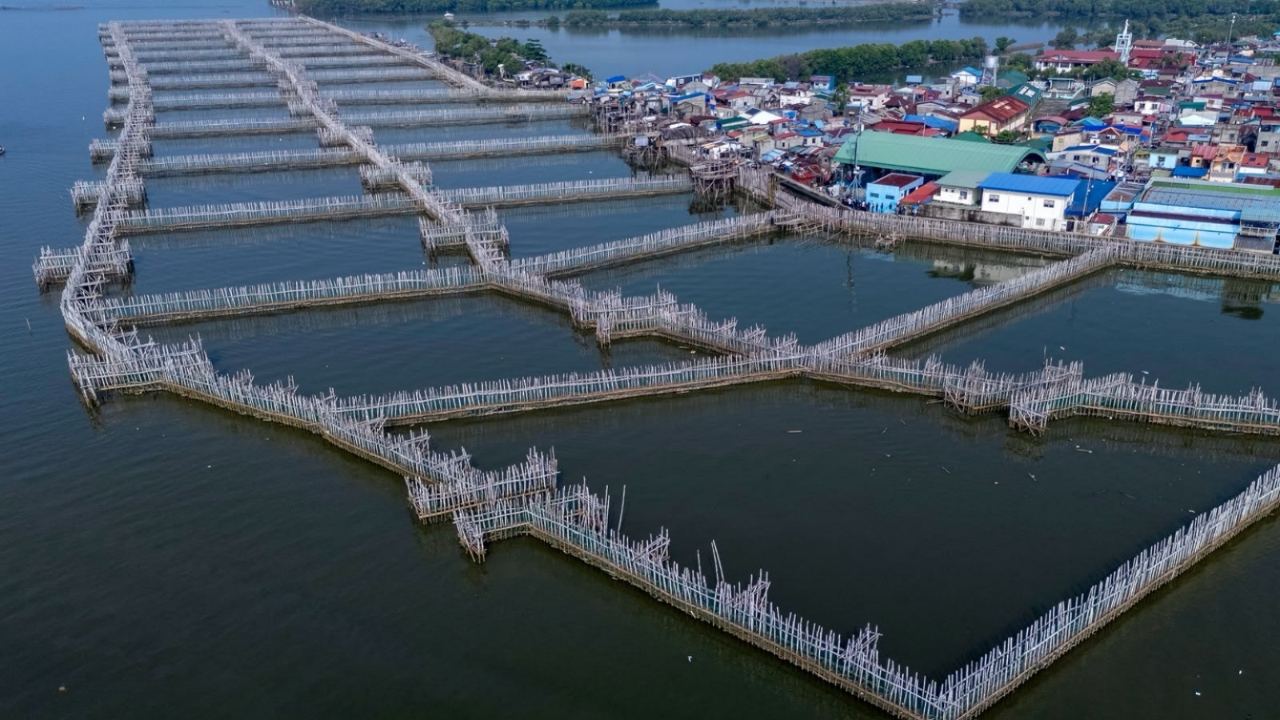
- Primary Velocity Reduction (The Bamboo Piling Grid): Driven vertically into the tidal mudflat in staggered rows, whole culms of mature bamboo (Bambusa blumeana or Dendrocalamus asper) act as rigid-yet-flexible roughness elements. Unlike steel or concrete piles, bamboo possesses a high strength-to-weight ratio and a natural modulus of elasticity that allows the culms to flex under peak storm surge loads without snapping, absorbing initial wave momentum before the water reaches the shoreline.
- Acoustic and Hydraulic Damping (The Oyster Shell Core): Crushed and whole bivalve shells (Crassostrea species) packed within the bamboo cribs provide high surface-area roughness and irregular void geometry. As water surges through the shell bed, constant directional changes strip away laminar flow, dramatically reducing wave height and orbital velocity.
- Capillary Filtration and Soil Binding (The Coconut Coir Matrix): Woven geotextiles and compressed bales of coconut husk fiber (Cocos nucifera) line the landward side of the barrier. High in lignin content, coconut coir resists rapid microbial degradation in saline environments while acting as a fine-mesh sediment trap that prevents backwash from pulling fine silts out to sea.
The Three-Input Waste-to-Infrastructure Supply Chain
Municipalities in the Philippines often struggle to fund climate adaptation because traditional infrastructure requires imported Portland cement, reinforcing steel, and heavy marine construction equipment. By structuring coastal defense around bamboo, oyster shells, and coconut waste, a village decouples its flood resilience from global commodity markets and anchors it in local circular-economy logistics.
1. Structural Bamboo Harvesting and Treatment
Bamboo functions as the load-bearing skeleton of the breakwater. Its viability depends entirely on harvest timing and preservation protocols. Culms must be harvested at three to five years of maturity, when silica content and vascular bundle density peak, ensuring maximum resistance to shear stress. Untreated bamboo submerged in brackish water degrades within two years due to marine borers—specifically shipworms (Teredinidae) and gribbles (Limnoriidae)—as well as fungal rot at the splash zone.
Effective field deployment requires non-toxic preservation methods that rural barangays can execute without industrial autoclaves. Submerging freshly cut culms in a solution of borax and boric acid (disodium octaborate tetrahydrate) displaces the water-soluble starches inside the vascular bundles, removing the primary food source for boring organisms. Alternatively, curing bamboo in brackish tidal creeks for four weeks leaches out residual sugars before installation, extending structural service life from 24 months to between five and seven years. That five-year window is operationally sufficient: the bamboo is not designed to last forever, but rather to survive long enough for natural sediment accretion and mangrove root systems to take over the load-bearing function.
2. Oyster Shell Valorization and Reef Nucleation
Coastal aquaculture communities generate thousands of metric tons of discarded oyster and mussel shells annually. Left in open dumps, these shells create anaerobic decomposition hazards, attract disease vectors, and leach calcium carbonate into terrestrial soils. Redirecting these shells into biodegradable mesh bags or bamboo-framed gabions transforms an environmental liability into self-repairing coastal armor.
Beyond physical wave damping, calcium carbonate shells alter the local water chemistry at the boundary layer, creating an ideal settlement substrate for free-swimming oyster larvae (spat) and barnacles. Within six to twelve months of deployment, wild bivalves colonize the shell gabions, secreting natural calcareous cement that binds the loose shells into a unified, living reef structure. Unlike concrete, which weakens over time due to saltwater intrusion and rebar corrosion, a colonized oyster shell matrix increases in mass, structural integrity, and elevation as biological growth outpaces physical wear.
3. Coconut Coir Geotextiles and Bio-Rolls
The Philippines ranks among the world's largest producers of coconuts, leaving vast quantities of husk waste across rural provinces. Mechanical decortication separates the husk into long bristle fibers and spongy coir dust (peat). Twisting the long fibers into high-tensile twine and weaving them into open-weave geotextile mats—or packing them into cylindrical fascines (coir logs)—creates a permeable membrane capable of stabilizing eroding embankments.
Coconut fiber contains roughly 40 to 45 percent lignin, a complex organic polymer that resists enzymatic breakdown far better than jute, hemp, or sisal. In intertidal zones, coir geotextiles maintain tensile strength for three to five years. During this period, the rough fibers reduce surface runoff velocity during heavy monsoon rains while retaining moisture and organic nutrients during low tide, creating a microclimate that accelerates the germination and root anchoring of salt-tolerant coastal vegetation.
Step-by-Step Deployment Architecture
Replicating a multi-material bio-engineered barrier requires strict adherence to site-specific hydrodynamic sequencing. Deploying materials out of order or ignoring tidal elevation profiles leads to rapid structural washout.
- Bathymetric and Tidal Zonation Mapping: Survey the intertidal profile to establish Mean High Water (MHW), Mean Sea Level (MSL), and Mean Low Water (MLW). Wave-attenuation barriers must be positioned between MSL and MLW to intercept waves before they shoal and break directly onto the upper beach face. Placing the structure too high leaves it dry during normal tides, preventing oyster colonization; placing it too low exposes it to deep-water wave forces that exceed the structural limits of bamboo pilings.
- Staggered Piling Installation: Drive treated bamboo culms at least 1.5 to 2.0 meters into the mudflat substrate using manual water-jetting pumps or drop-hammers. Arrange the pilings in two parallel rows spaced 1.0 to 1.5 meters apart, with individual culms spaced at 0.3-meter intervals in a staggered triangular pattern. Cross-brace the vertical pilings horizontally using split bamboo runners lashed with UV-stabilized polypropylene rope or galvanized wire to distribute lateral wave loads across the entire grid.
- Sub-Base Geotextile Placement: Lay heavy-duty woven coconut coir matting along the mudflat floor inside the bamboo crib before adding ballast. This basal layer prevents the heavy oyster shells from sinking into soft, unconsolidated mud under cyclical wave loading—a failure mode known as punching shear.
- Oyster Shell Infill and Compaction: Fill the bamboo crib with washed, sun-cured oyster shells encased in modular coir-netting bags. Packing shells in modular bags rather than pouring them loose prevents tidal currents from washing individual shells through the gaps in the bamboo pilings during extreme storm surges. Stack the bags to an elevation just below Mean High Water to allow tidal overtopping, which ensures continuous sediment delivery behind the wall.
- Leeward Sediment Trap and Mangrove Planting: Directly behind (landward of) the bamboo-shell breakwater, install anchored coconut coir logs parallel to the shoreline to create a quiescent lagoon. As sediment-laden water overtops the breakwater during high tide, the sudden drop in water velocity causes suspended silts and clays to settle inside this sheltered basin. Once sediment accretion raises the bed elevation by 15 to 30 centimeters, plant nursery-raised mangrove propagules (Rhizophora or Avicennia species) directly through the coir matting.
Quantifying the Sediment Accretion Feedback Loop
The primary strategic advantage of permeable bio-engineering over hard seawalls lies in reversing the sediment budget. Concrete walls starve the shoreline of sand and silt, causing the beach profile in front of the wall to steepen and deepen over time. Permeable bamboo and shell barriers act as sediment traps that actively rebuild lost land.
During flood tide, incoming waves carry suspended sediment particles across the mudflat. Because the bamboo-shell matrix allows water to pass through while stripping away its turbulence, the water behind the barrier enters a low-energy state. According to Stokes' Law of settling velocities, fine silt and clay particles that remain suspended in turbulent water rapidly drop out of the water column when flow velocity falls below critical shear stress thresholds.
When the tide ebbs, the water drains back through the porous oyster shell core and coconut coir filters at a slow, laminar rate. This outgoing flow lacks the kinetic energy required to re-suspend the settled sediment. Over consecutive tidal cycles, this asymmetry between flood-tide sediment import and ebb-tide sediment retention produces measurable vertical accretion. In functional Philippine estuarine deployments, trapped sediment layers frequently accumulate at rates of 10 to 40 centimeters per year, physically elevating the coastal buffer zone and counteracting localized land subsidence.
Structural Limitations and Operational Failure Modes
Treating bamboo, oyster shells, and coconut waste as a universal replacement for civil engineering leads to catastrophic misapplication. Bio-engineered coastal defenses operate within strict physical boundaries, and practitioners must account for four primary failure modes.
High-Energy Open-Coast Exposure
Porous organic structures cannot survive direct exposure to deep-water oceanic swells or Category 4 and 5 typhoon wave impacts on steep, unbuffered coastlines. In open-ocean environments where significant wave heights regularly exceed 2.5 meters, hydrodynamic drag forces will shear bamboo pilings at the mudline and scatter oyster shell gabions within hours. These systems are engineered exclusively for low-to-moderate energy environments, such as sheltered bays, tidal estuaries, deltaic mudflats, and wide, shallow continental shelves where wave energy is already partially attenuated by bathymetric friction.
Rapid Land Subsidence Outpacing Accretion
In parts of northern Manila Bay—such as Bulacan and Pampanga—excessive groundwater pumping has caused land subsidence rates of 4 to 10 centimeters per year. If local subsidence rates exceed the vertical sediment accretion rate of the bio-engineered trap, the structure will progressively submerge below its functional tidal window. Once the crest of the barrier drops below Mean Low Water, wave attenuation efficiency collapses, and newly planted mangroves drown from prolonged root inundation. Bio-engineering cannot solve a hydrological extraction crisis; it must be paired with strict municipal moratoriums on deep-well groundwater pumping.
Maintenance Deficit During the Transition Window
A bio-engineered breakwater is a transitional scaffold, not a permanent monument. Between Year 2 and Year 5, UV radiation, saline corrosion of lashings, and marine borers will degrade the bamboo culms and coir netting. If a barangay fails to inspect and replace damaged lashings or top up settled oyster shell bags before the living oyster reef and mangrove root network achieve structural maturity, a single seasonal monsoon storm can breach the weakened barrier and flush out years of accumulated sediment.
Eutrophication and Bio-Fouling Risks
Deploying unwashed oyster shells containing residual organic tissue introduces concentrated nitrogen and phosphorus loads into shallow coastal waters. In poorly flushed bays, this nutrient spike triggers localized algal blooms and hypoxic dead zones that kill surrounding seagrass beds and juvenile fish stocks. All aquaculture shell waste must undergo mandatory sun-drying and biological curing on land for at least 30 days prior to marine deployment to ensure complete tissue desiccation.
Economic Comparison Against Conventional Gray Infrastructure
For municipal budget officers evaluating coastal resilience investments, the financial divergence between concrete seawalls and bio-engineered barriers extends beyond initial construction costs to lifecycle maintenance and ecological externalities.
- Capital Expenditure (CAPEX): Constructing a reinforced concrete seawall in the Philippines typically costs between $1,500 and $3,500 per linear meter, driven by cement transport, steel reinforcement, cofferdam dewatering, and heavy machinery rental. A multi-row bamboo, oyster shell, and coconut coir breakwater costs between $80 and $250 per linear meter, with over 60 percent of that expenditure remaining inside the local village economy as direct labor wages and raw waste procurement.
- Operational Expenditure (OPEX) and Repair: Concrete structures require specialized marine contractors and heavy equipment to repair cracks or underpin scoured foundations; minor structural failures frequently require total demolition and reconstruction. Bio-engineered barriers require continuous, low-skill maintenance—re-tying lashings, adding shell bags, and replanting mangrove gaps—which local fisherfolk cooperatives can execute using hand tools and small outrigger boats (bancas).
- Asset Depreciation Versus Appreciation: A concrete seawall begins depreciating on the day of installation, losing structural strength as saltwater corrodes internal rebar until it reaches total failure in 15 to 25 years. A properly sited bio-engineered barrier appreciates in defensive value over time; as the bamboo and coir biodegrade, they are replaced by a self-sustaining mangrove forest and calcified oyster reef capable of attenuating up to 70 to 90 percent of incoming wave energy across a 100-meter forest width while sequestering blue carbon and restoring artisanal fisheries.
Tactical Blueprint for Municipal Scaling
To scale village-level bio-engineering from isolated pilot projects into district-wide coastal defense networks, local government units must shift from ad-hoc community volunteerism to formalized municipal procurement and ecological zoning.
First, municipal engineers must reclassify agricultural and aquaculture waste streams—specifically mature bamboo stands, oyster processing middens, and coconut decortication facilities—as strategic public works inventory. Establishing municipal collection depots and paying standardized tipping fees or purchase rates to local cooperatives guarantees a predictable supply of pre-treated materials prior to the onset of the southwest monsoon (Habagat) season.
Second, coastal zoning ordinances must mandate a minimum setback buffer behind every bio-engineered breakwater. Planting a single narrow row of mangroves behind a bamboo-shell barrier fails during major typhoons because wave attenuation requires horizontal cross-sectional width. Municipalities must reclaim or rezone at least 50 to 100 meters of landward intertidal space for multi-species mangrove silviculture, converting abandoned or unproductive fishponds back into tidal forest buffers.
Finally, funding mechanisms must transition from one-off infrastructure grants to payment-for-ecosystem-services (PES) models. By quantifying the avoided flood damage to coastal roads, schools, and agricultural fields alongside verified blue carbon sequestration credits, municipalities can fund multi-year maintenance stipends for village coastal defense brigades, ensuring the physical barrier is actively managed until the living ecosystem assumes permanent hydrological control.