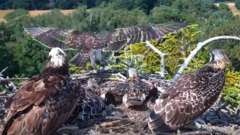
The transition of a juvenile osprey (Pandion haliaetus) from nest-bound dependent to a self-sustaining aerial predator is one of the most energetically demanding phases in avian biology. While a standard osprey clutch yields two to three eggs, the survival and successful fledging of a four-chick brood represents an extreme ecological anomaly. This phenomenon taxes the thermodynamic limits of the parental provisioning strategy and exposes the stark trade-offs of sibling competition. To understand the mechanics behind the first flight of the pioneer chick in a four-offspring nest, one must dissect the physical, energetic, and behavioural variables that dictate raptor development.
Fledging success is not a random milestone. It is the output of a complex bioenergetic equation balancing daily energy intake, aerodynamic wing loading, and asymmetric resource distribution within the nest. Recently making news in related news: The Architecture of Bureaucratic Sovereignty: Deconstructing the Mechanics of West Bank Administrative Integration.
The Thermodynamics of the Four Chick Nest
The primary constraint on osprey reproductive success is parental provisioning capability. Osprey are obligate piscivores, meaning their diet consists almost entirely of live fish. The male parent is solely responsible for foraging during the incubation and early rearing phases, while the female manages nest defense and prey distribution.
In a standard three-chick nest, the energy requirements of the brood scale predictably. However, adding a fourth chick introduces a non-linear increase in resource demand that often exceeds parental foraging efficiency. Further details on this are covered by NBC News.
The Provisioning Bottleneck
The daily energy expenditure ($DEE$) of growing osprey chicks increases exponentially until it plateaus near the onset of fledging, typically around 50 to 55 days post-hatch. For a single chick, the peak daily energy requirement is estimated at approximately 800 to 1,000 kilojoules.
$$\text{Total Brood Demand} = \sum_{i=1}^{n} DEE_i$$
Where $n$ represents the number of chicks. In a four-chick nest, the cumulative peak demand approaches 4,000 kilojoules per day. This requires the male to deliver between 8 to 12 high-quality fish daily, depending on species, size, and caloric density (e.g., salmonids vs. clupeids).
When weather conditions deteriorate or local fish populations migrate deeper, parental foraging success rates plummet. This creates an immediate caloric deficit within the nest, forcing a shift in how resources are allocated among siblings.
Sibling Aggression and Dominance Hierarchies
Ospreys exhibit asynchronous hatching, meaning eggs are laid and hatched over a span of several days. This biological design establishes an immediate size and developmental hierarchy within the nest.
- First-Hatched Chick (Alpha): Enjoys a structural developmental lead of 2 to 5 days. This chick dominates feeding sequences, monopolising the highest-quality prey portions.
- Middle-Hatched Chicks (Beta and Gamma): Occupy intermediate positions, feeding only after the Alpha's immediate hunger is satiated.
- Fourth-Hatched Chick (Omega): The most developmentally disadvantaged. In times of resource scarcity, the Omega chick faces severe nutritional deprivation, often leading to brood reduction (starvation or siblicide).
The successful fledging of all four chicks indicates an environment characterized by exceptionally high prey density and optimal foraging conditions, allowing the parents to bypass the standard biological pressures of brood reduction.
The Aerodynamics of Fledging
Taking flight is not merely a behavioral transition; it is a mechanical threshold. Before a juvenile osprey can lift off the nest platform, it must achieve a critical ratio of pectoral muscle mass to body mass, coupled with adequate primary feather development.
Wing Loading and Aspect Ratio
The physics of avian flight require the lift force ($L$) to exceed the gravitational force acting on the bird's mass ($W$).
$$L = \frac{1}{2} \rho v^2 S C_L$$
Where:
- $\rho$ is air density,
- $v$ is flow velocity relative to the wing,
- $S$ is wing surface area,
- $C_L$ is the lift coefficient.
Juvenile ospreys undergo a rapid reduction in water weight just prior to fledging. This process, known as physiological dehydration, decreases their overall mass, thereby reducing wing loading (mass divided by wing area). A lower wing loading allows the juvenile to generate sufficient lift at lower takeoff speeds, reducing the mechanical work required during the first flight.
Wing Exercise and Muscle Conditioning
Prior to the actual fledge, juveniles engage in "wing-flapping" or "helicoptering" behaviors. The bird grips the nest structure with its talons and vigorously flaps its wings, lifting itself several inches or feet into the air. This serves two vital developmental functions:
- Hypertrophy of Flight Muscles: The pectoral muscles (pectoralis and supracoracoideus), which comprise up to 20% of an adult osprey's body mass, undergo rapid conditioning to handle the high-frequency demands of flapping flight.
- Neuromuscular Coordination: The juvenile calibrates its vestibular system to interpret wind speed, direction, and lift dynamics, learning how to manipulate its tail feathers (retrices) to act as a rudder and brake.
The First Flight: Trigger Mechanisms and Flight Physics
The decision of the first chick to fledge is driven by a combination of internal energetic cues and external environmental stimuli.
[Internal Caloric Status] + [Thermal Updrafts / Headwinds]
                        │
                        ▼
            [Hormonal Surge (Corticosterone)]
                        │
                        ▼
             [Initiation of Takeoff]
The pioneer chick, typically the oldest and most well-fed (the Alpha), reaches developmental maturity first.
Environmental Triggers
Wind speed and ambient temperature play a decisive role in the timing of the first flight. Ospreys rely heavily on wind to assist in takeoff. A steady headwind of 10 to 15 knots provides immediate lift over the wings, reducing the necessary runway and flapping energy required to clear the nest rim.
Furthermore, solar heating of the ground creates thermal updrafts. These rising columns of warm air allow the novice flier to gain altitude with minimal energy expenditure, reducing the risk of a ground crash—a leading cause of juvenile mortality during early flight attempts.
The Mechanics of the First Takeoff
The first flight is rarely a graceful soaring display. It is typically a short, labored point-to-point transit, often directed toward a nearby perch (e.g., a dead tree branch or utility pole) within 50 to 100 meters of the nest.
The juvenile relies on high-amplitude, high-frequency wing beats to maintain altitude. Because the bird's flight feathers may not yet be 100% unfurled from their waxy sheaths, its aerodynamic efficiency is compromised compared to an adult. Landings are notoriously clumsy; juveniles often overshoot their targets due to a lack of experience in executing the flare maneuver, which stalls the bird safely just above the perch.
Post-Fledging Dependence and the Survival Curve
Fledging does not equal independence. The first flight marks the beginning of the post-fledging dependence period, which typically lasts between three to six weeks.
Fledging (Day 55) ───► Local Exploration (Weeks 1-2) ───► Hunting Practice (Weeks 3-4) ───► Migration (Week 6+)
During this window, the fledged juvenile remains entirely reliant on parental provisioning, returning to the nest platform to feed on fish delivered by the male parent.
Spatial Dispersal and Hunting Acquisition
The transition from dependent receiver to active hunter occurs in phases:
- Phase 1: Localized Perching (Days 1–7 post-fledge). The juvenile remains within a tight radius of the nest, conserving energy and refining its landing mechanics.
- Phase 2: Exploratory Flight (Days 8–21 post-fledge). The juvenile follows the parents to nearby foraging waters, observing diving techniques and learning to identify shallow-water prey.
- Phase 3: Foraging Attempts (Days 21+ post-fledge). The young osprey begins making shallow dives. The success rate of juvenile dives is exceptionally low (often under 10%), compared to the 50-70% success rate of experienced adults.
The Vulnerability Window
The post-fledging period is a demographic bottleneck. First-year mortality in ospreys ranges from 50% to 60%. The primary threats during this phase include:
| Threat Vector | Mechanism of Impact | Mitigation / Risk Factors |
|---|---|---|
| Starvation | Inability to transition to self-sufficient hunting before parental provisioning ceases or migration begins. | Exacerbated in four-chick nests due to lower average reserve fat per chick. |
| Predation | Vulnerability to apex predators (e.g., Bald Eagles, Great Horned Owls) during ground landings or low-altitude perching. | Decreases as flight maneuverability improves over the first two weeks. |
| Anthropogenic Hazards | Collision with power lines, entanglement in discarded monofilament fishing line, and exposure to environmental toxins. | High-density human coastal zones increase encounter rates. |
Strategic Implications for Conservation and Monitoring
The successful fledging of a four-chick brood is a vital bio-indicator of local ecosystem health. It signals a highly productive aquatic food web capable of sustaining top-tier trophic predators.
Monitoring Protocols
To capture accurate data on these rare four-chick successes, conservation biologists must implement non-invasive monitoring frameworks:
- Telemetry Tracking: Deploying lightweight, solar-powered GPS-GSM transmitters on juveniles prior to fledging. This allows researchers to track flight paths, dispersal distances, and survival rates during the critical migration phase.
- High-Resolution Nest Cams: Utilizing automated image analysis to quantify prey delivery rates, fish species composition, and sibling aggression metrics. This removes observer bias and provides continuous ecological data.
Protecting critical nesting habitats, mitigating shoreline development, and maintaining clean waterways are essential to ensuring that ospreys have access to the dense prey populations required to rear large clutches.