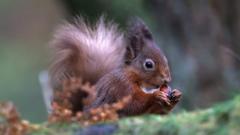
The geographic expansion of Squirrelpox virus (SQPV) into northern regions of the United Kingdom represents a structural shift in native wildlife epidemiological dynamics. Recent clustered mortality events in Dollar, Clackmannanshire, following a prior confirmed breach of the Central Belt in Dunfermline, demonstrate that historical geographic barriers are no longer sufficient to contain transmission. Evaluating this threat requires moving beyond descriptive conservation rhetoric and instead mapping the precise mathematical and behavioral vectors driving the pathogen’s reproductive rate ($R_0$). When SQPV enters a naive population of native red squirrels (Sciurus vulgaris), the interaction between a highly adapted, asymptomatic reservoir host—the invasive grey squirrel (Sciurus carolinensis)—and a highly susceptible native host creates an ecological bottleneck that accelerates population collapse by a factor of twenty compared to standard resource competition.
The Asymmetric Transmission Vector Engine
The fundamental mechanism driving local population crashes is the profound biological asymmetry between the two host species. Sciurus carolinensis functions as a highly resilient maintenance host. Evolutionary exposure has rendered grey squirrels largely seropositive but clinically unaffected by SQPV, allowing them to carry high viral loads without undergoing functional decline. Conversely, Sciurus vulgaris operates as an accidental, highly susceptible host.
The transmission mechanics rely on two core vectors: direct contact during periods of heightened conspecific interaction, such as breeding seasons, and indirect transmission via shared foraging infrastructure. The persistence of the virus in the environment turns shared geographic points into high-density infection zones.
+------------------------------------------+
|  Asymptomatic Maintenance Host            |
|  (Sciurus carolinensis)                   |
|  - High viral shedding                   |
|  - Zero clinical deterioration            |
+------------------------------------------+
                     |
                     v
   [ Environmental Fomites / Feeders ]  <--- Structural Multiplying Factor
                     |
                     v
+------------------------------------------+
|  Highly Susceptible Native Host          |
|  (Sciurus vulgaris)                      |
|  - 10-14 day mortality window            |
|  - 80%+ localized population decline     |
+------------------------------------------+
When an outbreak occurs, the clinical progression in red squirrels follows a rapid, deterministic timeline:
- Days 1–5 (Inoculation and Incubation): The virus replicates within subepithelial tissues following exposure to environmental fomites or micro-abrasions.
- Days 6–10 (Pathogen Manifestation): Development of exudative, weeping lesions, ulcers, and extensive scabbing around the facial mucosa, periocular tissue, digital pads, and genitalia.
- Days 11–14 (Systemic Failure): Severe cutaneous necrosis induces functional blindness and motor impairment. The inability to forage or masticate leads to acute dehydration, starvation, and secondary septicemia.
Empirical data from historical outbreaks, such as those documented in Gwynedd, Wales, and Tollymore Forest, Northern Ireland, indicate that localized mortality rates regularly fall between 82% and 93%. Survival is an anomaly. While retrospective serological testing suggests that approximately 8% of a population may possess or develop antibodies during an epidemic, these individuals typically exhibit higher baseline body-mass-to-shin-length ratios, indicating that pre-existing metabolic resilience is a prerequisites for surviving exposure.
Anthropogenic Aggregation: The Cost Function of Artificial Feeding
The primary accelerator of the viral transmission rate in suburban and fragmented woodland environments is the presence of artificial wildlife feeders. While intended to support conservation, these structures operate as high-efficiency pathogen exchange hubs by fundamentally altering the spatial ecology of the species.
In a natural, undisturbed canopy, red squirrels exhibit territorial spacing determined by food density. Foraging behavior is distributed over a wide home range, which naturally limits the basic reproductive number ($R_0$) of a density-dependent pathogen. Artificial feeding stations disrupt this equilibrium by creating a fixed point of high spatial convergence.
The multiplication of risk via artificial feeding infrastructure can be modeled through three distinct structural phases:
- The Aggregation Phase: The introduction of a high-calorie, stationary food source artificially compresses the foraging radiuses of multiple individuals, forcing higher contact rates per unit of time.
- The Fomite Contamination Phase: As an infected individual feeds, exudate from periocular and oral lesions comes into direct contact with the wood, plastic, or mesh surfaces of the feeder. The viral particles remain stable in cool, damp microclimates, turning the hardware into a continuous shedding site.
- The Vector Overlap Phase: The feeder attracts both native red squirrels and invasive grey squirrels. This cross-species utilization bypasses traditional competitive exclusion zones, allowing grey squirrels to deposit high viral loads directly into the path of native populations.
Because of this specific pathway, immediate biosecurity interventions require a complete cessation of artificial feeding within a minimum radius of a suspected outbreak. Removing these amplification points forces populations back into lower-density, natural foraging patterns, effectively reducing the frequency of high-exposure events.
Biosecurity Limitations and Pathological Constraints
Quantifying the true scope of an SQPV outbreak is constrained by severe data collection bottlenecks. Passive surveillance—relying on the public to report symptomatic individuals or recover carcasses—captures only a small fraction of total mortalities. Field data suggests that observed mortalities represent as little as 10% of actual fatalities during an active epidemic. The remaining 90% of casualties occur within nesting dreys or dense undergrowth, where carcasses rapidly degrade or are removed by scavengers.
The primary diagnostic bottleneck is institutional. Definitive confirmation of SQPV requires a comprehensive post-mortem examination, historically executed by specialized veterinary units such as the Royal (Dick) School of Veterinary Studies. Pathologists must evaluate the internal tissue architecture and execute molecular or serological surveillance to differentiate SQPV from alternative pathologies, including:
- Exudative bacterial dermatitis or deep-tissue abscesses resulting from inter-species trauma.
- Cutaneous manifestations of Mycobacterium leprae or Mycobacterium lepromatosis (endemic leprosy variants present in specific island populations).
- Superficial trauma secondary to road traffic accidents or raptor predation, which can obscure underlying systemic infections.
Compounding this diagnostic delay is a chronic funding deficit. Post-mortem monitoring programs frequently operate as secondary priorities within academic or teaching facilities, leading to administrative backlogs that can delay final diagnostic reports by several weeks. While suspected SQPV cases are fast-tracked, the lack of real-time genomic tracking means that management decisions must be made based on clinical observation and video evidence rather than definitive laboratory confirmation.
Strategic Intervention Blueprint
Containing an active SQPV outbreak requires a rapid pivot from passive monitoring to aggressive, targeted population management. Because no viable field vaccine is currently available for distribution, conservation metrics depend entirely on manipulating host density.
The operational strategy relies on a dual-action intervention framework designed to decouple the reservoir host from the susceptible population.
       [ SUSPECTED OUTBREAK IDENTIFIED ]
                       |
        +--------------+--------------+
        |                             |
        v                             v
[ BIOSECURITY PHASE ]       [ POPULATION ISOLATION ]
- Total feeder removal      - Live-trapping deployment
- 14-day zero-bias window   - Intensive grey culling
- Antiviral sanitation      - High-density capture grids
The first phase demands immediate biosecurity enforcement across all public and private lands within the target zone. All wildlife feeding apparatus must be removed for a minimum of 14 days. This zero-bias window disrupts the artificial congregation of vectors. Concurrently, any remaining permanent structures must be sanitized using broad-spectrum veterinary-grade antiviral solutions capable of disrupting the viral envelope.
The second phase involves intensive, localized population suppression of Sciurus carolinensis. Deploying high-density live-trapping grids in the periphery of the outbreak site achieves two critical goals: it lowers the absolute density of the reservoir host, minimizing the probability of new infectious shedding events, and it creates a biological buffer zone that slows the outward movement of the virus. Mathematical models demonstrate that when grey squirrel densities are maintained below a threshold of 0.1 individuals per hectare, the transmission cycle of SQPV breaks down, giving the surviving red squirrel population the spatial and temporal buffer necessary to gradually recolonize the cleared territory.


