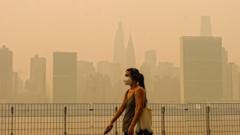
Detroit’s skyline disappeared again this week behind a thick, yellow wall of fine particulate matter, pushing the city to the top of the world pollution rankings. It is a miserable, throat-burning reality that millions of Americans in the Midwest and Northeast are dealing with for the third consecutive summer. Naturally, the political finger-pointing did not take long to cross the border.
A faction of congressional Republicans decided they have had enough of the bad air, pointing their fingers directly at Ottawa. Four Michigan lawmakers—Reps. Jack Bergman, John James, Lisa McClain, and John Moolenaar—fired off a scathing letter to Canadian Prime Minister Mark Carney, declaring that "American lungs are paying the price for Canadian inaction". They even threw down a heavy-handed ultimatum: if Canada does not start aggressively managing its forests, the U.S. will step in and do it for them. Senator Bernie Moreno of Ohio took it a step further, introducing a bill beautifully titled the "CANADA FIRE Act" to threaten our northern neighbor with financial sanctions.
Look, it is easy to understand the rage. Nobody wants to be trapped indoors in July because the air outside is literally toxic. But treating massive, climate-stressed boreal forests like a neglected suburban lawn that just needs a good mowing is a fundamental misunderstanding of how wildfires work. Demanding that a sovereign nation magically stop the wind from blowing smoke south is not a policy. It is a temper tantrum.
The Myth of Easy Forest Management
The core argument from the Republican coalition is that Canada’s wildfire crisis is born out of simple neglect. The letter explicitly blames a lack of active forest thinning, fuel reduction, and prescribed burns. They argue that if Canada simply logged more responsibly or cleared out the underbrush, the skies over Michigan would instantly clear up.
That sounds great in a press release, but it completely ignores the scale of geography.
Canada is home to nearly 907 million acres of boreal forest. That is roughly 9% of the entire forest cover on Earth. It stretches across thousands of miles of rugged, inaccessible, and unpopulated terrain. The fires currently choking the Midwest are tearing through northern Ontario—vast wilderness areas where there are no roads, no fire hydrants, and no easy way to deploy thousands of workers with chainsaws.
Anyone who has actually worked in forestry or emergency management knows you cannot manually thin a forest the size of a small continent. Prescribed burns are an incredibly effective tool for local wildland-urban interfaces, but they are not a magic wand for millions of square kilometers of isolated wilderness.
The Missing Link in the Political Narrative
The most glaring flaw in these political demands is the complete exclusion of the real culprit: the changing climate. The Republican letters and proposed sanctions bills completely bypass the fact that the boreal forest is drying out at an unprecedented rate.
We are seeing longer fire seasons, extreme lightning events, and prolonged droughts that turn healthy forests into tinderboxes. When a fire ignites in these conditions, it does not matter how much underinvested brush you think is sitting on the ground. The canopy itself burns with such intensity that it creates its own weather systems.
By framing this strictly as an issue of "Canadian inaction," lawmakers are avoiding the much harder conversation about global emissions and systemic environmental shifts. It is much easier to threaten Prime Minister Carney with sanctions than it is to address the root causes of extreme weather patterns affecting both nations.
Cross-Border Firefighting Is Already a Reality
The threat that the U.S. will "look elsewhere, and act on our own" to manage Canadian forests ignores a long, highly successful history of bilateral cooperation. The U.S. and Canada do not operate in silos when the woods are burning. For decades, the two countries have shared crews, water bombers, and intelligence through formalized mutual aid agreements.
When American states face catastrophic fire seasons, Canadian crews head south. When northern Ontario or Alberta gets overwhelmed, American hotshots catch flights north.
Suggesting that U.S. agencies will unilaterally cross the border for "direct involvement in fuel reduction" is a logistical and diplomatic fantasy. It undermines the actual, boots-on-the-ground cooperation that happens every day between the U.S. Forest Service and Canadian provincial fire agencies.
Moving From Blame to Actual Resilience
If Washington politicians genuinely want to protect American lungs, they need to ditch the empty political posturing and focus on strategies that actually work. Sanctions will not put out a single spark in northern Ontario.
First, both nations need to aggressively scale up funding for the joint deployment of suppression tech, like satellite-based early detection and shared drone fleets for remote monitoring. Second, regional governments must invest heavily in community resilience—upgrading air filtration systems in public schools, creating clean air shelters, and equipping vulnerable populations to handle the unavoidable smoke days ahead.
The smoke is not going away just because a few politicians signed a sternly worded letter. The climate reality of 2026 demands that we stop treating wildfires like a neighborhood dispute and start treating them like the borderless, systemic crisis they actually are.