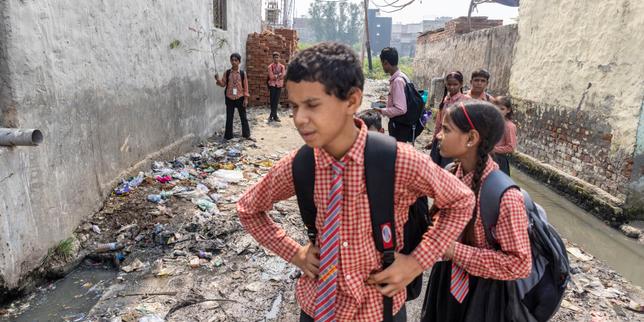
Everybody loves a pathetic visual. Plaster peeling off chalkboards, rusted tin roofs, children sitting on dirt floors while politicians sip tea in New Delhi air-conditioned suites. It makes for great television. It triggers immediate moral outrage. And it completely misdiagnoses why the Indian educational system is currently eating its own young.
When the Cockroach Janata Party (CJP) marched through classrooms under their satirical banners to expose decaying infrastructure, Western and domestic commentators nodded along with predictable uniformity. The lazy consensus claims that if we just pour billions into concrete, fresh paint, and smart boards, upward mobility will follow.
They are looking at the shell while the engine block is seized.
Physical decay is not the disease in Indian public education. Physical decay is a symptom of a systemic, ideological cartel that treats youth employment as a zero-sum patronage game. Fixing the walls of a schoolhouse means nothing if the curriculum taught inside trains students to memorize obsolete formulas for exams that lead straight into a 40 percent youth unemployment black hole.
The Comfort of the Superficial Fix
Let us define terms precisely. A decaying school building implies neglect. Neglect implies that an otherwise functional system simply forgot to allocate maintenance budgets. That is false. The Indian state has never forgotten how to spend money; it directs capital precisely where it protects incumbent political machinery.
When activists focus exclusively on broken windows and leaking roofs, they let the architects of the bureaucratic state off the hook. Imagine a scenario where every single government school in Maharashtra and Uttar Pradesh is instantly upgraded with marble floors, air conditioning, and pristine modern furniture. Does the structural unemployment crisis vanish? Do the million-plus engineering graduates suddenly find high-value market demand for rote-learning credentials?
No. Because the crisis is not hardware. It is software.
The obsession with crumbling bricks hides the rot of a credentialist trap. For decades, the social contract promised that a university degree or school completion certificate equaled a safe government desk job. That market died twenty years ago. Yet, the state continues to feed students into archaic examination funnels that reward regurgitation over critical reasoning.
Why Satire Beats Sympathy, But Stops Short
The rise of the CJP—born out of a judicial insult comparing young job seekers to pests—proved that humor can fracture authoritarian messaging faster than traditional opposition parties ever could. Wearing cockroach masks and auditing failing institutions brilliantly flipped the narrative back onto an out-of-touch elite.
Yet, satire is a tactic, not an economic policy.
By centering the entire national discourse on "how poorly we treat children", the movement accidentally reinforces a paternalistic trap. It begs the state to be a better caretaker. It asks the same machinery that created the bottleneck to kindly manage the queue more fairly.
That approach is fundamentally broken. You cannot beg a monopoly to dismantle its own control mechanisms. The public school system and the bureaucratic examination boards are tightly coupled. They exist to filter, rank, and ultimately reject the vast majority of the population while preserving elite access to administrative power.
Dismantling the Credentials Cartel
To understand why traditional education reform fails in South Asia, look at the incentives. Politicians do not want an educated, radically independent workforce that questions industrial policy or tech monopolies. They want a compliant, credentialed underclass desperate for low-level state patronage.
When youth movements demand better schools without demanding an absolute restructuring of labor markets and curriculum relevance, they are fighting for nicer waiting rooms on the way to nowhere.
If you want to fix the future of Indian youth, stop spending energy auditing peeling paint. Start dismantling the state-sanctioned exam monopolies that penalize vocational mastery. Decentralize curriculum design down to municipal tech hubs and local industrial clusters. Force schools to compete for students based on skill acquisition, not government-mandated completion certificates.
The cockroach metaphor worked because it weaponized dehumanization against the powerful. But a pest survives by hiding in the cracks of a crumbling structure. If the youth movement wants to do more than survive, it has to stop inspecting the cracks and tear down the walls entirely.