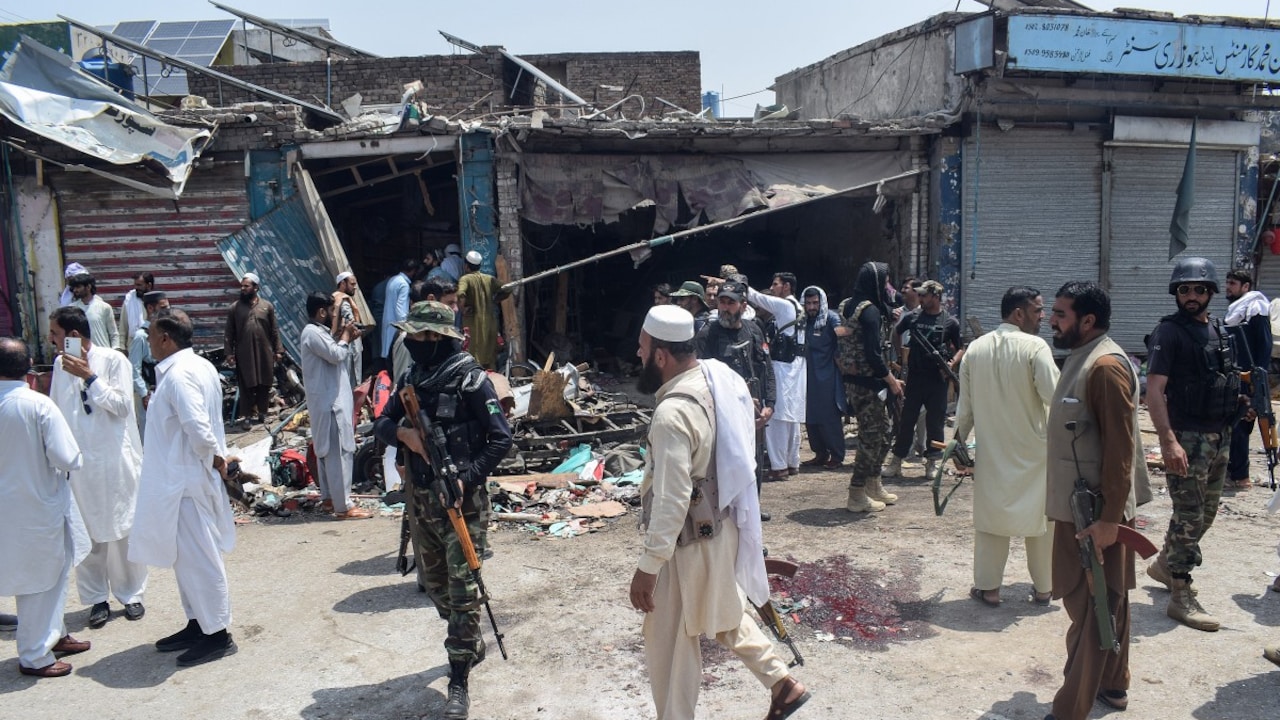
Every time uniforms return home in body bags, the headlines write themselves. Analysts reach for the worn-out dictionary of terror, politicians deliver identical memorandums of grief, and the public consumes a neat narrative about external enemies and radical ideologies.
Stop accepting the lazy consensus.
When five officers are killed and dozens injured in Pakistan, the instinctual diagnosis is a security failure against insurgent forces. That diagnosis is comfortable. It externalizes the pathology. It pretends the rot is coming from the mountains rather than the boardroom, the ballot box, and the barracks.
I have spent years watching strategic analysts miss the entire board because they refuse to look past the smoke. The official line treats these attacks as tactical anomalies executed by ideological zealots. That perspective is dangerously outdated. What we are witnessing is the predictable systemic collapse of an elite protection racket masquerading as a modern state.
The Anatomy Of A Misdiagnosis
Let us look at the standard narrative pushed by mainstream security commentary. It goes something like this: violent extremism surges, the state responds with kinetic force, intelligence gaps are identified, and new counter-terrorism funds are requested.
It is a closed loop of failure.
The core assumption is that militant groups operate entirely outside the state apparatus, driven solely by theological grievance or foreign sponsorship. While external actors certainly pour gasoline on the fire, the engine itself is domestic political economy.
Pakistan does not suffer from a simple shortage of checkpoints or surveillance hardware. It suffers from a chronic structural crisis where the state apparatus functions primarily to extract resources from the periphery to subsidize a predatory center. When you treat a structural crisis as a law enforcement problem, you do not solve it. You simply churn through casualties while the underlying infection spreads.
Consider the deployment patterns. Paramilitary forces and regular police are routinely thrust into volatile regions without adequate logistical backing, intelligence sharing, or institutional support. They are sent out as static targets in a dynamic asymmetric conflict. When disaster strikes, the leadership blames inadequate tactical equipment instead of strategic malpractice.
Follow The Incentives
If you want to understand why violence persists, stop listening to rhetoric and look at balance sheets.
Security is big business. For decades, the perpetual threat of internal instability has served as the ultimate justification for budget allocations, foreign aid packages, and unchecked political dominance. A fully pacified country does not require an oversized security-industrial complex.
This creates a perverse institutional incentive. Total victory over insurgent factions destroys the rationale for the very institutions built to fight them. Consequently, strategy often devolves into containment rather than elimination—managing a low-level burn to keep the funding flowing and the political leverage intact.
The foot soldiers pay the price for this macroeconomic reality. They are the ones in the field absorbing the impact of policy failures engineered miles away in air-conditioned headquarters.
The Myth Of Kinetic Solutions
Every time a high-casualty incident hits the news wire, the immediate demand is for more kinetic operations. More raids. More curfews. More emergency powers.
This approach ignores basic historical precedent. You cannot bomb your way out of a legitimacy deficit.
When local populations in border regions see zero economic development, rampant judicial corruption, and arbitrary state power, militant recruiters do not need to convert anyone to an ideology. They simply need to offer an alternative to a predatory status quo.
The state attempts to substitute governance with artillery. It fails every single time.
I have spoken with regional administrators who privately admit that their entire administrative strategy consists of holding out until their next transfer. Nobody is investing in long-term institutional reform because the horizon of political survival in Islamabad rarely extends past the next fiscal quarter or the next coalition crisis.
Dismantling The Official Playbook
To change the trajectory, we have to stop asking how the state can secure more territory and start asking why the population sees the current state structure as an adversary rather than a protector.
That requires flipping the conventional questions upside down.
Why Do Casualties Keep Mounting Despite Increased Budgets?
The popular answer assumes funding is insufficient. The structural answer is that money is allocated for patronage and self-preservation rather than tactical readiness and intelligence modernization. More cash into a corrupt procurement pipeline just buys more expensive failures.
Are We Dealing With Ideology Or Insurgency?
Ideology is the marketing; economics and governance are the product. Militant networks survive because they embed themselves within local smuggling economies, land disputes, and deep-seated grievances against central authorities. Cut off the economic oxygen and local complicity, and the ideological fervor collapses overnight.
Can Intelligence Agencies Fix The Problem?
Intelligence apparatuses in the region are historically optimized for domestic political engineering—managing elections, silencing dissidents, and curating political coalitions. When an organization spends seventy percent of its bandwidth monitoring opposition politicians and journalists, its counter-terrorism capabilities atrophy. You cannot repurpose a political surveillance machine into an effective counter-insurgency network without a complete institutional teardown.
The Cost Of Complacency
Accepting the surface-level explanation of these attacks is an act of active complicity. Every time we reduce a complex socio-political implosion to a simple tale of good versus evil, we grant immunity to the architects of failure.
The officers who died did not fall because of a sudden tactical lapse. They fell because an entire ruling class treats human lives as expendable currency in a game of perpetual political maneuvering.
Until the public stops buying the narrative of externalized terror and starts demanding internal structural accountability, the body counts will keep rising, the press releases will remain identical, and the machine will keep grinding forward.
Stop mourning the symptom while ignoring the design.