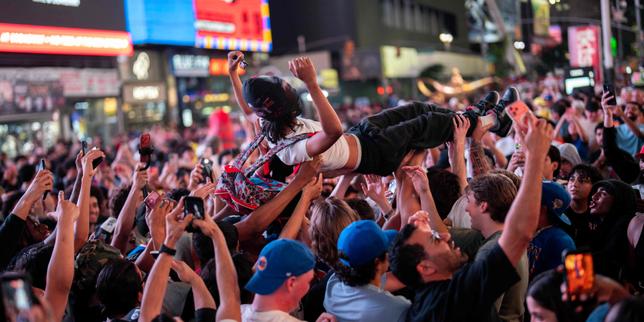
The air inside Madison Square Garden smells of expensive cologne, stale beer, and the metallic tang of sweat. It is November. The bass from the arena speakers thumps so violently it rattles the ice in the VIP plastic cups. When Donald Trump walks down the tunnel, flanked by a phalanx of secret service and a trailing entourage of tech billionaires and podcasters, the arena does not just cheer. It roars. It is a primal, deafening wall of sound that blurs the line between a political rally and a blood sport.
To the casual observer, this looks like a bizarre modern fracture in American culture. A president-elect sitting cageside while two men try to separate each other from their consciousness seems lightyears removed from the dignity of the Oval Office. Critics point to the raw violence of the Ultimate Fighting Championship and call it a dangerous degradation of the presidency. Supporters view it as the ultimate badge of populist authenticity.
Both sides are missing the point.
The spectacle of a commander-in-chief using the raw, visceral energy of sports to project power is not a modern aberration. It is one of the oldest traditions in American politics. Trump did not invent the weaponization of the athletic arena. He merely updated the playlist for a culture that prefers cage fighting to baseball.
To understand how we arrived at this cage side seats reality, we have to look past the flashing strobe lights of the MGM Grand and peer into the humid afternoon of 1905, inside a wood-paneled room where a different president was trying to save a different violent sport from itself.
The President Who Held the Whistle
The human body was never designed to endure the "flying wedge."
Imagine a massive, V-shaped wall of human meat and bone, locking arms and sprinting at full speed toward a static defender. In 1905, this was the premier play in American college football. It was not a game of grace. It was a localized war. Players wore flimsy leather caps, if they wore anything at all on their heads. That year alone, eighteen college players died on the field. Necks snapped. Skulls fractured. The public was horrified, and university presidents were on the verge of banning the sport entirely.
Enter Theodore Roosevelt.
Roosevelt loved violence. Or, more accurately, he loved what he called the "strenuous life." He believed that without physical hardship, American men would grow soft, decadent, and weak. But he also recognized that if football died, a vital pipeline of American masculinity would dry up with it.
He did not issue a bureaucratic memo. He summoned the coaches of Harvard, Yale, and Princeton to the White House.
Picture those men sitting in the stiff chairs of the Executive Mansion, smelling of pomade and wool suits, staring at a president who explicitly told them to fix the brutality or face an executive shutdown. Roosevelt used the prestige of the presidency as a blunt instrument to reshape the rules of the game. Out of those tense meetings came the legalization of the forward pass—a rule change designed to scatter the dense, bone-crushing crowds of the line of scrimmage and open up the field.
Roosevelt saved football by embedding the White House directly into its DNA. He understood a fundamental truth that every successful politician has mirrored since: the sports we watch reflect the image of the nation we want to be. For Roosevelt, it was a nation of rugged, disciplined warriors. The violence was acceptable, but only if it served a higher, structured purpose.
The Optics of the Perfect Swing
Fast forward a few decades. The anxiety shifts from national softness to global annihilation.
Consider the crushing weight borne by Dwight D. Eisenhower. The man who orchestrated D-Day was now tasked with navigating the terrifying, icy waters of the Cold War. The world was a button-push away from turning into ash. How does a leader project calm stability to a terrified public when the stakes are literally existential?
You play golf. Lots of it.
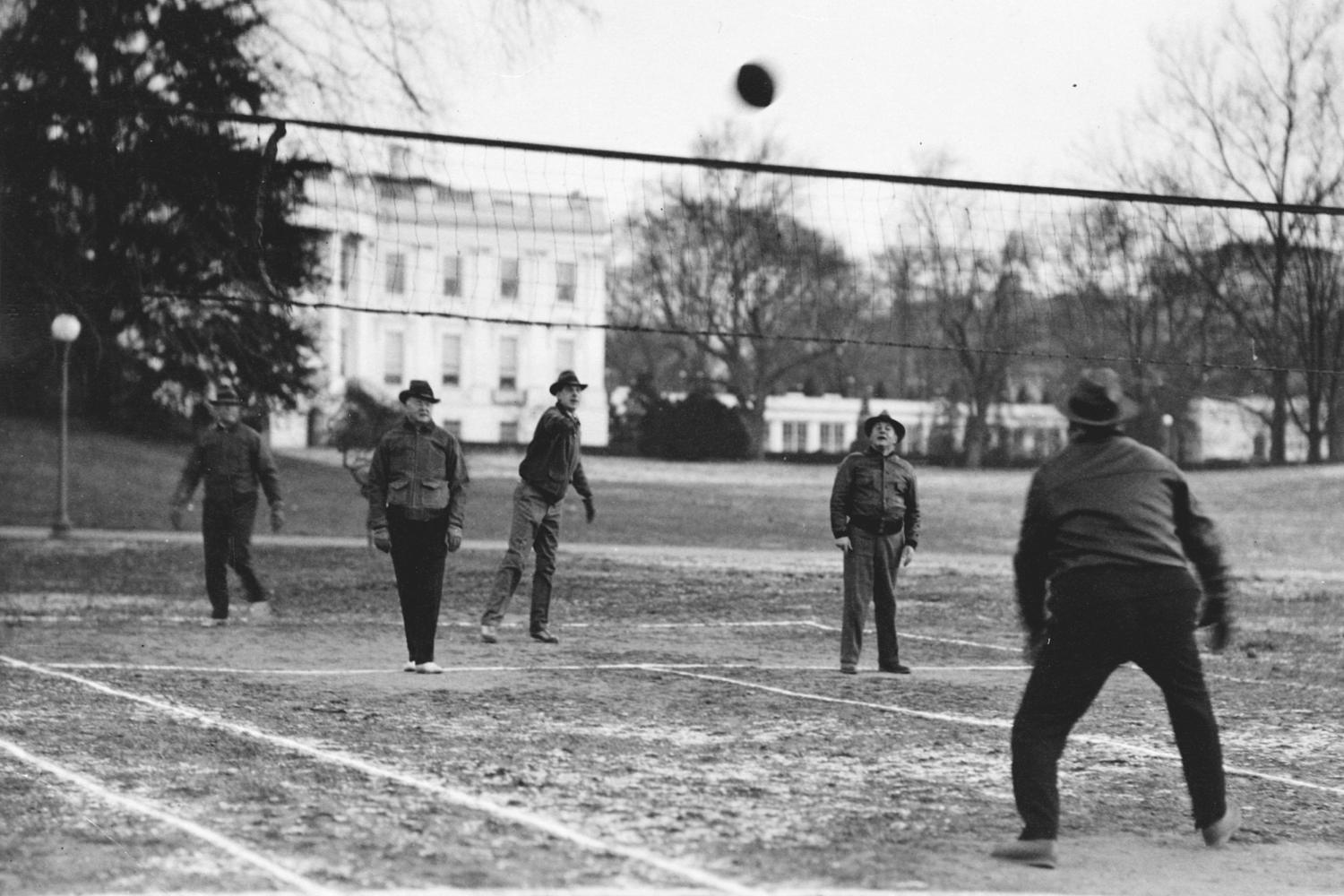
Eisenhower installed a putting green on the South Lawn of the White House, just steps from the Oval Office. To his detractors, it looked like a dereliction of duty. They painted him as an aloof, lazy grandfather who preferred the fairways of Augusta to the hard work of governance.
But look closer at the human element of that choice. Golf is a game of meticulous control, quiet contemplation, and emotional suppression. A bad temper ruins a golf swing. By spending his days chasing a little white ball, Eisenhower was projecting an invaluable psychological message to both the American public and the Soviet Union: I am not panicked. The situation is entirely under control. Look how smoothly I swing this iron.
The putting green was not an escape from the presidency; it was an extension of it. It was theater disguised as leisure.
The Sound of the Leather Jacket
Every president since has had to choose their stadium.
Richard Nixon was so obsessed with football that he famously called plays for the Washington Redskins. Jimmy Carter tried to project a humble, accessible image by jogging through the streets, though the imagery backfired terribly when he collapsed from exhaustion during a cross-country race in 1979—an unintended metaphor for his struggling presidency.
Then came Ronald Reagan, a man who understood the mechanics of a crowd better than anyone who had ever held the office.
Reagan did not just invite champions to the White House; he wore their skin. When the 1983 Washington Redskins won the Super Bowl, Reagan did not just shake hands in a suit. He put on a team jacket. He joked with the players. He transformed the Rose Garden into a locker room. By wrapping himself in the colors of the local champions, he absorbed their victory, turning their athletic triumph into a validation of his political philosophy.
We see this same instinct play out in one of the most emotionally charged moments in modern American history: October 30, 2001.
The smoke was still rising from the ruins of the World Trade Center. The nation was paralyzed by fear, grief, and uncertainty. George W. Bush walked out to the pitcher's mound at Yankee Stadium to throw the ceremonial first pitch of Game 3 of the World Series.
The air was freezing. The crowd was a raw nerve. Bush wore a heavy black jacket over a bulletproof vest. He walked to the rubber, not the front of the mound. He looked up at the towering stands, gave a simple thumbs-up, and delivered a strike right down the middle of the plate.
The stadium erupted.
In that single, fleeting moment, the ball flying from his hand was not about baseball. It was an act of defiance. It was a demonstration of physical competence and unshakeable resolve. It told a wounded country that the center would hold.
The Shift to the Octagon
This brings us back to the deafening confines of Madison Square Garden, and the heavy thud of human bodies hitting the canvas.
If Roosevelt had football, Eisenhower had golf, and Bush had baseball, Donald Trump has the UFC. The venue has changed because the culture has shifted, but the underlying political calculus remains identical.
Golf represents an elite, country-club establishment. Baseball, for all its history, carries a nostalgic, bygone innocence. But the UFC? The UFC is raw, hyper-individualistic, unapologetic, and intensely meritocratic. In the Octagon, there are no teams to hide behind, no complex bureaucratic rules to exploit. You win, or you get knocked out. It is a world divided entirely into winners and losers.
For a politician whose entire brand is built on the concept of relentless winning and fighting against an entrenched establishment, the UFC cage is the perfect symbolic home.
When Trump sits cageside next to Dana White, surrounded by cheering fans who skew heavily young and male, he is not just enjoying a night out. He is engaging in a highly sophisticated piece of cultural alignment. He is telling his base: These are my people. This is the world as it really is—a brutal, competitive arena where only the strongest survive.
The critics who view this as a shocking break from presidential tradition are misreading history. They are mourning a pristine, idealized past that never actually existed. The White House has never been a monastery detached from the vulgarities of popular culture. It has always been a mirror of the nation’s dominant energy.
The Arena Never Closes
Sitting in those arena seats, watching the strobe lights catch the mist of sweat sprayed from a fighter's face after a heavy left hook, the connection becomes undeniable.
Politicians will always seek the validation of the arena. They will always try to borrow the sweat-earned credibility of athletes to bolster their own fragile, poll-tested authority. We look at the past and see the dignity of Roosevelt’s forward pass or Bush’s perfect strike, but in those moments, contemporaries saw raw, calculated politics.
The cage at Madison Square Garden is simply the newest stage for a very old play.
As the final bell rings and the crowd filters out into the cold New York night, the stadium lights slowly dim, leaving the empty canvas stained with sweat and small drops of blood. The fighters will heal, the fans will go home, and the arena will go dark. But the scramble for the spotlight inside that fence never truly ends. The venue will inevitably evolve again, but whoever holds the highest office in the land will always be looking for a way to step into the ring, lock eyes with the crowd, and convince the world that they are the ones holding the championship belt.